Glass Skin Is Not a Product. It's a Biological Outcome.
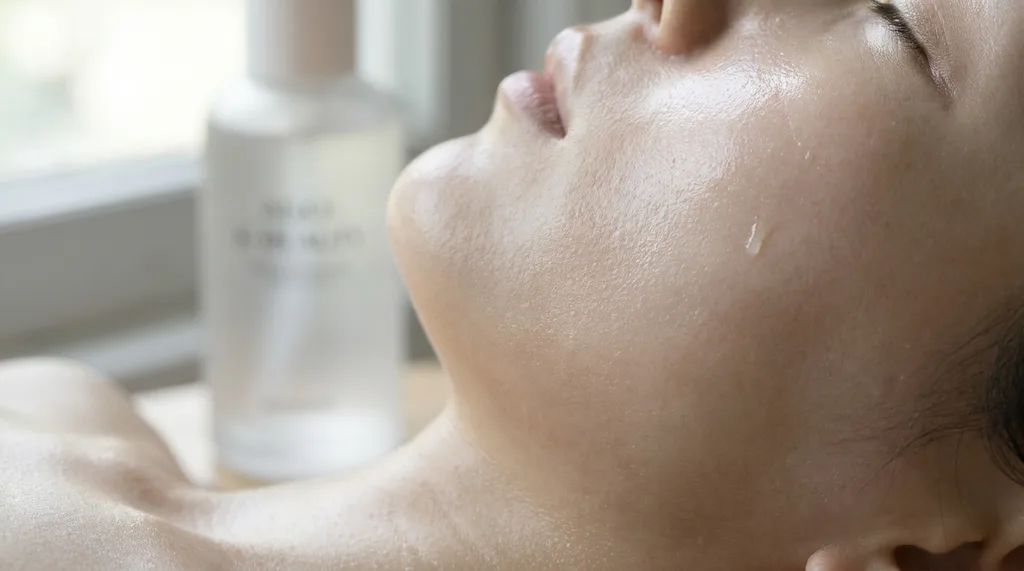
Here's a question worth sitting with before you touch your skincare shelf: Why do Korean women in their 40s often have skin that looks younger than their Western counterparts in their 30s — and why does the secret, when Korean dermatologists finally talk openly about it, have almost nothing to do with the products they're selling you?
That question has a real answer. But it takes a little demolition work to get there.
The 10,000 Products That Won't Get You There
Walk through the aisles of any Olive Young on a Friday night and you'll see something mesmerizing: shelves of toners stacked floor-to-ceiling, essences that cost as much as a restaurant meal, ampoules in dropper bottles that look like they were designed in a lab — because they were. It's intoxicating. The global K-Beauty market has crossed $11 billion and is projected to nearly triple by the time the decade closes. The "glass skin" segment alone sits at $2.5 billion and is climbing toward $6 billion by 2035.
All of that money, and yet K-Beauty insiders — the ko-deok (the true obsessives, the ones who memorize ingredient lists the way others memorize sports statistics) — will tell you something quietly unsettling: most people chasing glass skin are solving the wrong problem.
The standard international interpretation of glass skin goes something like this: find the right 10-step routine, layer Korean products in the correct sequence, add an essence, double-cleanse, apply a sheet mask twice a week, and the luminous result will follow. It's an appealing formula. It's also, according to dermatologists and formulation specialists, largely a marketing construct.
The actual mechanism of glass skin has nothing to do with how many products you use. It has everything to do with what your skin can do by itself — once you stop getting in the way.
What the Skin Is Actually Building (When You Let It)
Korean dermatological thinking frames glass skin not as an aesthetic you apply, but as a biological outcome you cultivate. The distinction sounds academic until you understand the mechanism, at which point it becomes genuinely hard to look at your skincare shelf the same way.
At the cellular level, the "glass skin" appearance — that translucent, lit-from-within luminosity — is the visual signature of a healthy, intact skin barrier. Specifically, it's what happens when the epidermis has high levels of filaggrin, a protein that acts as the precursor to natural moisturizing factors, and when tight junction proteins like claudin-1 and claudin-4 are maintaining the structural integrity of the barrier.
Certain ingredients actively support this process. Galactomyces Ferment Filtrate, the fermented yeast byproduct found in a number of well-regarded K-Beauty essences, works by activating the aryl hydrocarbon receptor (AHR), which in turn upregulates filaggrin production. This is not surface hydration. This is the skin being prompted to rebuild its own architecture. Research published in peer-reviewed dermatology literature supports the role of fermented filtrates in epidermal barrier marker expression — a distinction that separates them from ordinary moisturizers.
The other foundational pillar is pH. The skin's acid mantle sits naturally between pH 4.5 and 5.5. Alkaline cleansers — which includes a startling number of globally beloved Western face washes — disrupt this balance, weakening the barrier and leaving skin vulnerable to transepidermal water loss (TEWL).
[K-Beauty 101] Yak-san-seong (약산성) — slightly acidic, pH-balanced. In Korean skincare culture, this is considered the gold standard for any cleanser or toner. Products formulated to match the skin's natural pH preserve the acid mantle, the invisible protective film that's essentially the first line of defense for your barrier. When it's disrupted, nothing else in your routine works as well.
Korean formulators understood this decades before the global market caught up. And it explains something that often puzzles international K-Beauty converts: why a simple pH-balanced toner — boring by Instagram standards — sits at the foundation of every serious Korean skincare routine.
The Invisible Crisis That's Sabotaging Your Skin
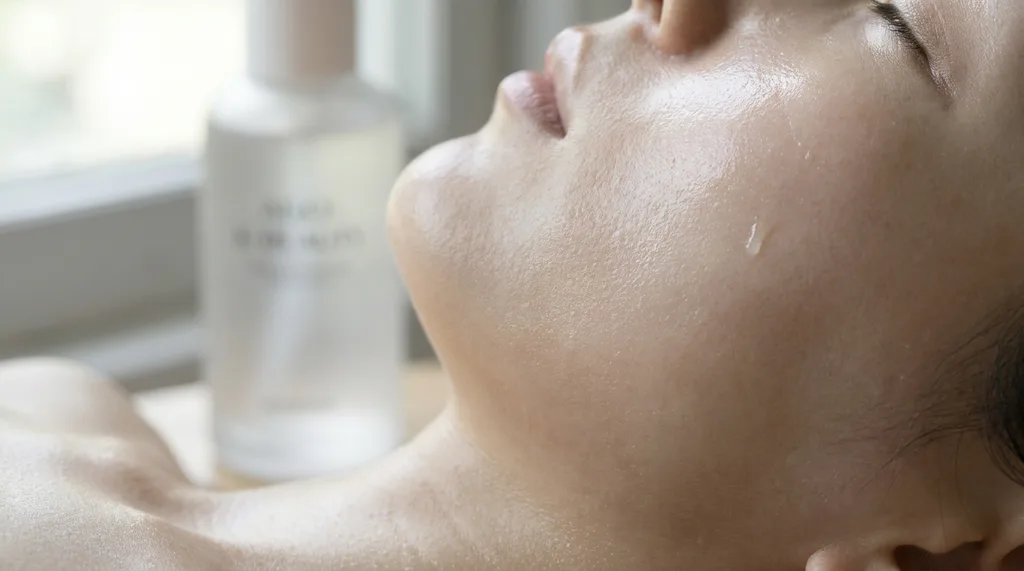
There's a condition that Korean skincare professionals talk about constantly, that rarely gets translated into Western beauty media, and that — once named — many international K-Beauty enthusiasts immediately recognize in themselves.
[K-Beauty 101] Sok-geon-seong (속건성) — inner dryness. The condition where the skin feels tight, parched, or uncomfortable from within, even when the surface appears oily, normal, or adequately moisturized. It signals a compromised barrier that is losing water faster than topical products can replace it.
Sok-geon-seong is the silent reason that layer after layer of product sometimes makes no difference. Korean skin experts describe it as trying to fill a bucket with a hole in the bottom. The issue is structural, not cosmetic. And the instinctive response — adding more products, more layers, more moisture — often compounds the problem by over-processing a barrier that simply needs to be repaired.
The ingredients that address this at a foundational level aren't the glamorous ones. They're ceramides, which mimic the lipid structure the barrier is made of. Panthenol (Vitamin B5), which accelerates barrier recovery. Madecassoside, the purified active from Centella Asiatica, which reduces the inflammation that silently degrades barrier integrity over time.
What they share is not a marketing story. They're barrier mimetics — materials that resemble what the skin already uses to build and repair itself. Korean dermatologists call this approach "skin-identical" formulation, and it increasingly underpins what forward-thinking K-Beauty brands prioritize in their formulas.
This is also where the honest conversation about risk belongs. Overcare — the K-Beauty community has its own word for it: over-care — is one of the most common self-inflicted skin problems seen in Korean dermatology clinics. Enthusiasts who follow the logic of "more steps = better results" can actually weaken the very barrier they're trying to protect. Exfoliating acids layered incorrectly, retinoids introduced too aggressively, vitamin C serums with incompatible pH ranges — each of these, used without the diagnostic thinking that Korean skincare was built on, can accelerate the sok-geon-seong cycle rather than resolve it.
If your skin stings when you apply toner, burns with serums, or still looks dull despite an elaborate routine, the barrier is likely compromised. The solution, according to clinical consensus in Seoul, is to strip the routine back to barrier-repair basics — not to add the next serum your algorithm recommended.
The Numbers That Actually Matter (And the Ones That Are Working Against You)
Once the barrier is in reasonable health, the active ingredient layer starts to matter. And this is where a second major misconception lives — one that costs real money and, in some cases, real skin damage.
Niacinamide has become the flagship ingredient of the glass skin aesthetic, plastered across serums, toners, and ampoules across every price point. What the marketing rarely tells you is that the clinical research has a very specific concentration window.
At 2–5%, niacinamide delivers measurable barrier support, meaningful anti-inflammatory action, and documented reduction in the inflammatory molecules associated with skin aging. The evidence base at this range is solid. But above 10% — where many premium products now play, because higher numbers feel more impressive — something shifts. Research shows that over-concentrated niacinamide frequently causes irritation, flushing, and sensitivity without a proportional clinical return. More is not more. It's just more.
The hyaluronic acid picture is similarly nuanced. High-molecular-weight HA (above 1 MDa) sits on the skin's surface, forming a film that reduces moisture evaporation and improves the appearance of plumpness and elasticity. It's visible, it's satisfying, and it photographs beautifully. But it doesn't reach the dermis. Low-molecular-weight HA — around 120 kDa — penetrates deeper, where research suggests it supports cell proliferation and may influence dermal thickness over time. The best-formulated K-Beauty essences use both, targeting different depths simultaneously. When you're reading an ingredient label and see only one form listed, you're getting half the story.
The clinical pairing that Seoul-based dermatologists increasingly recommend is niacinamide (at 2–5%) combined with low-molecular HA. Research published in peer-reviewed dermatology literature suggests this combination demonstrates what scientists call senomorphic activity — meaning it reduces the inflammatory secretions from aging cells (the senescence-associated secretory phenotype, or SASP) that quietly degrade skin structure over years. Put simply: the right concentration of these two ingredients, working together, targets the molecular-level inflammation that makes skin look older before it should.
The Philosophy Korean Dermatologists Never Exported
Here's where the open loop from the beginning closes, and it turns out the answer is quieter than expected.
Korean dermatologists, interviewed repeatedly in Korean medical and beauty publications, consistently emphasize something that gets lost in translation when K-Beauty travels internationally: the 10-step routine was never the point. It was a format that emerged from the industry, from Olive Young-era marketing, from the cultural enthusiasm for trying everything. But the underlying philosophy — the one that produces the 40-year-old with luminous, refined pibu-gyeol (skin texture, the grain and fineness of the surface) — is diagnostic-first.
What this means in practice: before any product is applied, the skin's current condition is assessed. Is the barrier intact? Is there sok-geon-seong? Is the skin currently inflamed, sensitized, over-exfoliated? The answer to those questions determines the entire routine — not a standardized template, but a responsive protocol.
Korean beauty consumers with genuinely remarkable skin tend to use fewer products than outsiders assume. Their routines are shorter than the 10-step template that went viral. What makes them effective is selectivity: every product in the lineup has a specific, understood purpose, and nothing is added that the skin doesn't currently need.
This is the information that no brand has an incentive to market to you. It may mean buying fewer products, not more. It means starting with a pH-balanced cleanser and a ceramide-based moisturizer and staying there until the barrier has recovered — weeks, sometimes months — before introducing anything active.
The ko-deok community on Korean platforms like Hwahae knows this. Their review culture — the sol-jeok hu-gi, the unsponsored honest feedback that Korean beauty forums are known for — is relentlessly critical of products that perform in the short term but compromise barrier health over time. The global market, still in love with the mythology of the 10-step, has largely missed this conversation.
Glass skin, in the end, isn't a look you achieve with the right serum. It's what the skin looks like when the barrier is healthy, pH-balanced, and no longer losing water it can't afford to lose. The translucency isn't applied — it's revealed. The glow isn't a product doing something extraordinary to your face; it's your face doing what it was always capable of, once you stopped fighting its biology.
The best K-Beauty practitioners aren't the ones with the most products. They're the ones who learned, sooner than most, when to put them down.
⚠️ Medical & Skincare Disclaimer: The ingredient science and routine guidance in this article is intended for general educational purposes only and does not constitute medical or dermatological advice. Skin conditions vary significantly between individuals. Before introducing active ingredients — including niacinamide, retinoids, or chemical exfoliants — into your routine, conduct a patch test for a minimum of 24–48 hours. If you experience persistent irritation, contact dermatitis, or worsening skin sensitivity, discontinue use and consult a board-certified dermatologist. Individuals with diagnosed skin conditions such as rosacea, eczema, or psoriasis should seek professional guidance before altering their skincare protocol.
Comments
Post a Comment