K-Beauty and Darker Skin: Where the Science Succeeds and Where the Industry Failed
Walk into a Korean dermatologist's office and describe your skin as "oily." Before any instrument touches your face, before any prescription is written, the follow-up question will almost certainly be: "But are you tight underneath?" That question doesn't have an equivalent in most Western dermatological intake forms. It assumes a kind of skin complexity — surface oil coexisting with deep dehydration — that Western skincare categories weren't built to capture. And that assumption, baked into the foundations of Korean skin diagnosis, turns out to be quietly revolutionary for anyone whose skin has spent years being misread.
Here's the tension that will hum under everything you read next: Korean skincare was never explicitly designed for darker skin tones. And yet, for some of the most persistent concerns melanin-rich skin faces — post-inflammatory hyperpigmentation, barrier disruption, chronic inner dryness misdiagnosed as simply "oily" — the Korean approach outperforms Western alternatives with surprising consistency. The reason isn't cultural alignment. It's structural.
But this article isn't a love letter. K-Beauty is two industries wearing the same name. The skincare science and the color cosmetics industry operate under completely different rules, produce completely different results for deeper skin tones, and deserve to be evaluated separately. Almost no one does that. Here's the map.
The Barrier Was Always the Point
The concept at the center of Korean dermatological philosophy is pibu jangbyeok — the skin barrier. Not just as a metaphor for "sensitive skin," but as a literal, measurable, repairable structure: the lipid matrix of ceramides, cholesterol, and fatty acids that sits between your skin and everything trying to harm it.
[K-Beauty 101] Pibu jangbyeok (skin barrier) — The lipid matrix protecting the skin's surface. In Korean dermatology, compromised barrier function is treated as the root cause of most skin problems — not a side effect of them. This distinction changes what you reach for first.
Western skincare has historically approached skin concerns aggressively: exfoliate faster, turn over cells quicker, force the skin to change. The Korean approach starts with the opposite premise — that a disrupted barrier is the source of most visible problems, and that restoration comes before any active intervention. Strengthen the barrier first. Then ask what else needs to happen.
For melanin-rich skin, this isn't just a philosophical preference. It's a clinical imperative.
Skin with higher melanin content produces post-inflammatory hyperpigmentation (PIH) more readily than lighter skin tones. Any assault on the barrier — over-exfoliation, high-pH cleansers stripping the acid mantle, retinoids at concentrations the skin isn't ready for — triggers an inflammatory response. That response, in darker skin, leaves a mark. A hyperpigmented mark that can take months to fade.
Korean skincare's core toolkit — Centella asiatica (cica) for barrier soothing, low-pH gel cleansers preserving the acid mantle at its natural 4.5–5.5 range, layered hydration building moisture from the inside out — was developed to prevent exactly this kind of inflammatory cascade. It just wasn't marketed that way to darker-skinned consumers, because those consumers weren't in the room where the marketing was made.
🎵 K-Mono Lofi — Seoul Study Beats
Read deeper with Seoul lo-fi in the background — curated by K-Mono Lofi
The other concept that makes Korean skincare diagnostically sharper for darker skin is suboji.
[K-Beauty 101] Suboji (combination-dehydrated skin) — An abbreviation for skin that is oily on the surface but deeply dehydrated underneath. Western dermatology typically categorizes this as "oily" and recommends stripping routines. Korean skincare recognizes that the oil is often the skin's emergency response to dehydration — and treats the dehydration instead.
Darker skin tones are statistically more likely to be misdiagnosed as simply "oily" in Western clinical settings, leading to prescriptions for drying acids and oil-free formulas that worsen the underlying dehydration — and, by extension, the PIH cycle. The suboji framework, by contrast, sends the formulator in exactly the right direction: layer in water-binding humectants, protect the barrier, and the surface oil self-regulates.
Two Industries, One Label
Now for the honest half of this conversation. Because calling K-Beauty "inclusive" without qualification is either naïve or a marketing move. And you deserve neither.
The skincare science is largely skin-tone agnostic. The color cosmetics industry — foundations, BB creams, cushion compacts, the category that made K-Beauty globally famous — has been systematically built around East Asian skin tones, photographically tested on lighter complexions, and released into global markets with shade ranges that effectively said: this is for some people, not all people.
✅ Where the Science Works — Largely Skin-Tone Agnostic
- Barrier repair via ceramides and Centella asiatica
- Low-pH cleansing (preserves acid mantle for all skin tones)
- MFDS-regulated niacinamide at 2–5% — verified for PIH reduction
- Layered hydration treating inner dryness, not surface symptoms
- Anti-inflammatory first, active second — prevents PIH cascade
- Adenosine and arbutin at regulated concentrations for brightening
⚠️ Where the Industry Failed — Cosmetics Bias Is Structural
- Foundation and cushion compact shade ranges built for light/medium tones
- Photographic testing conducted on East Asian complexions
- Pink-neutral undertone assumptions baked into formulas
- "Brightening" marketed as universal when it targets yellow dullness specifically
- Tutorial lighting calibrated for lighter skin — makes guidance irrelevant
- BB creams historically cover 3–4 shades in markets that need 20+
This division matters because the failure of K-Beauty cushion compacts to match deeper skin tones is real and documented — and it has caused legitimate frustration, even harm (ashy undertones from mismatched bases can look worse on deeply melanated skin than wearing nothing at all). But that failure belongs to the color cosmetics category. It does not touch the niacinamide serum. It does not invalidate the low-pH cleanser. Conflating them punishes the science for the industry's commercial choices.
There's also a more insidious problem. Some K-Beauty "brightening" products — particularly those marketed heavily in East Asian markets — contain ingredients calibrated to address the specific yellowish dullness associated with excess melanin production in lighter Asian skin. When applied to deeper skin tones, the mechanism is different, and some older formulations used ingredients like kojic acid at concentrations that caused paradoxical hyperpigmentation in users with higher baseline melanin. This isn't universal to K-Beauty, and modern Korean formulations have largely shifted toward niacinamide and arbutin as the preferred brightening agents. But it's a history worth knowing.
The Ingredient That Bridges Every Skin Tone
Niacinamide — vitamin B3, called niacinamide (나이아신아마이드 in Korean, simply romanized from the INCI name) in Korean formulations — is the clearest intersection between K-Beauty priorities and the specific needs of melanin-rich skin.
The MFDS lists niacinamide as a pre-approved active ingredient for "whitening" (skin-tone evening) functional cosmetics at concentrations between 2% and 5%. That regulatory floor matters enormously. When a Korean product carries the Gineungseong Hwajangpum designation for brightening with niacinamide, you know the concentration is verified to be within the clinically active range. No guesswork. No marketing opacity.
Niacinamide works by interrupting the transfer of melanin to the skin's surface — not by bleaching, but by blocking the cellular handoff. The mechanism is well-studied and it functions regardless of the user's baseline melanin level. It also provides barrier support and sebum regulation. For suboji skin — oily on top, dehydrated underneath — the same ingredient addresses two concerns simultaneously.
The deeper point: the Korean regulatory system creates a class of products where efficacy is structurally guaranteed within verified parameters. In a market flooded with $80 serums containing niacinamide at trace concentrations too low to do anything, the transparent regulatory framework of the MFDS is arguably the most underrated tool in your skincare education.
Know enough now to want to go deeper? The OMNIARK K-Beauty Black Book maps the exact ingredient thresholds, functional cosmetic certification markers, and product categories worth your money — organized by skin concern, not by trend.
How to Navigate This as a Smarter Consumer
The framework isn't complicated once you've separated the two industries. The skincare stack is yours to take. The color cosmetics shelf requires patience and specificity.
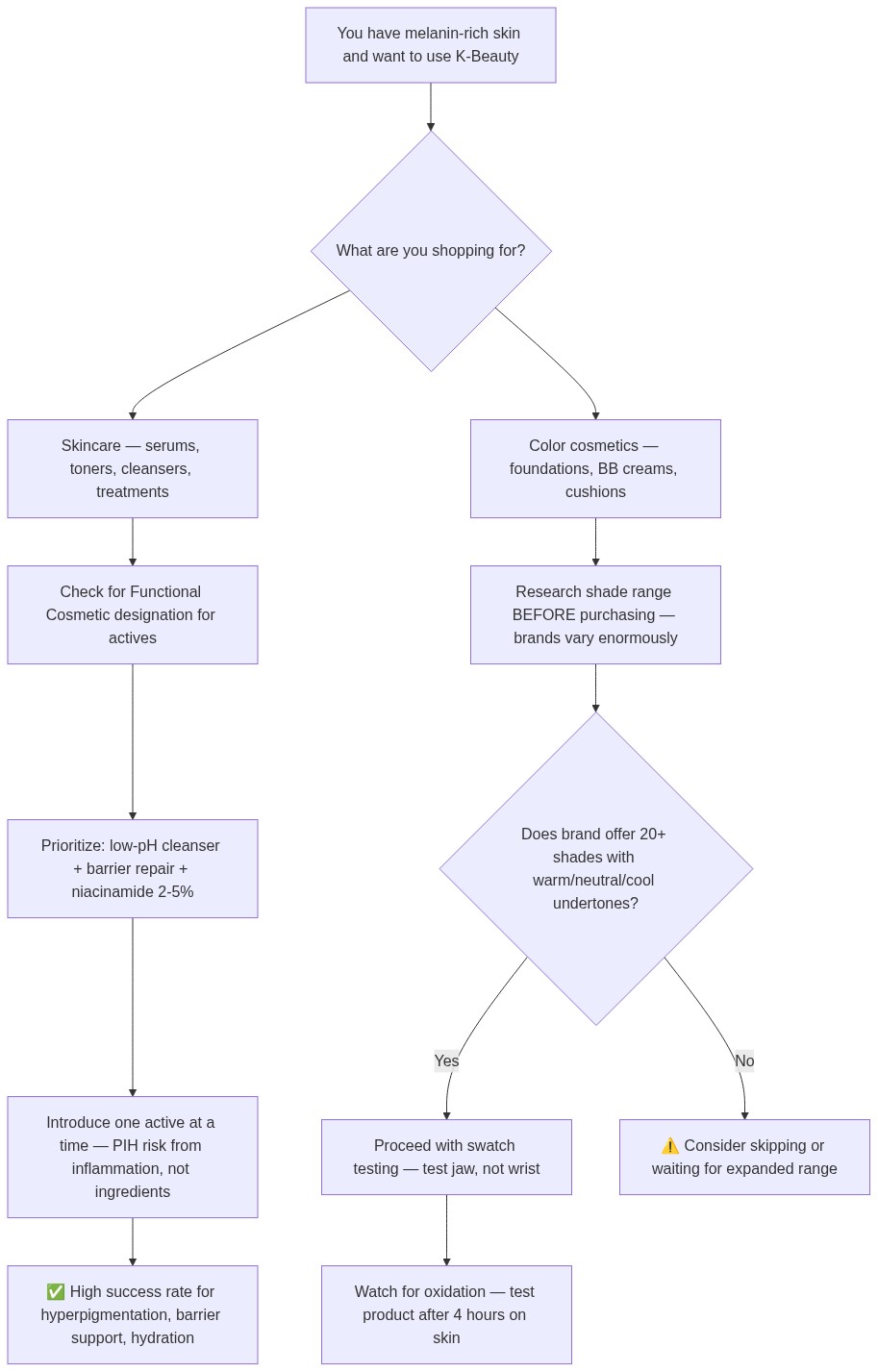
The actionable steps, kept specific:
1. Lead with the cleanser, not the serum. A low-pH gel cleanser (look for pH 4.5–5.5, confirmed by the brand or independent testing) is the single highest-leverage change in Korean skincare. It protects the acid mantle that acts as the first line of inflammatory defense. Disrupted acid mantle → inflammation → PIH. Fix the foundation.
2. Read the Functional Cosmetic declaration. Korean products targeting brightening, wrinkle improvement, or UV protection that carry the Gineungseong Hwajangpum designation have passed government efficacy review. Look for this on the product page or the Korean product label. Third-party sellers often list it in the product description.
3. Add niacinamide at a verified 2–5% concentration before any harsher active. Retinol, AHAs, and exfoliating acids all carry PIH risk for melanin-rich skin if introduced on a compromised barrier. Niacinamide first, for four to six weeks. Then introduce actives slowly, one at a time.
4. For color cosmetics, be a discriminating buyer. The shade gap is real. Brands are closing it at different speeds. Do not accept a mismatched formula because "it's K-Beauty and it looked good on the tutorial." The tutorial was not lit for your skin.
5. Patch test every barrier-active product on your inner arm for 48 hours before applying to your face. This is not optional for melanin-rich skin, where a reaction leaves a lasting mark rather than a temporary flush.
The science was never the obstacle. The industry built walls the science itself never needed. The difference between those two things is the entire map.
Sok-geonjo — that Korean word for deep inner dryness, the tightness your skin feels below the surface — has no direct English translation because Western skincare never built a framework to notice it. For deeper skin tones, the consequence of that missing framework wasn't just a vocabulary gap. It was years of stripping routines, mismatched foundations, and the specific loneliness of buying products designed for someone else. K-Beauty's skincare science, with its barrier-first philosophy and government-regulated actives, offers a better framework. That's worth claiming. Just know exactly what you're claiming — and what to leave on the shelf.
⚠️ Medical & Skincare Disclaimer: The information in this article is educational and does not constitute dermatological or medical advice. Ingredients discussed — including niacinamide, retinol, AHAs, and kojic acid — can cause adverse reactions in certain individuals, particularly on melanin-rich skin prone to post-inflammatory hyperpigmentation. Always perform a 48-hour patch test before introducing any new active to your routine. If you experience persistent irritation, hyperpigmentation worsening, or an allergic reaction, discontinue use and consult a board-certified dermatologist experienced with your skin tone. Regulatory standards described (MFDS, Functional Cosmetic designation) apply to products sold in South Korea; import versions may differ. Concentration claims are specific to the MFDS pre-approved list and should be verified on individual product labels.
✓ Researched and compiled using verified data as of the publication date.
 Operated by: Quiet Korea | Contact: rsl.2001.1975@gmail.com
Comments
Post a Comment