The 500 Dalton Secret: What Korean Dermatologists Know That Most Skincare Routines Ignore
There is a number Korean dermatologists know by heart that rarely appears on any serum label, skincare blog, or ten-step routine tutorial. It is 500. Specifically, 500 Daltons — the molecular weight threshold above which almost nothing crosses living human skin. And once that number lodges in your brain, you will look at your entire skincare shelf differently. Possibly with some grief. Definitely with clarity.
The question worth sitting with — before getting to the science — is this: if most expensive topical actives are physically too large to penetrate the skin, why does Korean skincare actually work? The answer isn't just in the products. It's in the architecture behind them. And part of that architecture happens on the inside, not the outside.
That's where this gets interesting.
The Wall Your Serum Has Never Told You About
The outermost layer of human skin — the stratum corneum — is not passive. It is an active, highly selective barrier that has been refined over millions of years to keep things out. Most things. Nearly all things, actually, that are larger than 500 Daltons in molecular weight. This is not a marketing claim or a theory. It is one of the most consistent findings in transdermal penetration research, replicated across decades of dermatological science.
Now consider hyaluronic acid — perhaps the most marketed hydration ingredient in modern skincare. Standard high-molecular-weight hyaluronic acid sits somewhere between 1,000 and 1,800 kilodaltons. That is not 1,800 Daltons. That is 1,800,000 Daltons. The molecule is so large relative to the skin's barrier that it cannot even theoretically cross into the dermis. It sits on the surface, forming a film, drawing moisture toward the skin's outer layers. That is not nothing — it is actually valuable. But it is not what the label implies when it says "deep hydration."
This is where Korean dermatology's understanding quietly diverges from global skincare marketing. Korean skin science has long operated with an awareness that the skin's barrier is the first conversation, not an obstacle to be overcome. The goal is not always penetration. Sometimes the goal is surface moisture retention. Sometimes it is creating the right conditions for smaller, more targeted molecules to do the actual work underneath.
The architecture of an effective K-Beauty routine is built entirely around this distinction.
[K-Beauty 101] Pibu-jangbyeok (Skin Barrier) — The structural integrity of the skin's protective layers. In Korean dermatology, a strong pibu-jangbyeok is not a given — it is the prerequisite for every active treatment. A compromised barrier renders even the most sophisticated serum routine ineffective, because the skin is simultaneously losing moisture and absorbing irritants.
What this means practically: the order in which products are applied is not cultural habit. It is molecular physics. Lighter, water-based products with smaller molecular weights — your toners, your essences — go first, not because tradition dictates it, but because they carry the molecules small enough to actually travel. Thicker products go last, because their job is to seal the environment created by everything beneath them. The ritual and the science have always been the same thing.
Why the 7-Skin Method Is Smarter Than It Looks
Walk into any Korean beauty community and ask about the 7-skin method — the practice of pressing multiple layers of a single lightweight toner into the skin in succession — and you will get passionate testimonials. What you rarely get is the scientific explanation for why it works, which is arguably more compelling than any before-and-after photo.
Skin has an absorption saturation point. Apply one heavy layer of hydration and the surface becomes occluded before the moisture has actually traveled anywhere useful. Apply seven thin, lightweight layers and something different happens: each layer has the opportunity to partially absorb before the next arrives, creating a cumulative reservoir of hydration without overwhelming the barrier. Korean skincare enthusiasts who practice this method report something specific — not just surface dewiness, but a resolution of what is called sok-geon-seong.
[K-Beauty 101] Sok-geon-seong (Inner-Skin Dryness) — The condition where skin appears normal or oily on the surface while feeling tight and parched underneath. It is the Korean skincare industry's diagnosis for a phenomenon Western beauty culture often attributes to the wrong cause, chasing oil-control when the real deficit is deep hydration.
Sok-geon-seong is the reason that someone with combination skin can have a shiny T-zone and still be fundamentally dehydrated. The solution is not to strip the skin of surface oil. It is to restore hydration deep enough that the skin stops overproducing oil in compensation. The 7-skin method is one of the most elegant tools for this — and it works precisely because it respects the physics of the barrier rather than fighting it.
Korean dermatologists approach post-procedure care through the same lens. After laser treatments, chemical peels, or microneedling — all of which deliberately disrupt the barrier to stimulate collagen remodeling — the recommended protocol is not aggressive actives. It is barrier restoration first. Lightweight hydration, ceramide support, nothing inflammatory. The skin's capacity to heal depends entirely on the integrity of the pibu-jangbyeok being re-established before anything else is asked of it.
The Ingredient Stack: What Evidence Actually Supports
This is where the honest accounting matters. The skincare industry is extraordinarily good at generating marketing claims that run several years ahead of clinical evidence. The Korean beauty community — the ko-deok (the devoted ingredient-readers and community gatekeepers who have effectively become the industry's quality control) — is unusually rigorous about calling this out. Understanding what the evidence actually shows is the difference between a routine that works and an expensive shelf decoration.
Here is what the current evidence landscape looks like for key layering ingredients:
| Ingredient | What It Actually Does at the Skin | Layering Position | Evidence Grade |
|---|---|---|---|
| Low-MW Hyaluronic Acid (20–300 kDa) |
Small enough to travel below the surface; genuine dermal hydration | Essence / early serum | Strong |
| High-MW Hyaluronic Acid (1,000+ kDa) |
Surface film; occlusive moisture retention — not penetration | Moisturizer / last step | Surface Only |
| Niacinamide | Pore appearance, sebum regulation, barrier reinforcement — synergizes with glycolic acid for tone evening | Mid-routine serum | Strong |
| Glycolic Acid | Exfoliation + documented synergy with niacinamide and azelaic acid for tone correction | Treatment step, PM only | Strong (PM) |
| Peptides | Signal proteins for collagen stimulation — promising but market claims run ahead of evidence | Serum, separate from acids | Promising |
| Standard Collagen (Topical) | Too large to penetrate; functions as humectant only. Claims of "rebuilding collagen" are purely marketing. | Surface moisturizer | Surface Only |
That last row is the uncomfortable one. Topical collagen — found in dozens of premium creams — cannot cross the 500 Dalton barrier. The collagen molecule is enormous. It does nothing structurally different from a basic humectant. Korean dermatologists know this, which is why the more sophisticated recommendation coming from Korean clinics isn't another collagen cream.
It's a supplement.
What Topical Products Can't Do — And What Korean Clinics Recommend Instead
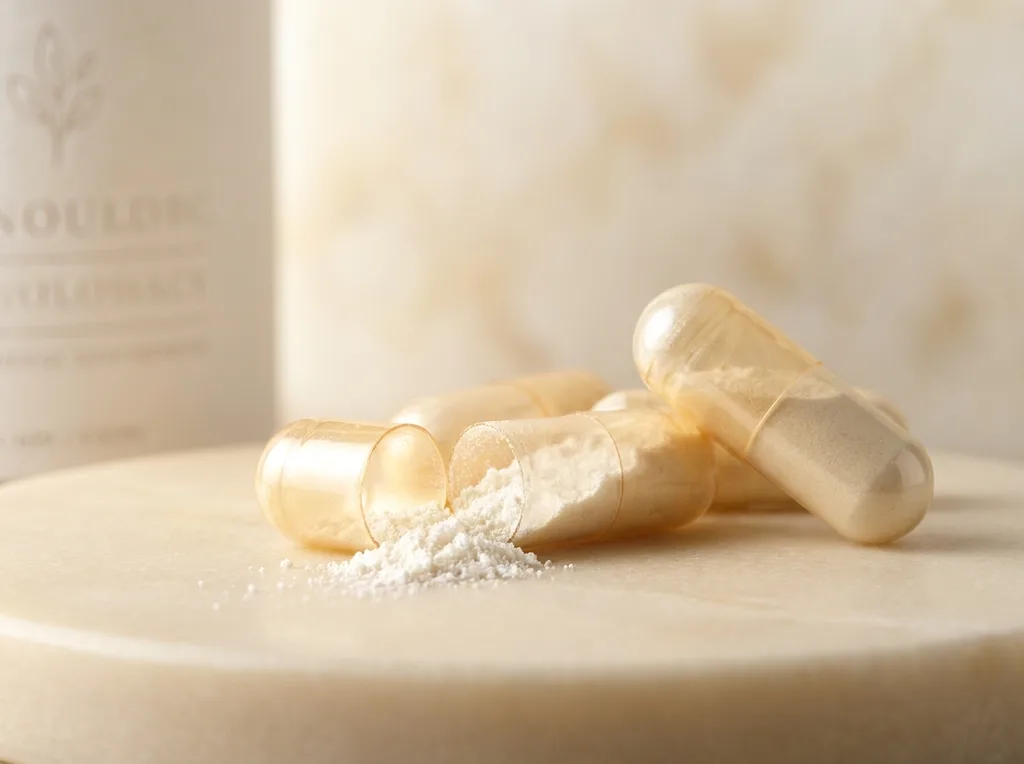
Here is the answer to the question planted at the beginning of this article. If the 500 Dalton barrier is real — and it is — then how does Korean skincare actually produce the results it's famous for? Part of the answer is the layering architecture described above. But the other part is something Korean clinics have recommended for years that Western skincare culture is only beginning to take seriously.
You feed the skin from the inside.
Oral collagen peptides work through a fundamentally different mechanism than topical collagen. When collagen is hydrolyzed into small peptides (typically under 5,000 Daltons for digestion, then broken further into dipeptides and tripeptides by the gut), those fragments enter the bloodstream and travel to the dermis, where they signal fibroblast cells to produce new collagen. This is not surface-level moisturizing. This is structural.
The peptide market is one of the fastest-growing segments in beauty science — a compound annual growth rate exceeding 8% through 2031 — precisely because clinical evidence for oral peptide supplementation is accumulating in a way that topical evidence for large-molecule ingredients never could. Korean post-procedure protocols at major dermatology clinics frequently include oral supplementation guidance alongside topical recovery care. The two are not competing strategies. They are designed to work at different depths.
The same logic applies to oral hyaluronic acid. What cannot penetrate the skin's barrier from outside can be delivered to the dermis from the bloodstream. The global skincare market is valued at roughly $190.8 billion in 2025, forecast to reach $366.7 billion by 2035 — and a meaningful portion of that growth is driven by inner beauty supplementation, not more serums.
This is the pivot that changes everything: understanding that your skincare routine has two arms. The topical arm — layered correctly, respecting molecular weight and barrier integrity. And the ingestible arm — delivering what the skin actually needs to build its own structural proteins, from the inside out.
The most honest approach to inner beauty is also the Korean approach: choose ingredients with actual clinical backing, understand the mechanism, and be skeptical of anything that promises structural results from a molecule too large to travel anywhere.
That's the ko-deok mindset. It's worth adopting.
The Part Nobody Puts in the Headline
Every honest guide about skincare science has to include a section on what goes wrong. Not hypothetically — actually, in practice, in real Korean beauty communities where the data from real users eventually surfaces.
The most common failure mode is called over-care in Korean skincare circles — and it is K-Beauty's most ironic trap. A reader absorbs enough science to understand layering, purchases a thoughtfully curated arsenal of active ingredients, and then uses them all. Every night. Glycolic acid and retinoids on the same evening. Vitamin C in the morning followed by a strong BHA. Niacinamide stacked over a freshly exfoliated surface without a buffer.
The skin does not reward this. It revolts. The barrier breaks down, sensitivity spikes, and paradoxically the skin looks worse than it did before the "optimized" routine began. Korean dermatology professionals see this pattern consistently — the enthusiast who over-equipped themselves without understanding that the goal is a healthy barrier, not maximum active-ingredient contact time.
The active-ingredient conflict map that most routines skip →
Glycolic acid is one of the most versatile actives in skin science — it exfoliates AND synergizes with niacinamide, peptides, and azelaic acid for compounded results. But this power cuts both ways. Pair it with retinoids on the same evening and both ingredients are simultaneously disrupting the barrier's renewal cycle, which increases irritation risk without proportionally increasing benefit.
The principle Korean dermatologists use is called buffered routining: never run two barrier-disrupting actives in the same session. Alternate nights if you use both retinoids and exfoliating acids. Let the skin complete one repair cycle before initiating another disruption. On rest nights, focus only on hydration and barrier support — ceramides, centella asiatica, low-molecular-weight hyaluronic acid.
For inner beauty supplements, the same caution applies. Vitamin C supplementation in high doses can interact with certain medications. Iron supplements taken alongside antioxidants require timing consideration. And anyone on blood thinners should discuss collagen peptides with a physician before beginning, as some formulations may carry interaction risk. The detail that makes the difference is not which supplement — it is whether it fits the full picture of your health profile.
For supplements specifically, the risks are worth spelling out plainly. Collagen peptides are generally well-tolerated — but they are typically derived from marine or bovine sources, which matters for people with fish allergies or specific dietary restrictions. Oral hyaluronic acid is not appropriate for everyone, particularly those with certain autoimmune conditions. And the fashionable practice of stacking multiple inner-beauty supplements simultaneously — collagen, HA, biotin, glutathione, all at once — is rarely studied as a combination. That does not mean it is dangerous, but it does mean nobody has comprehensively evaluated the interaction profile.
The honest position is the safe one: start with one supplement, evaluate your response over several weeks, and expand from there. Korean beauty culture frames this as a form of respect for the skin — the same patience that makes multi-layer toning more effective than one heavy application.
The Architecture, Not the Arsenal
A year from now, when the specific product names mentioned in whatever routine article you read this week have faded, the one thing worth carrying is this: effective skincare — topical or ingestible — is an architecture problem, not a product acquisition problem.
The 500 Dalton barrier is not an enemy. It is the map. It tells you exactly what belongs on the surface (moisture retention, barrier support), what can travel below (low-molecular-weight actives, water-soluble treatments), and what needs to arrive through a completely different route (oral peptides, supplemental hyaluronic acid, the building blocks the dermis synthesizes for itself). Work within that map and even a minimal routine becomes precise. Work against it — piling on expensive molecules that never had a chance to penetrate, running actives in combinations that cancel each other out — and no amount of money recovers what could have been a simple, intelligent system.
Korean dermatology figured this out by watching millions of patients, curating the honest feedback from a culture that takes skin seriously enough to compare notes, and building protocols around what actually works at a biological level. The layering ritual was never about products. It was always about physics.
Before diving deeper into how Korean dermatology approaches skin from the inside out, understanding the broader columnist framework that shapes these recommendations is worth the read: [K-Beauty Columnist — The Full Editorial Archive]
⚠️ Medical & Financial Disclaimer: The information in this article is educational and reflects general skincare science and publicly available clinical research. It is not a substitute for personalized medical advice. Before beginning any new supplement regimen — including collagen peptides, oral hyaluronic acid, or high-dose vitamins — consult a licensed physician or dermatologist, particularly if you are pregnant, breastfeeding, managing an autoimmune condition, or currently taking prescription medications. Supplement interactions are real and individual responses vary. Patch-test all new topical actives, especially exfoliating acids and retinoids, before full application. The author and publisher assume no liability for outcomes resulting from the application of information presented here.
Comments
Post a Comment