The Great Myth of the Price Tag: Why Your Skin Doesn't Care About Luxury Labels

Walk into a flagship department store in Seoul, and you are surrounded by the gold-plated promise of eternal youth. A single serum sits behind velvet-lined glass, its price tag deep into the triple digits. It is designed to make you feel like you are purchasing a secret, a miracle, or at the very least, an upgrade in your biological fate.
But travel just a few blocks away to the neon-lit aisles of an Olive Young at midnight, and you will see something entirely different. There, a young professional is scanning a 15,000-won serum with the intensity of an auditor. She isn't looking for the brand’s heritage or the elegance of the bottle. She is checking the ingredient list against the collective intelligence of millions of users on platforms like Hwahae.
This is the central tension of the modern K-Beauty era: the collision between the high-fantasy marketing of premium brands and the cold, hard logic of Gaseongbi—the Korean obsession with true value for money.
The 5% Ceiling: Why More Is Not Better
For years, the beauty industry has relied on a simple, seductive logic: if a little is good, a lot must be transformative. This is the foundation upon which luxury, high-concentration serums are built. Yet, when we move from the marketing copy to the clinical data, that foundation cracks.
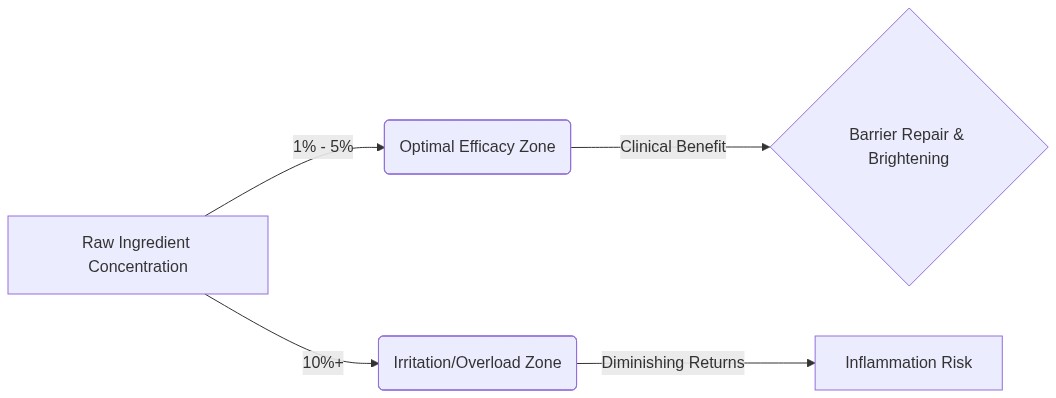
Take Niacinamide, the industry’s favorite multitasker. It is a brilliant ingredient for barrier repair, sebum control, and pigment regulation. You will see luxury bottles advertising 10%, 15%, or even 20% concentrations, charging a premium for the "strength" of the formula. However, clinical research tells a more sobering story.
Data indicates that the "Goldilocks zone" for Niacinamide is firmly rooted between 2% and 5%. At this range, the ingredient effectively drives ceramide synthesis and reduces transepidermal water loss. When you push past 5%, the marginal gains in efficacy plateau, but the risk of inflammation and barrier disruption skyrockets. The expensive, high-concentration serum isn't necessarily working harder; it is often just working louder, at the expense of your skin’s delicate ecosystem.
The Death of Blind Trust
The transition from brand-loyalty to ingredient-literacy has fundamentally altered the industry. In the past, a prestigious name was a shorthand for safety and quality. Today, that trust has been replaced by peer-to-peer verification.
Platforms like Hwahae have democratized the "beauty education" (뷰티 교육) of the average consumer. When a new "miracle" product launches, it is no longer the celebrity endorsement that determines its fate. It is the dissection of its formula by the Ko-deok—the beauty obsessives who treat skincare like a chemistry lab. If a luxury product contains the same core actives as an affordable counterpart, the community will notice.
In this environment, the "luxury" markup has become a liability. Consumers are increasingly viewing skincare as a preventative health practice rather than a status symbol. They want products that are Hwajalmeok (makeup-friendly) and scientifically sound, not products that serve as an expensive piece of shelf-decor.
🎵 K-Mono Lofi — Seoul Study Beats
Read deeper with Seoul lo-fi in the background — curated by K-Mono Lofi
Navigating the Marketing Fog
The industry does not make it easy to be a discerning consumer. There is a constant, subtle pressure to engage in over-care—the tendency to layer too many active ingredients in the pursuit of "glass skin." This is where the danger lies. A routine consisting of five different luxury serums, each packed with high-strength actives, is rarely a path to better skin; it is a recipe for a compromised barrier.
Ultimately, the choice between an affordable product and a luxury one should never be about the status of the brand. It should be a decision based on the specific, identified needs of your skin barrier at this exact moment. The most effective routine is rarely the most expensive one; it is the one that is boring, consistent, and built on ingredients that have been proven to work, not just marketed to sound like they do.
⚠️ Disclaimer: The information provided here is for educational purposes and reflects industry trends and clinical research. Skincare is highly individual; what works for one person may cause irritation for another. Always perform a patch test when introducing a new product to your routine. If you have persistent skin concerns, consult a board-certified dermatologist (피부과 전문의) to determine the best approach for your specific skin type and health needs.
✓ Researched and compiled using verified data as of the publication date.
 Operated by: Quiet Korea | Contact: rsl.2001.1975@gmail.com
Comments
Post a Comment