The Invisible System: What Korean Women Over 40 Actually Do for Their Skin
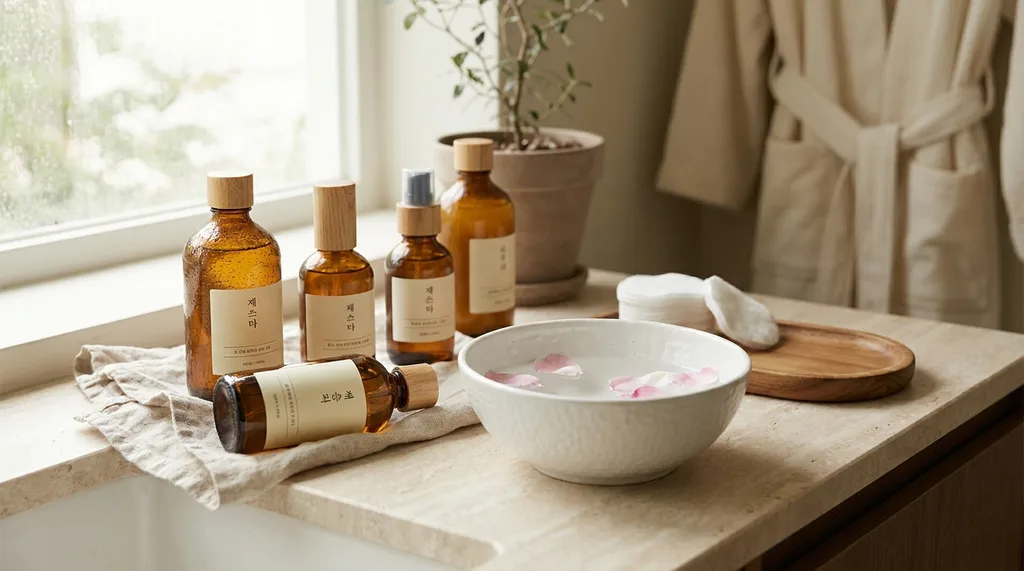
There's a detail that foreigners almost never notice when they first see Korean skincare products: a small printed line on the packaging that reads "기능성화장품" — Gineunseong Hwajangpum, Functional Cosmetic. It doesn't look like much. But that designation means the product has passed government-mandated clinical verification through the MFDS, Korea's Ministry of Food and Drug Safety. In other words: when a Korean product claims to reduce wrinkles or improve elasticity, it isn't a marketing headline. It's a regulated promise with a paper trail.
Most Western shoppers never encounter this fact. They buy Korean skincare for the aesthetic, the packaging, the glow of it all — and walk away bewildered when results don't match the viral before-and-afters. The gap isn't in the products. It's in the system they were built for.
Why do Korean women in their 40s and 50s so often look a decade younger than their age would suggest — and why can't that result be explained by any single serum? The answer isn't in any bottle. It's in a framework most outsiders never see. Hold that question. It's going to unravel everything you thought you knew about anti-aging.
When "Anti-Aging" Is a Legal Category, Not a Marketing Claim
Walk into any Olive Young and pull two products off the anti-aging shelf. One will have a small logo and the functional cosmetic designation. The other won't. That difference isn't about price or prestige — it's about proof.
South Korea is one of the few countries in the world where claiming "wrinkle reduction" or "skin brightening" on a cosmetic label requires documented clinical evidence reviewed by a government body. The MFDS enforces a clear line between general cosmetics and functional cosmetics, with the latter covering wrinkle improvement, UV protection, skin whitening, and — more recently — barrier repair. To carry these claims legally, a product's active ingredients must meet a verified standard of concentration and efficacy. Animal testing has been banned entirely since 2017, pushing brands toward in-vitro and human clinical trials instead.
This has shaped a consumer culture unlike anywhere else in the beauty world.
[K-Beauty 101] Gineunseong Hwajangpum (Functional Cosmetic) — A regulatory category requiring clinical verification for products claiming specific physiological benefits. This term signals the Korean consumer's expectation that skincare should function as "skin-medicine" — not aspiration, but accountable science.
Korean consumers — increasingly called "Skintellectuals" within the industry — use ingredient-tracking apps like Hwahae with the focus of amateur pharmacists. They cross-reference MFDS approval numbers. They debate optimal concentrations of Niacinamide (typically 2–5% for barrier support; higher for brightening effects) on forums with the rigor of a graduate seminar. Brand loyalty doesn't come from campaign photography. It comes from demonstrated ingredient transparency.
For a Western reader accustomed to a market where "clinically proven" means "we showed it to three people in our internal study," this is a genuinely different reality. And it explains something important: the K-Beauty products that have earned the most trust aren't the prettiest ones. They're the ones that passed the test.
The Target Nobody Is Talking About
Here's where Korean anti-aging philosophy diverges from Western thinking so sharply that the two systems barely recognize each other.
Western anti-aging has historically focused on one visible enemy: the wrinkle. You see a line, you treat a line. Retinoids, Botox, fillers — all precision tools aimed at a specific visible symptom. The logic is reactive and understandable. The results are also, eventually, visible: a face that looks corrected rather than preserved.
Korean women in their 40s and 50s are chasing something different.
[K-Beauty 101] Tallyeok (Skin Elasticity) — The skin quality most frequently cited by Korean women in midlife as their primary anti-aging concern. Unlike Western anti-aging's focus on line reduction, Korean treatments target the structural integrity of the dermis — the springback, the firmness, the way skin recovers after compression. A completely different goal. Which is why the results look completely different.
Elasticity lives in the dermis, in the collagen and elastin network. It starts declining visibly in the mid-30s — not just at 50. Korean women who look dramatically younger at 48 are not using miraculous products at 48. They started supporting dermal infrastructure in their late 20s, with products specifically formulated around elasticity — peptides, Adenosine (a MFDS-approved wrinkle-improvement active), and red ginseng extracts with documented collagen-stimulating properties.
This is the preventive infrastructure model. And it's what makes the result look fundamentally different from reactive treatment.
The other concept embedded in Korean anti-aging thinking is Sok-geon-seong — inner-skin dryness. The idea that dehydration happens beneath the surface, not just on top of it. Skin that is oily on the outside can be chronically parched in its deeper layers, and that hidden dehydration accelerates structural aging in ways that even a perfect moisturizer won't fully address unless it's designed to reach those layers. Korean essence and serum formulations — lightweight, deeply penetrating, layered — are specifically designed around this problem. The 7-skin method (applying thin, watery toner in successive layers) that looks obsessive from the outside makes perfect scientific sense from this angle.
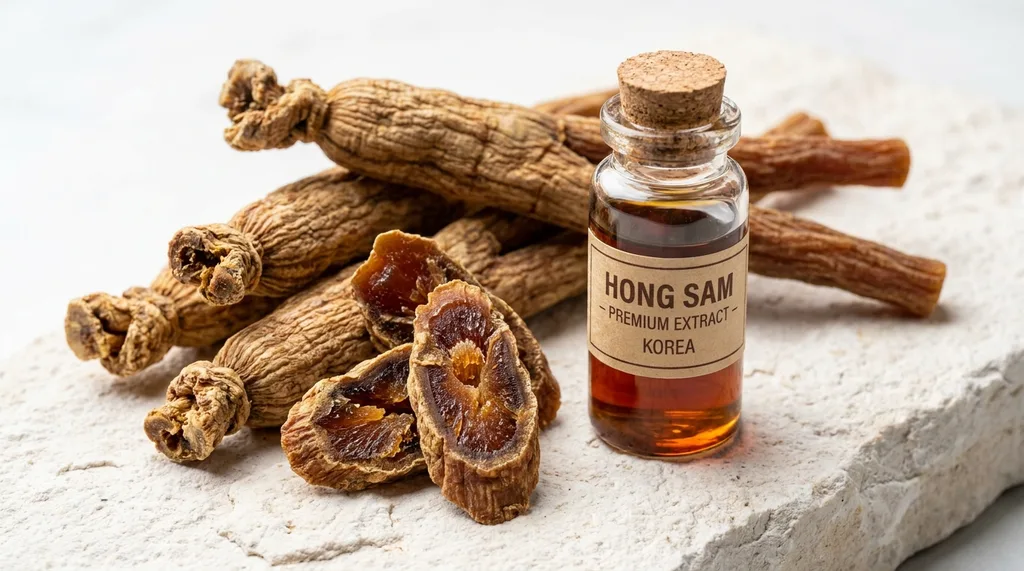
The other pillar of Korean anti-aging heritage is hanbang (traditional Korean medicine ingredients applied to skincare) — specifically fermented red ginseng, known in Korean as hongsam. Processing ginseng root through steaming and drying increases the bioavailability of ginsenosides, the compounds most associated with antioxidant activity and collagen synthesis. Fermented versions improve skin absorption further. This isn't folklore repackaged as science — it's a case where 2,000 years of empirical tradition and modern clinical research have arrived at the same ingredient through completely different routes.
Fermented ingredients more broadly — hibiscus extract rich in polyphenols, traditionally fermented botanical complexes — represent another pillar of this approach: high-antioxidant density delivered in formats that are gentle enough not to compromise the one thing Korean anti-aging philosophy protects above everything else.
The skin barrier.
The Line Between Effective and Destructive
This is where the honesty has to come in. Because the same culture that produced the most sophisticated anti-aging system in the world has also produced its share of damage.
The shift in Korean clinical and cosmetic science is moving clearly toward delivery technology — not higher concentrations, but smarter pathways into the skin. Micro-spicule technology (tiny physical channels derived from sea sponges) and nano-encapsulation systems allow active ingredients to reach target skin layers without the sustained surface irritation that degrades the barrier. PDRN (Polydeoxyribonucleotide — a cellular regeneration molecule that stimulates collagen synthesis) and Exosome formulations are being integrated into topical products with these delivery systems, aiming to achieve near-clinical regeneration results without clinic-level inflammation.
These are not mass-market ingredients yet. The research is promising, the clinical mechanisms are understood, but the topical delivery challenge remains a genuine scientific frontier. Any brand claiming PDRN or Exosome products produce dramatic visible results with one product should be held to exactly the same evidence standard Korean consumers hold everything else.
The slow-aging philosophy is not about aggressive correction. It's about maintaining the structural integrity of the skin's infrastructure so that the gap between biological age and visible age never has a chance to widen dramatically. That is a different goal than "fixing" aging. And it requires starting earlier — or, if you're encountering this system at 45, entering it strategically rather than desperately.
The Ingredient Science, Tiered Honestly
Not all validated Korean anti-aging ingredients sit at the same level of evidence. Here's the honest picture:
Where You Enter the System at 45
Here is the question the reader who found this article actually came here to ask: is it too late?
The honest answer is that the preventive infrastructure model works best when started early. The equally honest answer is that the biology of barrier repair, elasticity support, and deep hydration is not time-gated. You don't have to have started at 25 to benefit from the system at 45. You have to enter it correctly.
That means something different than buying an expensive ginseng serum and hoping for the best.
The actual entry point for mature Western skin encountering this system:
First, the barrier comes before everything. Korean anti-aging begins with barrier assessment, not active ingredient loading. If your skin has spent decades under Western skincare's stripping cleansers, toners with high alcohol content, and aggressive acids, the first phase isn't treatment — it's repair. A pH-balanced gentle cleanser. A ceramide-rich moisturizer. A consistent, mineral-heavy SPF. Nothing else. Six to eight weeks minimum. Your skin cannot absorb what it's too compromised to receive.
Second, address Sok-geon-seong — inner-skin dryness — as the root cause before addressing visible symptoms. A hyaluronic acid essence or lightweight toner layered while skin is still damp is not a trivial step. It is the foundation that allows every active ingredient applied afterward to actually penetrate.
Third, introduce Adenosine at the serum step. It is the single most evidence-backed elasticity-targeting active in functional cosmetic formulations, and it is the ingredient Korean women in their 40s are most consistently using. Not dramatic, not fast. But documented.
Fourth, approach fermented hanbang ingredients as a long-game investment, not a quick fix. Hongsam — red ginseng — at verified concentrations in a serum or ampoule applied consistently over months. The Korean grandmother who credited her skin to ginseng tea and ginseng cream was describing the same mechanism that clinical science later documented. That continuity is not a coincidence.
Finally: the slow-aging philosophy is a mental shift as much as a product protocol. The goal is not to aggressively reverse what has already happened. It is to ensure that what happens from this moment forward happens slowly, and on your terms.
The women in Seoul who look a decade younger at 55 are not people who found a secret. They are people who committed to a system that treats skin health as a lifelong infrastructure project — and never stopped. You can start that project today. The timeline adjusts. The system works regardless.
Anti-aging in Korea was never about fighting time. It was about making sure your skin's infrastructure was strong enough that time didn't hit so hard.
That distinction — building versus fighting — is the thing that changes how you see every product, every ingredient, every routine step from this point forward. The goal was never the same. Which is why the result never looked the same.
⚠️ Medical & Financial Disclaimer: The ingredients and approaches described in this article are based on publicly available clinical research and regulatory documentation. They are not medical advice. Active ingredients such as Adenosine, Niacinamide, and Retinoids can cause adverse reactions in certain skin types — always patch test new products on a small area of skin before full application. If you have a diagnosed skin condition, are undergoing hormonal therapy, or have experienced persistent irritation or hyperpigmentation, consult a board-certified dermatologist before adding new actives to your routine. PDRN and Exosome formulations are an evolving clinical area — prices vary significantly and efficacy data for topical applications continues to develop. Do not substitute skincare information for personalized medical guidance.
Comments
Post a Comment