The Number on No Skincare Label: What Korean Dermatologists Know About Absorption That Changes Every Product You'll Ever Buy
The Number on No Skincare Label: What Korean Dermatologists Know About Absorption That Changes Every Product You'll Ever Buy
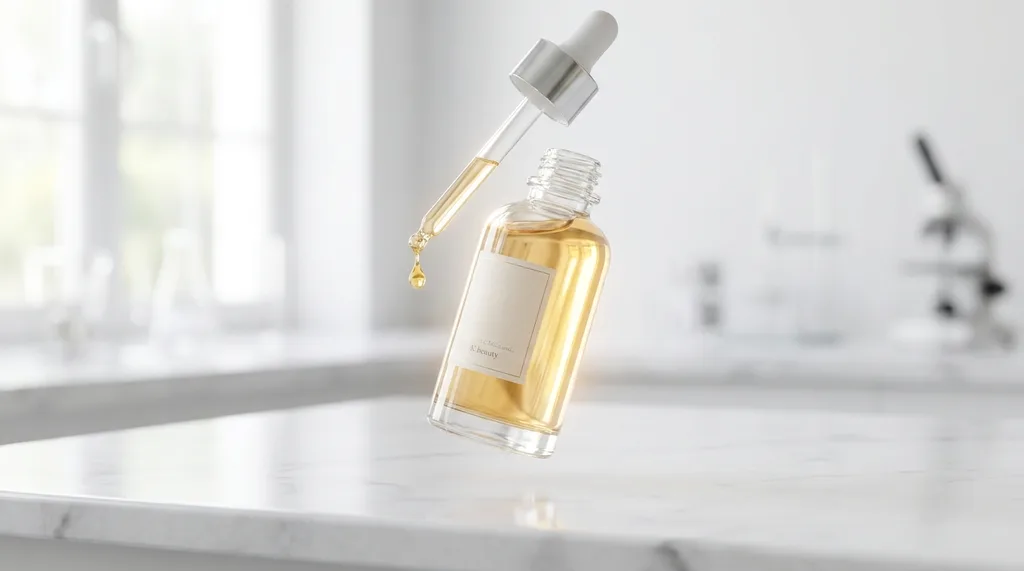
There is a number that cosmetic chemists reference like a physical law, that Korean dermatologists quietly use to evaluate every product claim they encounter, and that virtually no beauty brand will print on its packaging — because if consumers understood it, the industry would have to rebuild itself from scratch.
That number is 500.
Five hundred Daltons. It is the approximate molecular weight threshold beyond which a compound cannot penetrate the stratum corneum — the outermost layer of human skin. Molecules smaller than 500 Da slip through. Everything larger stays on the surface. And once you know this, you start looking at a fully-stocked skincare shelf with completely different eyes.
The K-beauty routine that captured the world's imagination — the 10-step protocol, the essence and serum and ampoule and cream — was never, at its core, about more products. It was always about understanding what molecules can actually enter your skin, and building every other decision around that one physical reality.
What a Cosmetic Chemist Sees When They Look at Your Skincare Shelf
Walk into any Olive Young and watch how Korean consumers shop. They're not reaching for the prettiest jar or the biggest marketing claim. Regulars in Seoul's beauty aisles — the community that calls themselves ko-deok (the self-appointed quality gatekeepers who memorize ingredient lists and share brutally honest reviews before any influencer has even received their PR package) — will flip a product to scan its ingredients before they've even looked at the front label. What they're hunting for, often without articulating it in Dalton terms, is the same thing dermatologists assess in clinic: can this actually get in?
The answer, for most products, is more sobering than the packaging suggests.
Take collagen — the single most marketed ingredient in K-beauty and global skincare alike. Native collagen molecules weigh approximately 300,000 Daltons. That is six hundred times larger than the 500 Da threshold. Applied topically, traditional collagen cream sits on the surface of your skin and does what any good film-former does: it temporarily reduces transepidermal water loss and makes your face feel smooth. That is not nothing — occlusion is genuinely useful. But it is not what the marketing copy implies when it promises to "replenish your skin's collagen."
Korean dermatologists are not surprised by this. The clinical community there has long distinguished between what a product does to the skin surface and what it does inside the skin. This distinction is the foundation of Seoul's famous skin science culture — a culture where the word pibu-jangbyeok (skin barrier, literally the "skin fortress") is treated as a clinical term rather than a marketing phrase, and where the difference between a film-forming moisturizer and a true active is considered basic consumer literacy.
[K-Beauty 101] Pibu-jangbyeok (Pibu-jangbyeok) — The skin barrier, or stratum corneum. Korean skincare culture treats this not as a surface to decorate but as a fortress to defend — because once it's compromised, no product performs as intended.
The 500 Dalton rule does not mean topical skincare is pointless. It means that surface-acting ingredients (humectants, occlusives, emollients) do exactly what they're designed to do, and that penetrating actives must be formulated specifically to breach the barrier — through molecular engineering, delivery systems like liposomes, or fatty acid modifications that allow absorption through the lipid-rich stratum corneum. The Korean cosmetic industry understands this distinction better than most markets in the world. Which is precisely why the layering order in a K-beauty routine is not a preference or a cultural quirk. It is physics.
Why the Layering Order Is Physics, Not Preference
The "thinnest to thickest" rule that every K-beauty guide repeats is, at its root, a molecular argument. Water-based products with low molecular weight and low viscosity — toners, essences, lightweight serums — must be applied before heavier, occlusive formulations not because Koreans have decided so, but because once a cream or oil establishes a lipid-rich film on the surface, it creates a physical barrier that prevents subsequent water-based actives from reaching the skin at all.
This is why the famous 3-second rule exists in Korean skincare culture: applying hydration within three seconds of cleansing, before the skin's surface has lost its post-wash moisture, exploits the brief window when the stratum corneum is most receptive. The phenomenon it addresses — sok-geon-seong, or inner dryness, the frustrating condition where skin feels parched deep within even when the surface looks fine — is treated as a genuine clinical concern in Seoul, not a marketing problem to solve with a heavier cream.
[K-Beauty 101] Sok-geon-seong (Sok-geon-seong) — "Inner dryness." The condition where the skin is dehydrated at a deep level while appearing normal or even oily on the surface. Korean dermatology treats this as a root cause, not a symptom — which is why K-beauty prioritizes layering hydration rather than simply applying more moisturizer.
Research into the 7-Skin method — the technique of applying seven sequential layers of toner or essence — reflects the same principle scaled up. The goal isn't volume; it's saturation at depth. Each layer, allowed to settle for two to three minutes, gives low-molecular-weight water-binding agents the time to descend through the upper layers of skin before the next layer drives them deeper. Brands like ANUA have built their entire philosophy around this — using lightweight, non-comedogenic textures specifically engineered to support sequential layering without pilling or suffocating the barrier.
The honest caveat that most content in this space skips: layering intelligence can also go wrong. The phenomenon Korean insiders call over-care — stacking too many actives without understanding their interactions or the skin's current state — is the K-beauty routine's most common failure mode. When the stratum corneum is compromised by over-exfoliation or an aggressive active, applying additional serums doesn't boost efficacy. It drives irritants deeper into damaged skin. Korean dermatologists on Naver blogs and in clinic consultations are remarkably consistent on this point: more layers only work on an intact barrier. Repairing the barrier comes first, always.
The Collagen Question Korean Dermatologists Actually Answer Differently
Here is where the 500 Dalton rule pays off in the most practical way — and where Korean dermatology parts sharply from how collagen is sold globally.
If a 300,000 Dalton collagen molecule cannot cross the stratum corneum, the logical conclusion is not "stop caring about collagen." It is: change the delivery system. Korean cosmetic science has pursued two parallel strategies for this. The first is topical: ultra-low molecular weight collagen peptides, engineered down to around 243 Daltons, which can penetrate through the barrier and — critically — stimulate fibroblasts in the dermis to produce the skin's own collagen. Clinical data shows this stimulation effect can reach up to 184% enhancement of collagen synthesis compared to untreated controls. This is a completely different mechanism from applying a collagen cream; it is using a small molecular fragment as a signal rather than a filler.
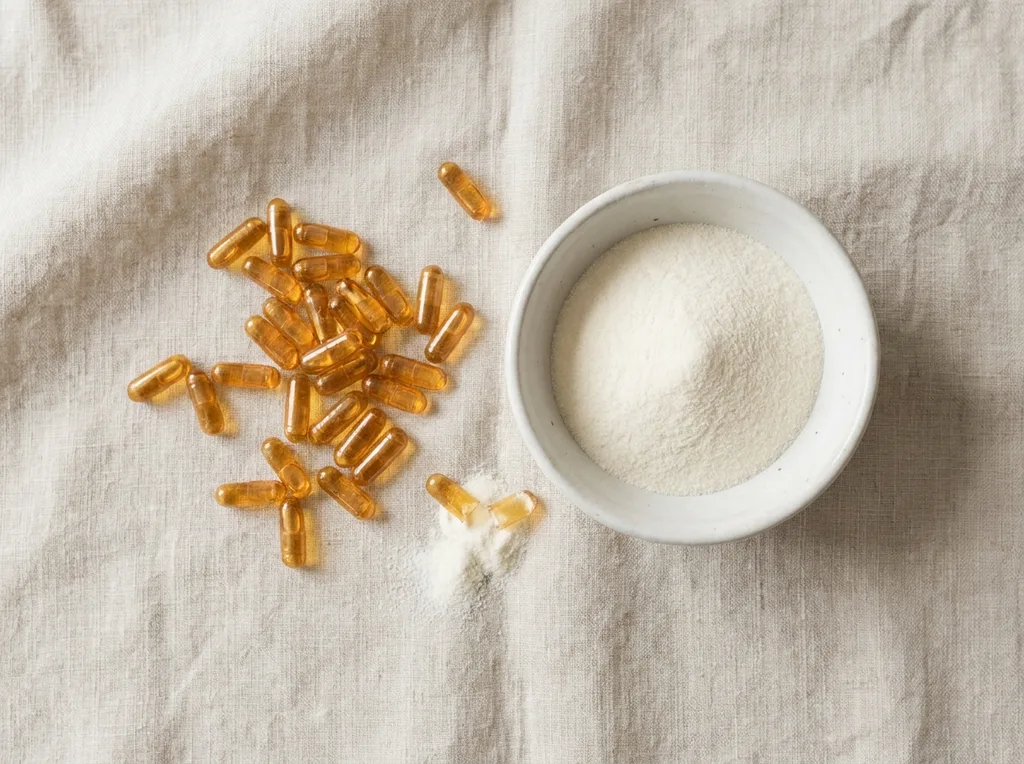
The second strategy is one that Korean clinics and wellness culture have embraced long before Western beauty media caught on: ingestible collagen. The inside-out logic is clean. If the barrier keeps large molecules out from the surface, bypass the barrier entirely — consume hydrolyzed collagen peptides orally, where they are absorbed through the gut, enter circulation, and reach the dermis from within. This is not new science in Korea. Collagen drinks, supplements, and inner beauty products have been mainstream in the Korean wellness market for years, found at the same Olive Young registers where topical products sit.
The clinical data table below reflects what Korean dermatologists actually reference when recommending supplements — not marketing claims, but mechanism, dosage, and timing:
| Active | Mechanism | Clinically Studied Dose | Effect Onset | Notes |
|---|---|---|---|---|
| Hydrolyzed Collagen Peptides (low MW) | Gut-absorbed; stimulates dermal fibroblasts | 2.5–10g/day | 8–12 weeks | Choose products specifying molecular weight; "collagen" alone is insufficient |
| Vitamin C | Collagen cross-linking cofactor; antioxidant | 500–1000mg/day | 4–8 weeks | Enhances both topical and ingestible collagen protocols |
| Ceramide (oral) | Barrier lipid replenishment from within | 30–40mg/day | 6–8 weeks | Evidence-based for dry skin conditions; less established for anti-aging per se |
| Astaxanthin | Antioxidant; UV damage mitigation | 4–12mg/day | 8–16 weeks | Marketing claims significantly outpace clinical evidence at higher dose ranges |
The honest read of this table: the top three have genuinely meaningful clinical backing at the doses listed. Astaxanthin's evidence is promising but thinner than its marketing suggests — and Korean skincare communities, with their culture of fact-checking (팩트체크), have noticed. Honest ko-deok reviewers on community platforms regularly call out the gap between promotional claims and published studies. That skepticism is a feature of Korean beauty culture, not a bug.
The supplement timing question matters too. Korean dermatology tends to align ingestible collagen with the body's natural repair cycle — taking collagen peptides in the evening, alongside vitamin C, to support the overnight period when cellular regeneration is most active. This isn't clinical gospel, but it is the practical protocol that Seoul skin clinics recommend to patients who ask how to integrate supplements into a topical routine.
Where the Global Reader Can Actually Access This

For most readers outside Korea, the challenge isn't understanding the science — it's finding products that meet the molecular weight and purity standards the science demands. "Collagen peptide supplement" on a global e-commerce search returns everything from 243 Da precision-formulated products to large-molecule powders that function essentially as expensive protein shakes.
iHerb has become the platform Korean beauty-conscious shoppers outside Asia trust precisely because its sourcing standards reduce the counterfeit risk that plagues supplement categories on less regulated marketplaces — and because the selection covers both the hydrolyzed collagen peptide category (look specifically for labels that specify "low molecular weight" or "hydrolyzed collagen peptides") and the Vitamin C forms that function as necessary cofactors.
If you're new to this category and building your first evidence-based supplement protocol alongside a K-beauty topical routine, the search terms that filter toward the right products: "hydrolyzed marine collagen peptide," "collagen tripeptide," and "vitamin C buffered" for those with sensitivity to ascorbic acid in its pure form. Use code QAK3042 at checkout for an additional discount on first orders.
The price comparison reality: Korean ingestible collagen products sold at Olive Young are formulated to a high standard but carry a significant import premium for global buyers. iHerb's direct sourcing model typically brings equivalent-spec products to roughly 30–50% lower landed cost once shipping is factored in — which matters if you're committing to the 8–12 week supplementation window that clinical studies require for measurable results.
The Part That Protects You
Before any supplement protocol: a brief safety map, because the Founder's Heart of this channel demands it.
Hydrolyzed collagen peptides are generally well-tolerated, but individuals with fish or shellfish allergies must verify source (marine vs. bovine vs. porcine collagen), as marine-derived products carry clear allergen risk. People on blood-thinning medications should consult a physician before beginning high-dose collagen supplementation, as some collagen-associated compounds may have mild anticoagulant properties. Pregnant and breastfeeding individuals should default to consulting their OB or midwife before adding any supplement to their routine — the clinical data on collagen supplementation during pregnancy is insufficiently established to give general clearance.
For the topical side of this equation: patch testing new actives remains non-negotiable, and anyone currently managing a sensitized or compromised barrier should rebuild it (ceramide-rich moisturizer, minimal actives, broad-spectrum sunscreen) before introducing penetrating actives that exploit the 500 Da window. Breaking the barrier down further in the name of better absorption is not the K-beauty philosophy. Protecting the fortress is.
The 10-step routine was never about the steps. It was always about understanding the physics of your skin — and building everything around that one number. Know the number, and you'll never be fooled by a label again.
⚠️ Medical & Financial Disclaimer: The information in this article is educational and does not constitute medical advice. Supplement protocols, including hydrolyzed collagen peptides and Vitamin C, should be reviewed by a qualified healthcare provider before beginning, particularly for individuals with allergies, existing medical conditions, pregnancy, or those taking prescription medications. Product efficacy varies by individual, formulation, and consistency of use. Price comparisons reflect general market observations and may not reflect current retail pricing. Always verify molecular weight specifications and allergen information directly on product labels before purchase.
✓ Researched and compiled using verified data as of the publication date.
 Operated by: Quiet Korea | Contact: rsl.2001.1975@gmail.com
Comments
Post a Comment