What Korean Dermatologists Recommend That Never Goes Viral
There's a question that surfaces whenever someone who has been deep in K-Beauty long enough starts comparing notes with Korean consumers, rather than Korean content creators. It goes something like this: if the serums and the toners and the famous ten-step routines are doing the heavy lifting, why do Korean women in their forties consistently report that the single biggest shift in their skin came not from a new product, but from something they started taking?
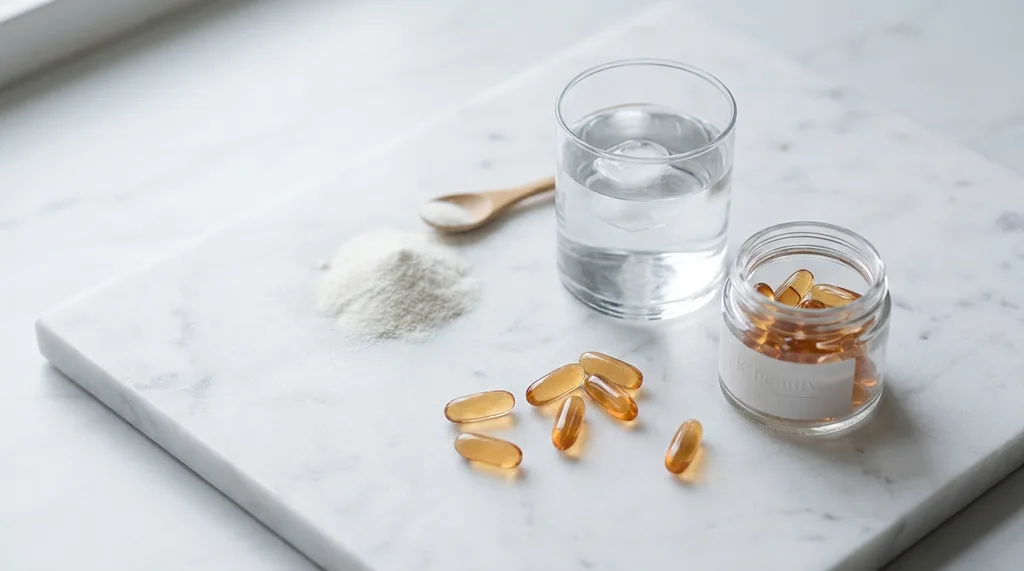
The supplement shelf inside a Seoul dermatology clinic — not an Olive Young display, an actual clinical waiting room — looks nothing like the content that has defined K-Beauty globally. No cute packaging. No glass skin promises. Just a quiet row of pharmaceutically-graded supplements that most dermatologists here have been recommending for years, long before any of it had a hashtag.
This is the part of K-Beauty that never got exported with the rest.
What the Clinic Knows That Your Feed Doesn't
The global understanding of K-Beauty was built almost entirely around its visible layer — the products, the textures, the routines. That's a reasonable place to start. But Korean dermatology, at its most rigorous, has always held a different conviction: that the skin is a system, and that topical intervention can only do so much before it hits a ceiling dictated by what's happening beneath.
This isn't mysticism. It's the same logic embedded in South Korea's regulatory framework. The Ministry of Food and Drug Safety (MFDS) operates a notably strict binary for cosmetic claims: a standard notification process for government-approved ingredient concentrations, and a full clinical review for novel compounds. Niacinamide, for instance — the brightening ingredient currently dominating every global skincare conversation — is regulated for topical whitening claims at a 2–5% concentration. Not the 10% that fills Western shelves. Not the 20% that influencers push as "stronger means better." Two to five.
That regulatory conservatism reflects something cultural: Korean skincare philosophy, at its core, is not about maximum dosage. It's about sustainable, barrier-respecting intervention. And once you understand that, the move toward inner beauty supplements feels less like a trend and more like a logical extension of the same principle.
[K-Beauty 101] Sok-geonseong (속건성) — "inner dryness." The condition where skin appears normal or oily on the surface while being chronically dehydrated in deeper layers. Korean dermatologists cite this as one of the most commonly mismanaged skin states — and it's the exact problem that topical hydration alone cannot fully resolve.
The insight that Korean inner beauty culture centers on is simple and slightly humbling: if your skin is deficient at the cellular level, no serum reaches that far. Consumer sentiment data from Korean beauty platforms reflects this understanding. Discussions increasingly distinguish between "surface-level maintenance" — the serums, the hydration layers, the SPF — and "foundational work," which is where supplements enter the picture.
This is what the most discerning Korean beauty consumers, the ko-deok (코덕) who memorize ingredient lists and interrogate brand claims on community boards, have been saying for years. The topical routine is the conversation you have with your skin's surface. Supplements are the infrastructure.
The Science Behind the Shelf — Minus the Marketing Noise
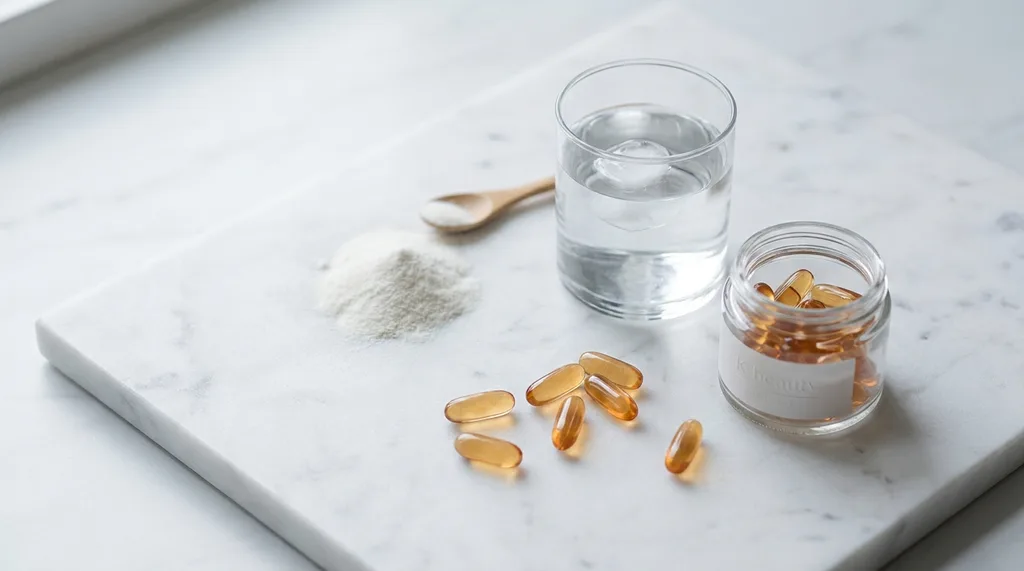
Not every supplement marketed under the K-Beauty umbrella earns its price tag. This is worth saying plainly, because the global appetite for anything Korean-skincare-adjacent has created fertile ground for products where marketing ambition outruns clinical evidence. Knowing how to read the shelf is more valuable than any specific product recommendation.
The evidence landscape, as Korean dermatologists and clinical researchers currently understand it, falls roughly into three tiers:
Tier one — strong clinical consensus. Collagen peptides (hydrolyzed into low-molecular forms that can be absorbed) have a growing body of clinical literature behind them, particularly for skin elasticity and hydration. Korean beauty culture has embraced these long before the Western market caught up, partly because the clinical evidence was there before the trend was. Niacinamide taken orally shows a distinct profile from its topical counterpart — oral supplementation research explores systemic effects that a topical serum simply cannot replicate.
Tier two — promising but early. PDRN (polydeoxyribonucleotide), EGF (epidermal growth factor), and exosome-based formulations are generating intense interest in Korean dermatology circles — particularly in clinical and cosmeceutical settings. These are genuinely exciting areas of research. They are also genuinely early-stage for supplement applications. Korean dermatologists themselves are careful to separate what the injectable versions accomplish in a clinical setting from what an ingestible supplement can realistically deliver. The gap is significant. Consumers should be aware that marketing for these ingredients tends to run several years ahead of the evidence.
Tier three — marketing claims lead the science. There are ingredients in the inner beauty category where the clinical story is thin, the consumer story is enthusiastic, and the price premium is steep. The honest answer is that some of what gets sold under "K-Pharm Beauty" labeling is benefiting more from the halo of the category than from robust efficacy data.
The table below reflects the current clinical landscape honestly — including where the evidence genuinely supports use and where it doesn't yet:
| Ingredient | Clinical Evidence Tier | What the Evidence Actually Shows | Realistic Onset |
|---|---|---|---|
| Hydrolyzed Collagen Peptides | Strong consensus | Skin hydration, elasticity improvement in multiple RCTs | 8–12 weeks |
| Oral Niacinamide | Moderate (systemic effects differ from topical) | Immune modulation, some photoprotection research | 4–8 weeks |
| PDRN / EGF (oral) | Early / Emerging | Promising in injectable clinical research; oral bioavailability less established | Unclear |
| Ceramide Complex (oral) | Moderate | Barrier function support; small but consistent trial data | 6–10 weeks |
| Galactomyces Ferment (ingestible) | Limited direct evidence | Topical evidence strong; oral form under-researched | Unclear |
The 팩트체크 (fact-check) culture that Korean beauty communities have built is the appropriate lens here. These communities — particularly the honest review spaces where sponsored content is explicitly labeled and called out — have collectively arrived at a cleaner read of the inner beauty space than most international coverage offers. Their conclusion mirrors what cautious dermatologists say: collagen and ceramide have earned their place; newer biotechnology ingredients are interesting but should be approached with measured expectations and a budget to match.
How Koreans Actually Build the Inner Routine
There's a layering logic to the Korean supplement approach that mirrors the topical routine philosophy — and that's not a coincidence. The same principle that governs why you apply toner before serum governs how Korean dermatologists think about supplement stacking.
The foundation layer is hydration and barrier support: hydrolyzed collagen, ceramides, and hyaluronic acid in food-supplement form. These aren't glamorous. They don't go viral. But Korean consumers report that this combination — taken consistently, over months rather than weeks — is what creates the baseline the rest of the routine works on. The concept of hwajal-meok (화잘먹) — skin so optimally conditioned that makeup applies without caking or patching — is, according to regular forum discussion in Korean beauty communities, far more reliably achieved through internal support than through topical products alone.
The second layer is targeted: brightening support (oral niacinamide or vitamin C complexes), antioxidant protection, or specific recovery protocols following dermatological procedures. Korean clinics that perform laser treatments, chemical peels, or injectables frequently recommend a post-procedure supplement protocol that includes high-dose antioxidants and collagen peptides during the healing window. This is standard practice that international patients routinely describe as their most surprising take-home instruction.
Timing matters in the Korean approach. Collagen peptides are generally taken in the morning with food to support absorption. Ceramide complexes are often evening-weighted. High-dose antioxidants are timed around sun exposure or procedure recovery. The specifics should be confirmed with a dermatologist for individual skin conditions, but the underlying principle — that timing affects efficacy, and that supplements are part of a system — is consistent across the Korean clinical approach.
[K-Beauty 101] Ko-deok (코덕) — Korea's obsessive beauty consumer class. Self-appointed quality gatekeepers who memorize ingredient lists and share unsponsored feedback in community spaces. Their collective intelligence has repeatedly surfaced ingredient truths long before mainstream media catches up — and their current consensus is that inner beauty is not a trend but an infrastructure investment.
What Korean consumers are increasingly clear about is the risk of over-supplementation. The same 오버케어 (over-care) principle that warns against layering too many actives topically applies internally. More supplements do not equal faster results. Korean dermatologists are explicit that collagen at a clinically useful dose is categorically different from taking three different collagen products simultaneously because each had appealing packaging.
The honesty that makes Korean beauty culture worth listening to extends to this: most Koreans who have found supplements genuinely useful describe a patience of months, not days. The skin-from-within results don't look like a before-and-after photo. They look like fewer rough mornings, more consistent texture, a slow accumulation of resilience that makes everything else — the topical routine, the sun protection, the occasional clinic visit — work better.
Getting the Real Thing, From Anywhere in the World
Here's where geography has historically been a problem for global K-Beauty followers. The inner beauty supplement category that Korean dermatologists actually recommend has poor global distribution. Most of what makes it to international retailers is the visible, packaged face of K-Beauty — the serums, the sheet masks, the cushion foundations. The clinical-grade supplement protocols have largely stayed domestic.
The practical workaround that Korean skincare communities outside Korea have converged on is sourcing from platforms with direct supply chains and authentic product verification — specifically because the supplement category has a counterfeiting problem that the cosmetic category doesn't. A fake serum is annoying. A counterfeit supplement is a genuine health risk.
The category worth exploring spans hydrolyzed collagen peptides, ceramide complexes, oral hyaluronic acid, and vitamin C in forms with demonstrated bioavailability. These are the foundational ingredients with clinical backing, available through legitimate supply chains, and consistent with what Korean dermatology recommends as the baseline inner beauty stack.
One Last Thing: Who Should Slow Down
The supplements discussed here are generally considered safe for healthy adults. "Generally considered safe" is doing real work in that sentence, and it warrants unpacking.
Individuals taking blood-thinning medications should consult their physician before adding high-dose vitamin C or fish-derived collagen peptides. Those with fish or shellfish allergies need to verify the source of their collagen carefully — marine collagen is prevalent in Korean inner beauty formulations, and labeling in imported products is not always conspicuous about this. Pregnant and breastfeeding individuals should treat any supplement — regardless of how "natural" or "beauty-focused" the marketing is — as something requiring explicit medical clearance.
PDRN and EGF-adjacent supplements, being in genuinely early research territory, are the supplements where the caution is highest. These are ingredients where the interesting clinical work has been done in injectable or topical pharmaceutical contexts, not oral supplement contexts. The translation from clinical injectable to oral supplement involves a bioavailability story that the research has not yet fully told. Korean dermatologists who are enthusiastic about injectable PDRN in clinic will frequently be considerably more cautious about recommending its supplement-form equivalents to patients without specific clinical guidance. Follow their lead.
The same critical intelligence that makes Korean beauty culture genuinely useful — the 솔직 후기 (honest review) culture, the 팩트체크 reflex, the willingness to say "the evidence doesn't support that claim yet" — is exactly what serves you here. The most sophisticated K-Beauty consumers don't take supplements because they went viral. They take them because the clinical logic holds, the evidence tier is strong, and the dermatologist said yes.
That is a very small, very curated list. It's also the only list worth following.
⚠️ Medical Disclaimer: The information in this article is for educational and informational purposes only and does not constitute medical advice. Skincare supplements can interact with medications and may not be appropriate for all individuals, including those who are pregnant, breastfeeding, or managing chronic health conditions. Ingredient efficacy data cited reflects current research and may not apply to all supplement formulations. Always consult a licensed dermatologist or qualified healthcare provider before beginning any new supplement regimen — particularly if you are taking prescription medications or have underlying health conditions. Patch-test all new topical products before full application.
Comments
Post a Comment