[Haul & Commerce Review] Hwahae Autopsy
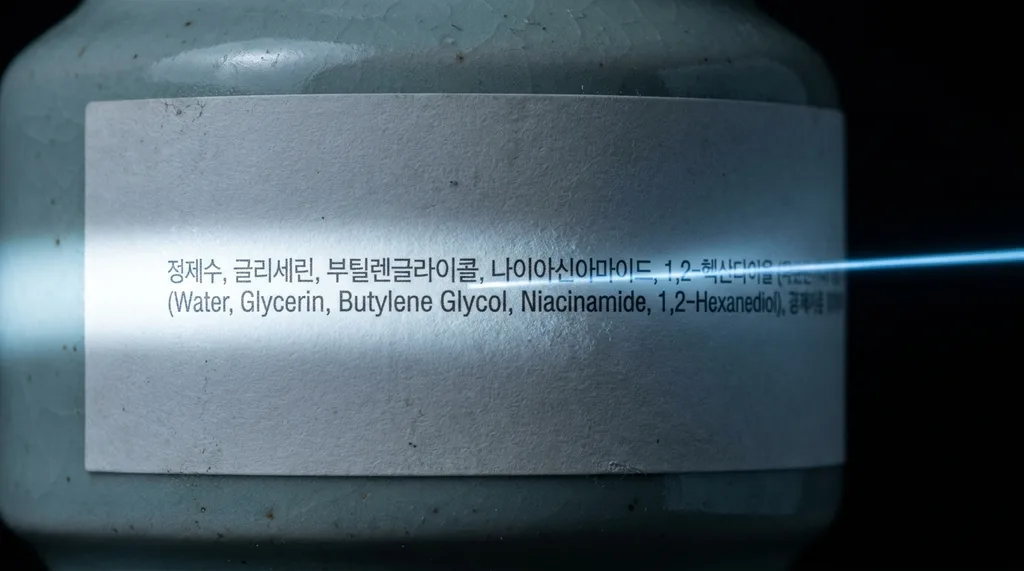
Why do the most ingredient-literate beauty consumers on earth — people who memorize INCI names, cross-reference databases at midnight, and refuse to buy anything until they've read the full label — still break out? Still deal with sudden redness, disrupted barriers, mystery sensitivities that appeared after switching to supposedly "safer" products? The answer isn't in their skin type. It's hiding inside the very rating system they trust more than their own intuition.
- The Green Badge Lie Nobody in Marketing Wants to Discuss
- What Hwahae Actually Built — and Why It Still Matters
- The Honest Breakdown — A Hwahae Autopsy in Practice
- What Hwahae Cannot Tell You — and Who Pays for That Gap
- How to Actually Use Hwahae Without Being Played by It
- Explore Ingredient-Verified Korean Skincare Alternatives
That system is the EWG Skin Deep database. And the app that built an empire on it is Hwahae — Korea's most influential cosmetic ingredient court.
[K-Beauty 101] Hwahae (화해) — Literally meaning "reconciliation" or "harmony," it is Korea's dominant ingredient analysis platform — part database, part community verdict, part brand accountability engine. The name implies a peace treaty between distrustful consumers and opaque brands. Whether that peace is fully earned is the question worth asking.
Both of these tools are genuinely useful. Both are also profoundly misunderstood. And the gap between what consumers think these systems measure and what they actually measure is exactly where the beauty industry hides its most profitable lies.
🎵 K-Mono Lofi — Seoul Study Beats
Read deeper with Seoul lo-fi in the background — curated by K-Mono Lofi
The Green Badge Lie Nobody in Marketing Wants to Discuss
When a product displays "EWG Green Certified" on its front panel, the average consumer reads: scientifically proven safe. That is not what the badge says. That is not even close to what it measures.
The EWG Skin Deep database operates on something called the Precautionary Principle. It assigns a hazard score from 1 to 10 based on a substance's inherent potential for harm — not the actual dose of that substance in your moisturizer. Not the way it interacts with the other 22 ingredients surrounding it. Not your specific skin barrier condition, your sensitivity history, or whether the ingredient in question appears as the second item on the list or the twenty-seventh.
Toxicologists have a phrase for this: "the dose makes the poison." Paracetamol can destroy your liver at high doses. Botulinum toxin, the most lethal substance known to science, is injected into foreheads across Seoul every morning at therapeutic concentrations — safely. EWG ignores this entirely.
Here is what that blindspot actually looks like in practice:
The bottom-right quadrant is where most of the beauty industry's damage hides. An "EWG Green" preservative at 20% concentration in a base formula. A "natural" alcohol like benzyl alcohol — rated relatively low-hazard by EWG — that strips your skin barrier when it's the third ingredient on the list. A fragrance compound that EWG assigns a 1 to, but which triggers contact dermatitis in 15% of sensitive skin users at the concentrations found in most commercial serums.
This is not a flaw that Hwahae invented. It is a flaw that Hwahae — and every "clean beauty" brand that slaps an EWG logo on its packaging — inherited and, too often, amplified.
What Hwahae Actually Built — and Why It Still Matters
Hwahae's genius was never the EWG database. It was the jeon-seonbun.
[K-Beauty 101] Jeon-seonbun (전성분) — The complete, legally mandated ingredient declaration of every compound in a Korean cosmetic product, listed in descending order of concentration. In Korean beauty culture, ignoring the marketing copy and reading the jeon-seonbun first is not obsessive behavior — it is baseline literacy.
Before platforms like Hwahae, cosmetic brands controlled the narrative entirely. They led with their "hero ingredient" — the cherry blossom extract, the 1% peptide, the proprietary "bio-complex" — while the actual formula was built on a foundation of fillers, synthetic emulsifiers, and preservatives that consumers had no practical way to analyze. The ingredient list was required by law to appear on the packaging, but it was printed in 6-point font, in INCI Latin nomenclature, with no translation, no ranking, no explanation.
Hwahae put a barcode scanner on that fine print and handed it to 10 million users.
The platform's ju-ui seonbun (caution ingredient) system — 20 categories of flagged compounds — became the de facto consumer benchmark. Parabens, PEG-based compounds, synthetic fragrances, certain silicones: flagged, categorized, surfaced. Not because they are universally dangerous at every concentration (they are not), but because their presence forced brands to be honest. A product with seven caution flags can no longer hide behind a "dermatologist tested" claim on its front panel. The flags are right there, visible to any teenager scanning the shelf at Olive Young.
That transparency is the actual revolution. And it worked.
The market pressure generated by Hwahae's rating ecosystem is not theoretical. Korean brands reformulated. Clean K-beauty product lines proliferated. The information asymmetry that had protected cosmetic manufacturers for decades — the gap between what brands knew about their formulas and what consumers could understand — began to close.
The ko-deok (the Korean beauty obsessive who reads every INCI name before purchasing) went from being an unusual consumer to being the market-shaping majority. When enough consumers read the label and reject what they find, brands change what's in the bottle.
The Honest Breakdown — A Hwahae Autopsy in Practice
Here is the framework for how a disciplined, Hwahae-informed ingredient analysis actually works. Not for a specific product (those scores update with every reformulation — check the app directly), but for the methodology you need to apply:
What Hwahae Cannot Tell You — and Who Pays for That Gap

There is a category of skin damage that no ingredient analysis app catches. It is not caused by parabens or PEG compounds or synthetic fragrance. It is caused by the accumulation of active ingredients that are, individually, perfectly safe — but which, layered together in the modern 10-step routine, chronically over-exfoliate and destabilize the piji-mak (the skin's natural sebum barrier).
The "clean beauty" consumer who has carefully screened every product for caution ingredients, achieved zero Hwahae flags across their entire routine, and still developed reactive, sensitized skin is not a statistical anomaly. Korean dermatology clinics see this pattern consistently — the jeon-seonbun-literate patient whose barrier has been quietly eroded by three "Green-rated" AHAs, two "natural" retinoids, and a vitamin C serum used simultaneously.
Hwahae tells you what is in each bottle. It cannot tell you what six clean bottles do together, every morning, to a barrier that needed rest.
The global "clean beauty" market's explosive growth — valued at multi-billions with double-digit annual growth projections — is driven not by evidence of superior outcomes, but by the emotional power of fear-based marketing that replaced one set of anxieties ("parabens!") with another ("your routine has too many actives!"). Brands benefit from every iteration of the anxiety cycle. The consumer pays for it with their skin.
This is not Hwahae's fault. The platform did something genuinely radical: it forced transparency. But transparency about individual ingredients in isolation is not the same as safety guidance for a complete routine.
How to Actually Use Hwahae Without Being Played by It
The practical framework, stripped of any marketing noise:
Read the position, not just the presence. When Hwahae surfaces your product's ingredient list, your first question is not "does this have a caution flag." It is: "where on the list is the ingredient I'm paying for?" If the brand's featured peptide is ingredient number 19 and dimethicone is ingredient number 3, you have bought a silicone primer with peptide marketing.
Filter community reviews by your actual skin concern. The platform's community data is its most valuable asset — not the algorithmic score. A product with a mediocre overall Hwahae rating but 800 five-star reviews from users who explicitly describe combination, acne-prone skin is more relevant to your decision than a top-rated product whose reviews come from dry skin types.
Treat fragrance as a binary question. Does this leave-on product contain "Fragrance," "Parfum," or an essential oil blend in a meaningful position? For sensitive or reactive skin, the answer to that question ends the analysis. No EWG Green rating compensates for a hidden fragrance cocktail on disrupted skin.
The iHerb upgrade path, when it matters. If the Korean mass-market formula you've been using contains actives you want at a higher or more clinically precise concentration — niacinamide above 10%, Centella Asiatica extract in a dedicated formula, or a fragrance-free vitamin C derivative — the international ingredient science market has closed that gap significantly. Comparable or higher-concentration formulations are accessible globally, often at similar price points, formulated without the synthetic fragrance that Korean mass-market products frequently use for sensory appeal.
The most important thing Hwahae ever gave Korean consumers was not a score. It was a habit: the habit of turning the bottle around. Of reading the back panel before the front. Of asking who put the hero ingredient in position seventeen and why.
That habit — not any badge, not any database, not any marketing claim about "clean" — is the only tool that protects you. Apps change their algorithms. Brands reformulate. EWG ratings shift. The question "where is this ingredient, and at what concentration?" never stops being the right one to ask.
Your skin problems are not a failure of diligence. They are the predictable result of an industry that built an entire economy on the gap between what it tells you and what it puts in the bottle. Hwahae narrowed that gap. It didn't close it. That closing is still your job — and now you know exactly how to do it.
Explore More: → Hwahae Autopsy: The Science Behind K-Beauty's Ingredient Revolution — the companion deep-dive into how Korean ingredient culture developed and what it means for your routine.
⚠️ Disclaimer: The information in this article is for educational purposes only and does not constitute dermatological or medical advice. Ingredient sensitivity is highly individual — what causes no reaction in one person may trigger contact dermatitis in another, regardless of EWG rating or Hwahae score. If you are experiencing persistent skin reactions, barrier disruption, or inflammatory skin conditions, consult a board-certified dermatologist before adjusting your skincare routine. Patch-test any new product on the inner forearm for 24–48 hours before full application, particularly if your skin is currently reactive or compromised. EWG ratings and Hwahae ingredient scores are subject to change with product reformulation — verify current data directly within each platform before purchase.
✓ Researched and compiled using verified data as of the publication date.
 Operated by: Quiet Korea | Contact: rsl.2001.1975@gmail.com
Comments
Post a Comment