Glass Skin Masterclass
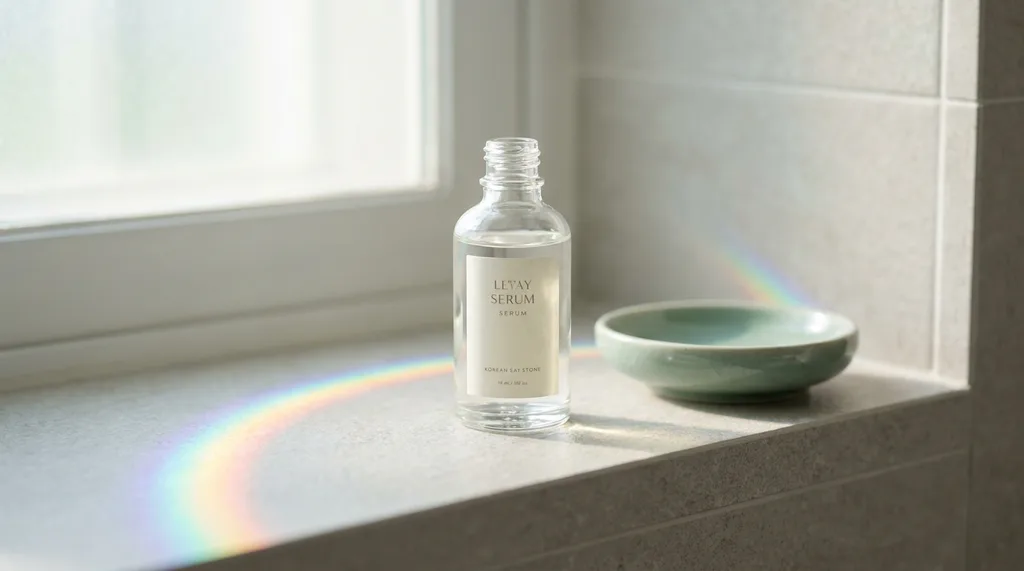
Somewhere in Seoul, a woman in her mid-forties is finishing her morning routine in about four minutes. Two products. Maybe three. Her skin looks like the inside of a seashell held up to light — that particular luminosity that makes you stop mid-conversation and think: what is she doing?
She's not doing more than you. She's doing less. And the reason that gap exists is something the K-Beauty product industry has a profound financial incentive never to explain.
Here's the thing nobody putting together a glass skin tutorial mentions: the rough, uneven texture most people are trying to scrub and layer away? It isn't dead skin waiting to be removed. In most cases, it's a compromised barrier asking you — begging you — to stop. And the harder you chase glass skin with exfoliating acids and vitamin C and back-to-back actives, the further it retreats.
That's the trap. This article is how you get out of it.
The Texture You've Been Misreading
There's a Korean term for the skin frustration that sends people down the 10-step rabbit hole: yocheol — microscopic, sand-like surface irregularities that no amount of toner seems to smooth away. If you've ever run your fingers across your cheeks after a "complete" routine and still felt that faint roughness, you've met it.
The default Western diagnosis is exfoliation deficit. Not enough AHA. Not enough chemical peeling. So the instinct is to reach for a stronger acid, a more aggressive scrub, a glycolic toner. And for a day or two, the skin does look smoother — because you've stripped back the outermost layer. But a week later the yocheol returns, slightly angrier. The cycle accelerates. The barrier gets thinner. The "dehydration" gets worse. The products multiply.
What's actually happening is a condition Korean skincare professionals call sok-geon-jo — internal dehydration. The skin's surface reads as oily or textured, so it gets treated as such. But the root issue is deeper: the lipid matrix of the stratum corneum is damaged, transepidermal water loss is elevated, and the skin keeps producing compensatory sebum to replace what it's losing. You're not looking at excess — you're looking at panic.
[K-Beauty 101] Sok-geon-jo (속건조) — internal skin dryness, distinct from surface dryness. The skin feels tight beneath its surface despite appearing oily or normal on top. Addressing it requires deep penetrating hydration and barrier repair — not heavier creams and not more exfoliation.
This misdiagnosis is why the 10-step routine fails so many people. It was designed to sell ten categories of product, not to cure sok-geon-jo. The real methodology has always been quieter — and it starts with understanding what glass skin biologically is before reaching for a single product.
The Biology Nobody Explains
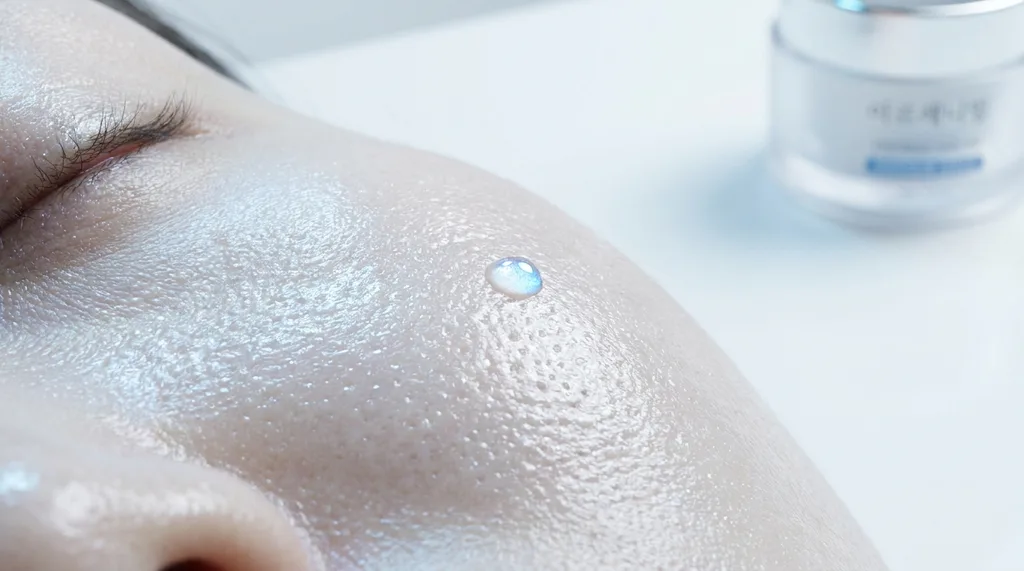
[K-Beauty 101] Yuri-al Pibu (유리알 피부) — literally "glass-bead skin," a complexion so clear and light-refracting it resembles polished glass. The key distinction: this isn't the temporary glow of a face oil or highlighter. It's the way healthy, deeply hydrated skin naturally catches light when the barrier is functioning at full capacity.
The science of glass skin is, at its core, the science of barrier homeostasis.
When the skin's lipid barrier is intact — ceramides in the right ratios, fatty acids plugging the gaps between corneocytes, the skin's pH sitting comfortably around 5.5 — something remarkable happens. Transepidermal water loss (TEWL) drops. The cells of the stratum corneum plump with retained moisture. Light scatters evenly across the surface instead of catching on irregular texture. The result isn't achieved with a product. It emerges from conditions.
The most exciting ingredient science to come out of Korean dermatology research in the last decade centers on fermented filtrates — specifically what they do inside the skin rather than on its surface. When plant compounds are fermented by organisms like Saccharomyces (yeast) or Lactobacillus, complex molecules are broken down into smaller, bioavailable aglycones. These pass through the stratum corneum far more effectively than their unfermented equivalents. What they do on the other side is genuinely remarkable: they stimulate the skin's own production of hyaluronic acid and ceramides, and they activate a pathway called NRF2 — the body's master antioxidant regulator.
NRF2 activation doesn't just fight free radical damage. It modulates the low-grade chronic inflammation researchers now call "inflammaging" — the slow, background fire that degrades collagen, disrupts barrier function, and produces exactly the kind of dull, textured skin that people mistake for needing more exfoliation. In clinical testing, formulations leveraging this mechanism showed a 30.9% improvement in skin barrier function and a 46.2% reduction in sebum production over 28 days. Not by stripping. By restoring.
This is why Korean skincare philosophy has always prioritized fermented essences and filtrates over the vitamin C megadoses and retinol saturation popular in Western routines. The goal isn't to attack the surface. It's to rebuild the conditions from which glass skin naturally appears.
The skin doesn't care how many steps you use. It cares whether those steps are helping or damaging the barrier. That distinction is what splits the results between someone who has "done K-Beauty for two years" and still looks the same, and someone who quietly achieves that luminous quality that turns heads at dinner.
🎵 K-Mono Lofi — Seoul Study Beats
Read deeper with Seoul lo-fi in the background — curated by K-Mono Lofi
Now. The actual method — and why the order of operations matters as much as the products themselves.
The Morning Protocol
The AM routine has one central purpose: protection. You are not correcting, not treating, not aggressively improving anything. You are sealing last night's barrier repair work inside and defending it from everything the day will throw at it.
☀️ AM ROUTINE — Protect & Defend
Step 1 — Gentle Rinse (Purpose: Remove nighttime product residue)
Lukewarm water only — no cleanser. Your skin rebuilt its acid mantle overnight. A cleanser will strip it before 8am. Splash with water, press with a soft muslin cloth. Done.
Step 2 — Softening Toner / Dak-to (Purpose: pH calibration + light exfoliation)
Saturate a cotton pad until it's completely soaked — not damp, soaked. Swipe once across the face following skin texture direction, never against it. This removes overnight flaking and brings the skin's surface pH to 5.5, which unlocks better absorption for everything that follows. Wait 45 seconds.
Step 3 — Hydrating Essence / Chap-to (Purpose: Deep hydration layering)
A few drops into cupped palms. Hold for ten seconds — your body heat thins the formula slightly, improving absorption. Press both palms across your face simultaneously, then hold for a slow count of five. The warmth drives hydration inward. If using the 7-skin method (chil-skin-beop), repeat this motion up to seven times with a water-thin essence, letting each layer go from wet to just-tacky before the next.
Step 4 — Barrier Serum (Purpose: Ceramide + fermented filtrate delivery)
A serum containing ceramides, fermented filtrates, or hyaluronic acid variants. Apply in upward pressing motions — not rubbing strokes. Wait a full 60 seconds before the next step. This is not optional. Rushing the wait time is the single most common reason layering fails to absorb properly.
Step 5 — Light Emulsion or Gel Moisturizer (Purpose: Occlusive seal)
Warm a small amount between fingers, then press — not rub — across cheeks, forehead, chin. Your skin should feel like it has a second skin on top of it: present but weightless.
Step 6 — SPF 50+ (Purpose: The only anti-aging product that matters)
Apply two finger-lengths of sunscreen. Two full fingers. Most people apply a quarter of the tested dose and wonder why it doesn't protect. Korean sunscreen formulas are engineered to layer like a skincare product — finish with patting, not rubbing, to avoid moving your moisturizer underneath.
The Evening Protocol
The PM routine is where the actual rebuilding happens. Your skin's cell renewal peaks between midnight and 2am. Everything you apply after cleansing is being absorbed into a skin that is, biologically speaking, more receptive than at any other point in the day. The evening is not the time for restraint. It is the time for precision.
🌙 PM ROUTINE — Repair & Rebuild
Step 1 — Oil Cleanser / I-jung Se-an Phase One (Purpose: Dissolve, not strip)
A cleansing balm or oil-type cleanser onto dry skin — this is critical. Water deactivates the oil-dissolving chemistry. Massage in circular motions for a minimum of 60 seconds. You are not hurrying. Sunscreen, sebum, airborne particulate — none of these emulsify in under a minute. Add a small amount of water to your fingertips to emulsify, then rinse thoroughly.
Step 2 — pH-Balanced Foam Cleanser / I-jung Se-an Phase Two (Purpose: Barrier-safe removal)
A *yak-san-seong* (mildly acidic, pH 5.5) foaming cleanser. Lather fully in your palms before touching your face — never apply undiluted. Massage for 30 seconds, rinse with water that's skin temperature or cooler. Hot water is a barrier enemy. Pat — never rub — with a clean towel.
Step 3 — Active Treatment (Purpose: Targeted repair while receptivity is highest)
This is your one slot for actives — niacinamide, a low-concentration retinoid, a fermented ampoule. One. Not three. The instinct to stack actives at night is understandable, but layering a retinol on top of a BHA on top of a vitamin C is how you manufacture chemical conflict on your face. Choose the single ingredient most relevant to your current skin concern and let it work in isolation.
Step 4 — Sheet Mask (2–3x per week, Purpose: Intensive hydration pulse)
The *1-il 1-pack* (one mask per day) trend is real among Korean celebrities — but the detail that never makes it into the headlines is *which* kind. A highly occlusive, high-nutrition mask used daily will clog and irritate. Twice or three times a week, a lightweight hydrating or centella-based sheet mask, worn 15–20 minutes and removed before it dries. Pat residual essence in; don't rinse.
Step 5 — Sleeping Pack or Rich Moisturizer (Purpose: Overnight occlusion)
Press — not spread — a generous layer of a ceramide-rich cream or sleeping mask over still-damp skin. The moisture already on your skin is what you're sealing in. If your skin is in a compromised state, this step alone (with a pH-correct cleanser and a simple essence beneath it) will do more for glass skin than any 10-step routine you've run at full speed.
The Korean concept that separates serious practitioners from casual enthusiasts here is hwa-jal-muk — literally "makeup eats well," meaning the skin is so perfectly plumped and balanced that foundation glides on without settling into texture. It's the benchmark. If your morning makeup is caking, your PM repair is incomplete. If it's floating, you're close.
What nobody tells you is that hwa-jal-muk is a lagging indicator. It reflects what your PM routine accomplished 48 hours ago — not last night. This is why consistency over a month quietly outperforms even a perfect routine run sporadically. The cells being rebuilt tonight are the ones that will be visible at the surface three weeks from now.
The insider knowledge most worth protecting lives here. This is the part the 10-step marketing playbook never reaches — because there's no product category to sell around it.
The Philosophy That Outlasts Every Trend
Walk through the K-Beauty editorial landscape from 2013 onwards and you'll watch a quiet rebellion unfold. The same community that invented the 10-step routine began, gradually, to dismantle it. Korean beauty forums started describing a concept called skip-care — not laziness, but a principled reduction. When skin is compromised, overwhelmed, or in a reactive state, the answer is not a new serum. It's removal. Strip back to cleanser, essence, and moisturizer. Let the barrier breathe. Let the NRF2 pathway fire without being interrupted by six competing ingredients.
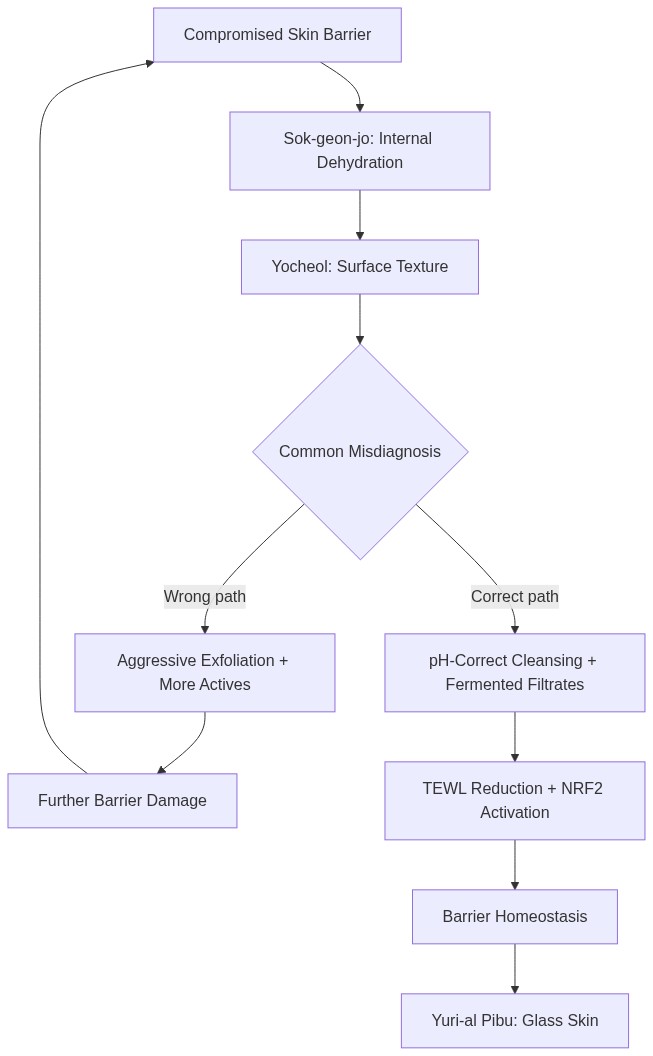
The cycle in that diagram is what most people are stuck in without realizing it. They buy a new toner. The toner contains a mild acid. The barrier, already compromised, reacts with temporary smoothness followed by increased sensitivity. They interpret the sensitivity as a sign they need to build tolerance, so they persist. The barrier doesn't improve. They buy the next product.
The exit from that loop is unglamorous. A "skincare diet" — skincare diet in Korean beauty parlance — means two weeks of nothing but a gentle cleanser and a ceramide moisturizer. No actives. No acids. No brightening agents. Just the two things your barrier actually needs: clean and protected. Most people find it terrifying. Most people also report that their skin has never looked better by the end of week two.
Glass skin was never something waiting to be unlocked by the right product combination. It's what your skin looks like when it's no longer in crisis mode. The reflection, the translucency, the light — that's not applied. That's revealed.
The K-Beauty industry's most honest practitioners know this, even if the marketing around them rarely says it out loud. The deepest beauty tradition in Korean skincare isn't the product. It's the patience. The 40-year-old woman in Seoul with four-minute mornings and luminous skin didn't get there with ten categories of serum. She got there by spending years learning to leave well enough alone.
That's the 80% nobody writes about. You have it now.
Medical & Financial Disclaimer:
⚠️ Disclaimer: The skincare information in this article is educational and does not constitute medical advice. Individual skin responses vary significantly based on skin type, existing conditions, allergies, and the specific formulations used. Before introducing new active ingredients — including retinoids, AHA/BHA exfoliants, and high-concentration niacinamide — perform a patch test on a small area of skin for 24–48 hours. If you have a diagnosed skin condition (eczema, rosacea, perioral dermatitis, psoriasis), consult a board-certified dermatologist before modifying your routine. The clinical data cited reflects specific formulations tested under controlled conditions; results in personal use will vary. No skincare routine is a substitute for professional medical advice, diagnosis, or treatment.
✓ Researched and compiled using verified data as of the publication date.
 Operated by: Quiet Korea | Contact: rsl.2001.1975@gmail.com
Comments
Post a Comment