[Haul & Commerce Review] Glass Skin Masterclass
Walk into any Korean pharmacy and ask what creates glass skin. The answer won't be a product name. It'll be a single concept you've almost certainly never seen on any English-language skincare label: sok-geon-jo — internal dehydration. That word, and what it means for your routine, is where this whole story starts. And it explains why your 10-step routine isn't working.
If you've already been through the science side of this — the barrier biology, the fermentation chemistry, the NRF2 pathway — then you know the philosophy. This piece is the field intelligence. The actual products. The techniques. The honest breakdown of what Korean consumers are buying right now, what insiders consider worth your money, and how to get it regardless of where you live.
What the Korean Community Actually Talks About
The global beauty conversation around glass skin gets stuck on aesthetic outcomes. Flawless skin, luminous finish, no pores. The Korean community — in Olive Young review threads, on Naver Beauty, in Hwahae app comment sections — doesn't talk about glass skin that way. The obsession is diagnostic. The question isn't "what products give me glass skin?" It's: "Is my sok-geon-jo resolved?"
[K-Beauty 101] Sok-geon-jo (속건조) — Internal skin dryness that presents as tightness deep beneath the surface, often masked by surface oil. Korean skincare treats this as the root cause behind most texture problems. The West would call it "dehydrated skin," but the Korean framing is more precise: it's not just about water content, it's about where the water sits — and isn't.
This distinction matters enormously for product selection. When Korean consumers see a rough, sand-papery texture on their skin — what's called yocheol — the instinct is not to reach for an exfoliator. It's to question whether they've been stripping the barrier with the wrong cleanser, over-exfoliating, or layering products incorrectly. Because here's the thing almost no Western beauty brand tells you: that rough texture is frequently a symptom of a compromised barrier trying to retain water. Scrub it, and you accelerate the cycle. Flood it with strategically layered hydration, and it resolves.
This is the local intelligence that separates Korean skincare results from everyone else's. And it shapes every product choice that follows.
The Honest Breakdown — What's Actually Worth Buying
The product category driving the most consistent clinical results in the glass skin segment right now is fermented essence and toner. Not because fermented filtrates are trendy — because the mechanism is genuinely different from conventional humectants.
Saccharomyces and rice ferment filtrates convert large plant compounds into bioactive aglycones with superior skin penetration. They don't just sit on the surface delivering moisture. Clinical data shows they stimulate ceramide and hyaluronic acid synthesis at the cellular level, and activate the NRF2 pathway — the body's endogenous antioxidant defense against inflammaging. In a controlled 28-day trial, products built around this technology showed barrier function improvement of 30.9%, sebum reduction of 46.2%, and firmness improvement of 16.18%. These are not vanity metrics. These are barrier homeostasis metrics.
Here's the honest scorecard for this product category:
The AM Blueprint — Technique Is Everything
The sequence matters because molecular weight is physics. Lighter molecules must go first — they cannot penetrate through a heavier film. This isn't a preference. It's chemistry.
AM, Step 1 — Toner (the dak-to/chap-to sequence): Korean toner use is a two-sub-step process. First, a cotton pad saturated with toner — soaked through, not just damp — is swept gently along the skin's grain to lift any residue and very lightly address surface texture. This is dak-to: wiping toner. Minimal pressure. Let the toner do the work. Then, if your skin runs dry, follow immediately with chap-to: the same toner or a slightly richer version, pressed into the skin with warm palms using rhythmic patting motions. Seven layers, if you're dealing with significant sok-geon-jo. This is the 7-skin method (chil-skin-beop), and it's not theatrical — it's a delivery mechanism.
AM, Step 2 — Essence or Ampoule: This is your fermented active layer. Cup a small amount in both palms, hold it there for three seconds to warm it to skin temperature, then press both palms to your face simultaneously and hold for five seconds. The warmth from your hands opens the skin slightly and improves absorption. Pat — never rub — across cheeks, forehead, and neck with gentle rhythmic strokes. Wait 60 seconds. No exceptions.
AM, Step 3 — Moisturizer: Apply with upward motions. The molecular weight is heavier here; it's sealing the hydration below it, not penetrating. If your skin still feels tight after this layer, your barrier needs more time to heal — not more product. The instinct to add more is how routines collapse into over-layering.
AM, Step 4 — SPF: The only non-negotiable in this entire routine. Apply it after the moisturizer has been fully absorbed — at least 60 seconds. Pressing SPF directly onto a still-damp cream layer dilutes both products.
[K-Beauty 101] Yuri-al Pibu (유리알 피부) — Glass skin. Not a glow you apply, but a glow you earn. The name "glass bead" skin comes from the way deeply hydrated, barrier-intact skin refracts light — not by reflecting it off a surface layer of oil, but by transmitting it through plumped, uniform dermal cells. This distinction is the entire philosophy.
The PM Blueprint — Where Barrier Repair Actually Happens
The evening routine has one priority that the morning routine doesn't: preparation for cellular repair, which peaks between 10pm and 2am. Everything you do in the PM routine is either setting up conditions for that repair or getting out of its way.
PM, Step 1 — Oil Cleanser: This is the most-skipped, most-important step. Sunscreen and sebum are lipophilic — they respond to oil, not water. A cleansing balm or oil cleanser, massaged dry onto dry skin for a full 90 seconds, then emulsified with a small amount of water before rinsing, dissolves the lipid-soluble layer completely. The emulsification step is where most people rush, and it's critical: the white milky texture that forms when you add water to an oil cleanser means it's releasing the dissolved impurities. Rinse that away. Rinse thoroughly.
PM, Step 2 — Foam Cleanser (pH 5.5, nothing stronger): A mildly acidic (yak-san-seong) formula only. The skin's natural pH hovers around 5.5; alkaline cleansers push it up to 8 or 9, which disrupts the acid mantle, the barrier's first line of defense. That "squeaky clean" feeling is a warning sign, not a success signal. The PM foam cleanser should leave skin feeling slightly slippery, never tight.
PM, Steps 3–4 — Treatment and Seal: Your fermented essence goes on immediately after cleansing, while skin is still slightly damp. This is when absorption is highest. Layer it three to five times if you're in active barrier repair mode. Then seal with a rich cream or, if the climate is dry, a facial oil over the cream layer. The seal is what maintains the work overnight.
Getting This Outside Korea — The Global Access Guide
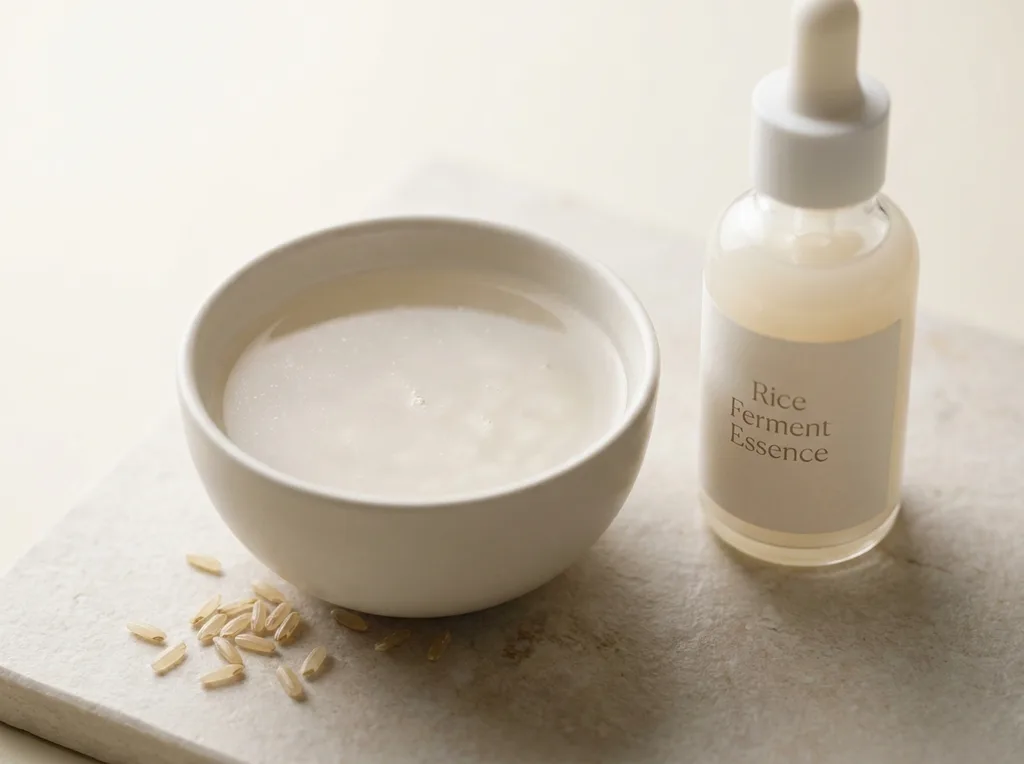
Olive Young's global shipping platform has made direct access to Korean formulations viable for most of the world. Shipping costs are the main variable — consolidating orders is worth it. Look for products with "Saccharomyces Ferment Filtrate" or "Rice Ferment Filtrate (Filtrate/Extract)" as primary INCI names; this is the active technology the clinical data refers to.
For those who prefer sourcing from iHerb — where shipping is often faster and more predictable — the hero ingredients translate cleanly:
- Saccharomyces Ferment Filtrate: look for serums with this INCI name in the top five ingredients
- Ceramide complex formulas: NP, AP, and EOP ceramides together signal a legitimate barrier-repair product
- Centella Asiatica (Cica) extracts: madecassoside and asiaticoside specifically — these are the anti-inflammatory, barrier-rebuilding fractions that matter
The formulation technology that makes Korean fermented products work has no geographic exclusivity. What matters is the ingredient, its concentration, and its position in the formula hierarchy. iHerb carries legitimate formulations across all of these categories. Use code QAK3042 for an additional discount on your order.
🎵 K-Mono Lofi — Seoul Study Beats
Read deeper with Seoul lo-fi in the background — curated by K-Mono Lofi
Where to Go from Here — The Upgrade Path
Once the barrier foundation is established — once sok-geon-jo is resolved and the texture of yocheol has cleared — the next layer is targeted actives.
The sequence is: barrier first, actives second. Always. A vitamin C serum applied to a compromised barrier just irritates. The same serum applied to a healthy, well-hydrated barrier penetrates cleanly and delivers its brightening and antioxidant effects without reactivity.
For the skip-care school (seukip-keo) — those who have pared back to essentials after over-layering — the upgrade path is actually about adding back selectively rather than building up volume. A single well-formulated fermented essence in the evening, a ceramide-rich moisturizer morning and night, and daily SPF. That's the three-product baseline that Korean dermatology keeps coming back to when patients present with reactive or sensitized skin.
The deeper architecture of glass skin — the cultural framework, the barrier philosophy, the fermentation science — is covered in full in the Glass Skin Masterclass:
Read next: → Glass Skin Masterclass — the science behind why fermented filtrates activate your skin's own repair mechanisms, and why Korean women in their 40s have a fundamentally different relationship with aging than their skincare products alone can explain.
Glass skin isn't a look you achieve. It's what your skin looks like when you finally stop fighting it.
⚠️ Medical & Skincare Disclaimer: The information in this article is for educational purposes and does not constitute medical or dermatological advice. Skincare responses are highly individual — what improves one person's barrier may aggravate another's. If you have active skin conditions (eczema, rosacea, fungal acne, dermatitis), consult a board-certified dermatologist before introducing fermented ingredients or new actives. Always patch test new products on the inner arm for 24–48 hours before full application. Clinical data cited reflects study-specific results and may not replicate across all skin types or product formulations.
✓ Researched and compiled using verified data as of the publication date.
 Operated by: Quiet Korea | Contact: rsl.2001.1975@gmail.com
Comments
Post a Comment