How a Financial Crisis Built the World's Most Powerful Beauty Industry
In the winter of 1997, something happened in South Korea that has no real parallel in modern economic history. Ordinary citizens — grandmothers, newlyweds, office workers — lined up outside banks and collection centers carrying small cloth pouches. Inside those pouches were gold wedding rings, family heirlooms, Olympic medals, military decorations. They were donating them. Voluntarily. To save the national economy.
The Geummoueugi Undong (금모으기 운동), the National Gold Collection Campaign, gathered over 225 tons of gold from 3.5 million Koreans in just a few months. It is the single most vivid symbol of what the 1997 IMF financial crisis did to Korea — and what Korea decided to do in response.
Now here is the question nobody asks when they pick up a Korean skincare product at Sephora: what does a national economic catastrophe have to do with the world's most sophisticated beauty industry? The answer is everything. And understanding it will change how you see every K-Beauty product you ever buy.
The Day Korea's Economy Collapsed — and the Beauty Industry Was Reborn
The 1997 Asian financial crisis hit South Korea with surgical violence. The Korean won lost nearly half its value almost overnight. Major corporations — the chaebol (재벌) conglomerates that had defined Korean industrial identity — folded or were forced into emergency restructuring. The era of junghujangdae (중후장대) — the heavy, thick, capital-intensive industries of steel, shipbuilding, and semiconductors that had built Korea's postwar miracle — suddenly looked terrifyingly fragile.
The beauty industry, which had been largely a domestic, conglomerate-controlled sector feeding Korean women standard fare from a handful of large brands, faced a fundamental choice: evolve structurally or disappear.
What emerged from that pressure was not an incremental improvement. It was an architectural reinvention.
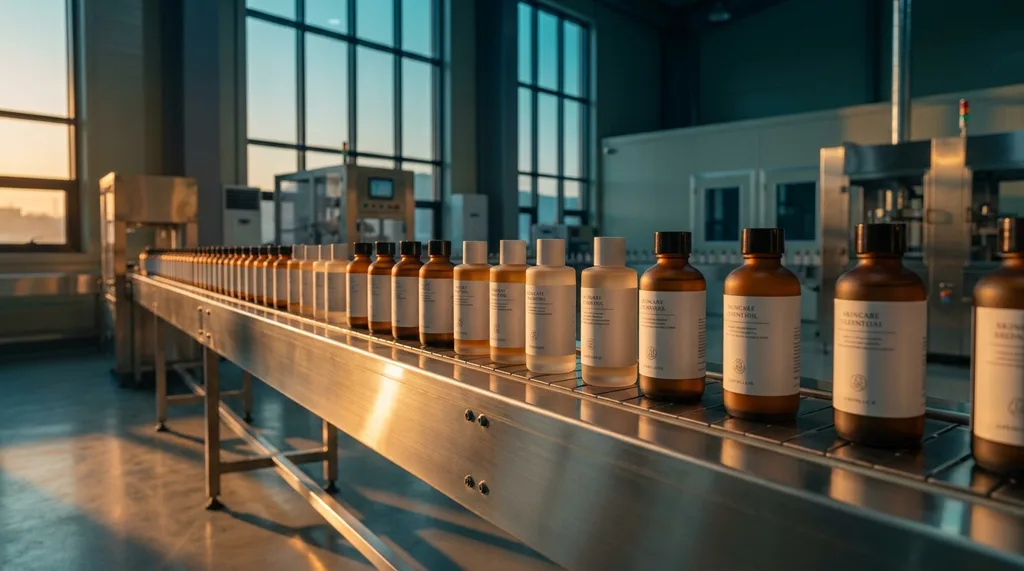
The crisis forced Korean industrial logic to break apart and reassemble into something more agile. Rather than large companies owning every stage of production — from R&D to manufacturing to retail — a new division of labor appeared. Specialized OEM/ODM manufacturing firms rose to become the industry's invisible backbone. Companies like Cosmax and Korea Kolmar built sophisticated, world-class production facilities that any brand — large or tiny — could access on contract. They industrialized the R&D process itself.
[K-Beauty 101] OEM/ODM (Original Equipment Manufacturing / Original Design Manufacturing) — Korea's cosmetics factory infrastructure where thousands of brands access world-class R&D without owning labs. A ten-person indie brand can produce a formula more sophisticated than most Western conglomerates because they share infrastructure with the entire industry.
This is the structural fact that most K-Beauty coverage completely ignores: the reason a two-person Seoul startup can compete with L'Oréal isn't mystical innovation. It's borrowed infrastructure. The crisis forced Korea to build a manufacturing commons — and that commons became the most powerful competitive advantage in the global beauty industry.
🎵 K-Mono Lofi — Seoul Study Beats
Read deeper with Seoul lo-fi in the background — curated by K-Mono Lofi
The Factory Nobody Mentions
Walk into any Olive Young in Seoul and you'll see hundreds of brands. Brands with entirely different aesthetics, price points, ingredient philosophies, target consumers. Some look clinical and dermatologist-adjacent. Others are playful and pastel. A few look like they were designed in a Scandinavian studio. They feel like completely separate universes.
Many of them come from the same factory.
That is not a criticism — it is the entire point. The OEM/ODM system Korea built post-1997 is the reason K-Beauty can move faster than any other beauty market on earth. When a viral ingredient appears — PDRN, exosomes, centella asiatica in a new delivery format — Korean indie brands can have a product formulated, safety-tested, and on shelves in a fraction of the time it takes a Western conglomerate to convene a single development meeting.
The democratization this creates is real and radical. A brand founded by a former dermatology nurse with a specific patient problem to solve doesn't need $50 million in manufacturing capital to bring her formula to market. She calls a Cosmax representative. She accesses the same fermentation vats, the same encapsulation technology, the same stability testing that the biggest names in K-Beauty use. Her product may — and often does — outperform products from companies with a century of history and research budgets she'll never see.
This is the hidden architecture that explains why K-Beauty keeps producing "overnight" success stories that aren't overnight at all. The infrastructure was 27 years in the making.
But here is the honest caveat nobody prints: the same system that enables brilliant indie innovation also enables undifferentiated product flooding. Not every brand using the shared infrastructure is doing something genuinely new. Some are simply relabeling market-tested formulas with a different aesthetic. When you're browsing a ten-page Olive Young shelf of "ceramide barrier creams," a significant number of them may share more DNA than their packaging implies. The OEM/ODM system rewards speed and cost efficiency — which means discernment, for the consumer, matters more than ever.
The Trojan Horse That Wore a Crown
Understanding K-Beauty's manufacturing backbone explains how it could scale globally. It doesn't fully explain why the world was ready to receive it.
That requires a different story — one that starts not in a factory, but in a government ministry.
After 1997, Korean policymakers made a decision that looks, in retrospect, like one of the most effective industrial strategies of the late 20th century. They recognized that Korea's path to economic resilience could not run through heavy industry alone. Soft power — cultural exports — would become the new vehicle. Films, music, television dramas, and everything downstream from them: food, fashion, and beauty.
This is the origin story of Hallyu (한류), the Korean Wave.
[K-Beauty 101] Hallyu (한류) — The global spread of Korean culture beginning in the late 1990s. Not a spontaneous cultural phenomenon: partially engineered by Korean government cultural export policy following the 1997 financial crisis. The context that makes K-Beauty's global reach make sense. Without Hallyu, K-Beauty looks like a lucky trend. With it, it looks like a strategy.
Korean drama stars became, inadvertently and then very deliberately, beauty advertisements watched by hundreds of millions of people across Asia and eventually the world. A heroine in a Korean drama does not just have good acting — she has extraordinary skin. Not glamorous Hollywood skin, either. Something different: translucent, hydrated, alive. The Korean beauty standard of tong-tong — round, firm, almost luminous — became aspirational not through a marketing campaign but through storytelling. Through narrative empathy. Through 16 episodes of watching someone you cared about, noticing the texture of her cheek in a rain scene.
When those viewers went looking for what she was using, Korea had the products ready. The OEM/ODM infrastructure meant supply could meet the demand that culture created. Hallyu was the desire-generation engine. The manufacturing ecosystem was the fulfillment infrastructure. They were, together, a machine.
Amorepacific (아모레퍼시픽) understood this before almost anyone. Founded in 1945 from a single jar of camellia hair oil, Amorepacific is the institution whose arc is inseparable from the arc of modern Korea — surviving occupation, war, dictatorship, financial crisis, and now global expansion. Its brands — Sulwhasoo, Laneige, Innisfree, Etude — span every price point and aesthetic from Joseon dynasty herbal luxury to millennial pastel pop. When Hallyu opened doors across Asia, Amorepacific walked through them already carrying a full portfolio.

The $11.4 Billion After
The numbers at the end of this story are almost difficult to process in context.
In 2024, Korea's beauty exports crossed $10.23 billion — a milestone the industry had been building toward for a decade. In 2025, they reached $11.4 billion, a record. In just the first five months of 2026, exports hit $5.6 billion. Korea now exports beauty products to 202 countries, generating a trade surplus in cosmetics that exceeds $10 billion annually. It has surpassed the United States to become the world's second-largest cosmetics exporter, behind only France — a country with centuries of luxury heritage and conglomerates like LVMH behind it.
Korea built this in 27 years. Starting from a financial crisis that required citizens to donate their wedding rings.
But the story does not stop with the numbers, and this is where K-Beauty 2.0 begins — and where the honest complications emerge.
📦 K-Beauty 1.0 (2011–2018)
Driver: Viral product moments (BB cream, sheet masks, 10-step routine)
Primary Market: China (>30% of exports)
Risk: Geopolitical dependency; local Chinese competitors rising fast
Model: Volume-based, trend-chasing
🔬 K-Beauty 2.0 (2020–Present)
Driver: Dermatological science (PDRN, exosomes, advanced peptides)
Primary Market: USA & Western Europe (fastest-growing segments)
Risk: Premiumization pressure; ingredient science claims need scrutiny
Model: Brand equity-building, clinic-to-shelf pipeline
The pivot away from China was not a choice — it was a necessity. Geopolitical tension and the meteoric rise of domestic Chinese beauty brands forced Korea's hand. What followed was a strategic reorientation toward Western markets, and with it a shift in what K-Beauty means. K-Beauty 1.0 was about novelty. K-Beauty 2.0 is about credibility.
This shift carries genuine risks that the industry's breathless coverage rarely acknowledges. Premiumization is a strategy that requires trust to work — and trust requires transparency about what ingredients actually do at what concentrations. Some of the frontier ingredients in K-Beauty 2.0 marketing (exosomes, in particular) are scientifically promising but still early-stage in terms of topical efficacy evidence. When a brand leverages its country's clinical reputation to sell products that haven't cleared the same evidentiary bar as that reputation implies, it borrows against the trust the entire industry spent decades building. If Western consumers — already well-educated and increasingly skeptical of skincare claims — experience a wave of over-promised, under-delivered "medical" products, the K-Beauty 2.0 narrative takes damage that will be hard to repair.
The history demands that we hold both things simultaneously: genuine, structurally superior innovation, and a marketing culture that sometimes outruns its own science.
Reading the Landscape — What This History Actually Tells You
Understanding how K-Beauty was built is not academic. It changes how you navigate the market.
First: When you see a small Korean indie brand making claims that sound too sophisticated for a ten-person company, don't dismiss it. The OEM/ODM infrastructure means their formula may genuinely have been developed by the same R&D talent as products from conglomerates fifty times their size. Evaluate the formula. Don't penalize the brand for being small.
Second: When you see "dermatologist-tested" and "clinical-grade" on a K-Beauty 2.0 product, ask the harder question — tested for what, at what concentration, for how long? Korea's dermatological clinic culture is genuinely world-class, and the pipeline from clinic to shelf is real. But the term "clinic-inspired" has also become a marketing genre as much as a formulation category. The two are not the same.
Third: The geographic pivot matters to you as a consumer. Products originally designed for the Korean market — particularly lighter textures calibrated for Korean environmental conditions and skin types — are increasingly being reformulated for Western skin diversity. Newer launches from major Korean brands targeting US and European markets often have different concentrations and textures than their domestic equivalents. If you're ordering a product shipped directly from Korea versus buying a Western-market distribution version, they may not be identical.
Fourth: Hallyu is not slowing down. The live commerce market around K-Beauty products — essentially real-time shopping broadcasts — was worth $678 million in 2024 and is projected to reach $4 billion by 2030. The cultural engine that started with a government policy decision in 1997 is now a self-sustaining machine. K-Beauty's reach will expand not because Korea produces more, but because its cultural distribution infrastructure — streaming, live commerce, global social media — is permanently wired into global consumer behavior.
The 225 tons of gold that Korean citizens donated in 1997 could not have bought what they built instead: an industrial ecosystem so well-designed that it turned cultural influence into a delivery mechanism for one of the world's most sophisticated consumer product industries.
K-Beauty didn't win the beauty world by being trendy. It won by being engineered — and the engineering started on the day Korea nearly ran out of money.
Medical & Financial Disclaimer:
⚠️ Disclaimer: This article is for educational and informational purposes only and does not constitute medical, dermatological, or financial advice. Skincare products — including those referenced in this article — may cause reactions in individuals with sensitivities or allergies. Always conduct a patch test before introducing new products to your routine, and consult a board-certified dermatologist before using active-ingredient formulations if you have a diagnosed skin condition, are pregnant, or are taking medications with known topical interactions. Market projections and export figures cited reflect published data at the time of research and should not be used as the basis for investment decisions.
✓ Researched and compiled using verified data as of the publication date.
 Operated by: Quiet Korea | Contact: rsl.2001.1975@gmail.com
Comments
Post a Comment