K-Beauty for Melanin-Rich Skin: The Honest Dupe Map
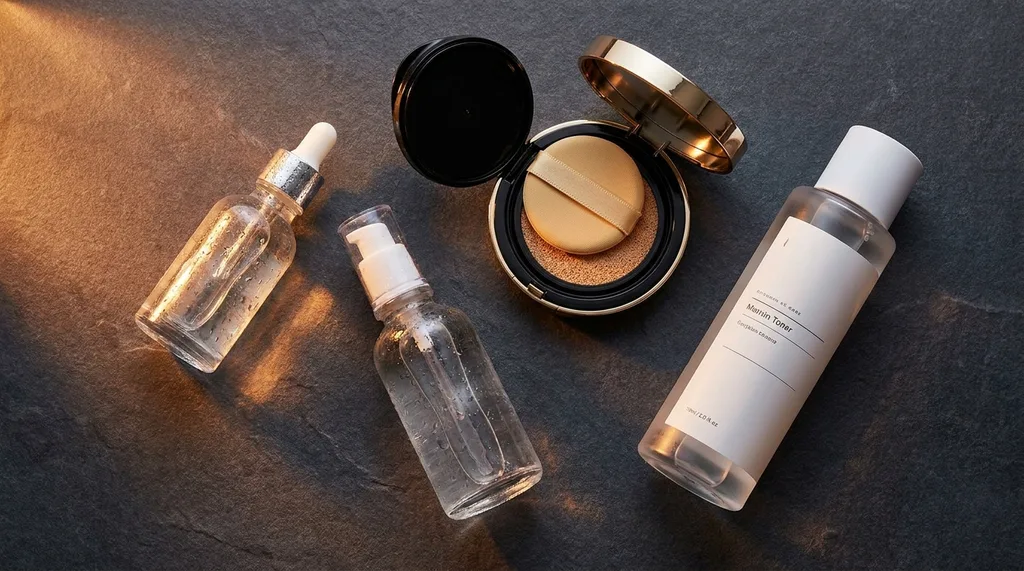
There's a word Koreans coined for a very specific kind of beauty exhaustion: 파데 유목민 (Pade Yumokmin) — the Foundation Nomad. It describes someone who has tried every brand, bought every shade, and still cannot find the one that looks like them rather than like a slightly different version of someone else. Korean beauty communities were documenting this frustration with their own vocabulary before "shade inclusion" became a global industry mandate. The irony is that melanin-rich consumers around the world have been living that same nomadic existence — often because of the very Korean brands who coined the term.
That tension is exactly where this guide starts. Not at the comfortable end, where brands wave expanded shade ranges as proof of progress, but at the honest middle: K-Beauty's skincare science and its cosmetics industry are two entirely different stories, and conflating them has cost darker-skinned consumers real money and real skin damage.
Here's what nobody maps cleanly: the science behind K-Beauty was never designed around a specific skin tone. The barrier repair philosophy, the low-pH cleansing system, the layered hydration approach — these work on a biological level that melanin content doesn't override. In some cases, they work better for melanin-rich skin than for the East Asian complexions they were originally marketed toward. But walk into the makeup aisle of any Olive Young, and you'll find a shade story that is only now being rewritten. Understanding which half you're dealing with is the most valuable thing this article can give you.
🎵 K-Mono Lofi — Seoul Study Beats
Read deeper with Seoul lo-fi in the background — curated by K-Mono Lofi
The Skincare Science That Was Never About Shade
[K-Beauty 101] 피부 장벽 (Pibu Jangbyeok) — Skin barrier. In the context of melanin-rich skin, this concept carries unusual weight: barrier disruption triggers Post-Inflammatory Hyperpigmentation (PIH) at a rate that lighter skin tones simply don't experience as severely. K-Beauty's obsession with barrier preservation isn't just philosophy — for deeper skin tones, it's clinical necessity.
The mechanism matters here. Melanin-rich skin has a structurally sound barrier in its native state, but it reacts to disruption — over-exfoliation, alkaline cleansers, aggressive actives — with inflammatory responses that deposit melanin unevenly. This is PIH, and it's the skincare concern that dermatologists working with Fitzpatrick IV–VI patients deal with constantly. Western dermatology's historical answer has often been prescription retinoids or hydroquinone — effective, but heavy-handed.
K-Beauty took a different approach by accident. The emphasis on low-pH cleansers preserves the skin's acid mantle, reducing the micro-inflammatory events that trigger PIH. The layered hydration system — toner, essence, serum, moisturizer in thin sequential layers — builds transepidermal water retention without the occlusive heaviness that can clog pores on skins that produce more sebum. And the formulation philosophy around barrier-calming actives like Centella Asiatica addresses inflammation at the source, before it becomes a dark spot.
None of this was engineered with a Nigerian complexion or an Indian skin tone in mind. It was engineered for the specific anxieties of East Asian skincare culture. But the biology aligned remarkably well with what melanin-rich skin actually needs.
The most direct overlap is niacinamide.
[K-Beauty 101] 나이아신아마이드 (Niacinamide) — Vitamin B3. Clinically validated for reducing melanin transfer between cells (thereby addressing hyperpigmentation), supporting barrier function, and regulating sebum. Korean formulations frequently deliver it at 2–5% concentrations with well-constructed supporting formulas — making K-Beauty one of the most reliable global sources of effective niacinamide skincare at multiple price points.
Korean brands have been formulating niacinamide into serums, toners, and moisturizers for years, at concentrations that actually move the needle on hyperpigmentation. The ingredient was almost prescient in its alignment with what melanin-rich skin requires. When you find it in the skincare aisle at effective concentrations, that's not a coincidence of trend — it's a convergence of Korean cosmetic chemistry and your skin's actual biology.
Where the risk lives: Not every "brightening" product is safe for deeper skin tones. Certain chemical exfoliants — particularly high-percentage AHAs marketed for "glow" — can trigger PIH if the formulation isn't calibrated carefully. The K-Beauty industry's regulatory term 미백 (Mibaek) translates to "brightening" in the MFDS framework, meaning inhibition of melanin production in hyperpigmented areas — not bleaching. The science is sound. But some K-Beauty products lean on fragrance and alcohol in ways that compromise barrier integrity for reactive skin types, which for melanin-rich skin means PIH risk. Read the INCI list, not the marketing copy.
The Cosmetics Problem — Where the Industry Actually Failed
Now the harder story.
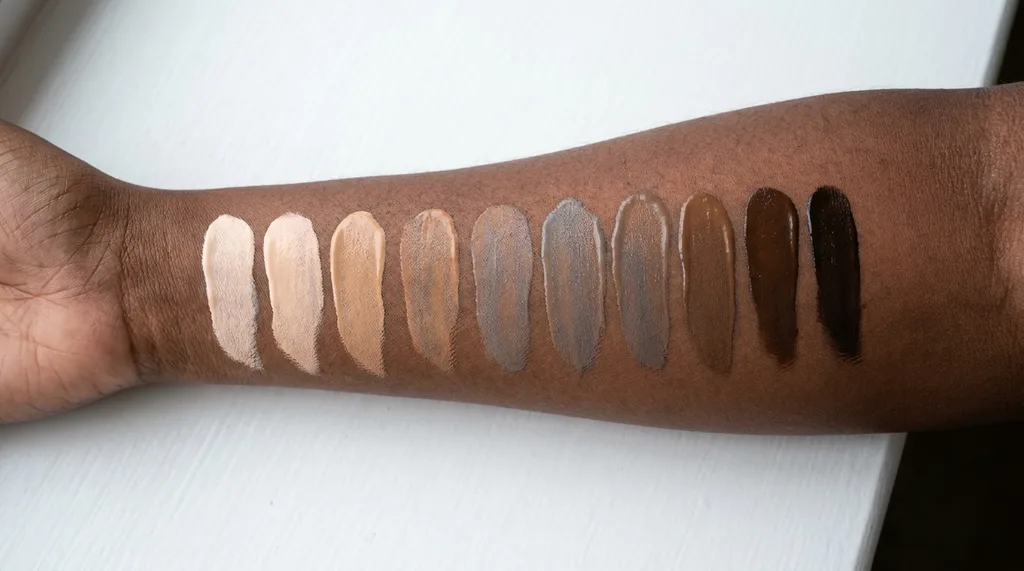
Put on the wrong Korean cushion foundation and you risk 회기 (Hoe-gi) — that ashen, drained, grayish cast that settles onto deeper skin tones like dust. It happens when a formula lacks the warm-spectrum pigments needed to interact with higher melanin content, when the undertone assumptions are locked to cool-neutral East Asian baselines, and when the photographic testing was done under conditions where a deeper complexion never appeared. It's not a subtle miss. It's visible in fluorescent light, in photographs, in the mirror at 7am. And it's the reason millions of melanin-rich consumers wrote K-Beauty makeup off entirely.
The structural reason: Korean foundations were historically tested, color-matched, and consumer-validated against a narrow Fitzpatrick I–III range. The brand vocabulary didn't have strong vocabulary for warm-depth undertones in deeper skin. The shade naming conventions — numbered systems like "21" and "23" — weren't built to scale. And when a brand offers fourteen cushion shades designed for that narrow band, the mathematics of inclusion simply don't work.
The honest reckoning: the problem wasn't malice. It was market design. Korean brands built for Korean consumers, used Korean panel testers, and marketed outward without rebuilding the foundation (literally). The result was exclusion by default rather than by intent — which doesn't make it less real for the consumer who bought the wrong shade and couldn't return it.
What's Genuinely Changing — and the Question Nobody Asks

The most cited evidence of change is TirTir's cushion shade expansion: from 3 shades to over 45. That's not a soft pivot — that's a structural rebuild of the product line, driven by colorimetric research and global consumer feedback. When a brand goes from 3 to 45, something real shifted in the engineering room, not just the marketing deck.
Innisfree extended its cushion range to 14 shades — smaller movement, but still directional. And Amorepacific's AI-driven manufacturing system represents perhaps the most consequential development in K-Beauty's inclusion story: real-time skin diagnostics drawing on accumulated skin data, combined with robotic manufacturing that can produce over 200 foundation variants. The technical ambition is real. The 착붙 (Chak-but) — that perfect adhesion where foundation becomes indistinguishable from skin — is theoretically achievable for any complexion when the pigment engineering is precise enough.

But here's the question nobody asks about an AI system built on 78 years of accumulated skin data: whose skin?
Seventy-eight years of Amorepacific data is, almost by definition, predominantly East Asian skin data. That doesn't invalidate the technology — the diagnostic precision is genuinely impressive, and the manufacturing flexibility is real. But applying a model trained on one skin population to optimize for another is a calibration challenge, not a solved problem. The brands making real progress acknowledge this. The ones making marketing progress gloss over it. The difference matters when you're deciding where to put your money.
For a deeper understanding of how K-Beauty's skincare and cosmetics systems intersect with different skin tones, read: Beyond Shade 21: An Honest Map of K-Beauty for Melanin-Rich Skin
The Dupe Map — Where to Actually Put Your Money
This is what every previous article on this topic should have given you and didn't. A clear, category-by-category verdict on where K-Beauty earns your budget versus where you should look elsewhere — or wait.
✅ Spend Here — K-Beauty Wins
Low-pH cleansers: Barrier-safe, acid-mantle preserving. Reduces PIH triggers at step one. Often dramatically cheaper than Western equivalents with superior pH calibration.
Niacinamide serums (2–5%): K-Beauty delivers this at clinical concentrations with well-constructed supporting formulas. The intersection with hyperpigmentation science is direct.
Centella Asiatica (Cica) treatments: Anti-inflammatory action upstream of PIH formation. Highly relevant for reactive, post-procedure, or chronically sensitized deeper skin.
Hydrating toners and essences: Layered hydration addresses 수부지 (suboji) — combination-dehydrated — patterns common in melanin-rich skin that are frequently misdiagnosed as simply oily.
⚠️ Proceed With Specificity — Cosmetics
Cushion foundations: Only buy from brands with documented 30+ shade ranges and undertone variety. TirTir's 45+ shade expansion is the current K-Beauty benchmark. Verify swatches on actual deeper complexions, not interpolated digital renders.
Sunscreens: K-Beauty SPF formulas are technically exceptional (broad-spectrum, elegant textures, no white cast in newer chemical-filter versions). But "no white cast" claims should be verified for Fitzpatrick V–VI specifically before committing — some formulations still cast gray.
Lip and blush: Pigment density in K-Beauty color products was historically calibrated for lighter skin, meaning sheerer finishes may not show. Seek products described as "buildable" or with full-pigment formulas.
The honest verdict on sunscreen, because it comes up constantly: K-Beauty's sunscreen technology — particularly the newer UV filters like Tinosorb S and Uvinul A Plus — produces formulas that feel nothing like the chalky Western SPF experience. For Fitzpatrick III–IV skin, these are genuinely transformative. For Fitzpatrick V–VI, the "no white cast" promise is brand-specific and still inconsistent. Test on your jawline before buying a full bottle. The science is excellent. The finishing calibration hasn't caught up uniformly.
The Actionable Three — What To Do Today
Step 1: Start with the skincare side, where the science is already on your side. A low-pH cleanser, a niacinamide serum at 4–5%, and a ceramide-based moisturizer form the core K-Beauty framework that works independently of your Fitzpatrick type. This combination addresses the barrier disruption that produces PIH — which is the root problem for most melanin-rich skin concerns, not any single dark spot.
Step 2: For K-Beauty makeup, shop with two filters active simultaneously. Filter one: does the brand have more than 30 shades, with documented undertone variety across warm, neutral, and cool lines — not just depth variety? Filter two: are swatches shown on Fitzpatrick V–VI skin in official brand photography? Both filters together narrow the field quickly. TirTir passes both currently. Research newer launches as the market continues to shift.
Step 3: Use the 찰떡 (Chaltteok) test. That Korean concept — "sticky rice cake," meaning a product that becomes indistinguishable from your skin — is the only real measure. Not the shade number on the bottle, not the undertone category on the website. Match, test, photograph in natural light. If it reads as your skin and not as a product sitting on top of it, you've found your 찰떡 moment. K-Beauty is getting better at making that moment possible for every complexion. It's not there uniformly yet. But the direction is real.
The skincare philosophy was always yours to use. The cosmetics industry is catching up. Knowing which is which saves you money, protects your skin, and makes every purchase decision a calibrated one rather than a gamble.
The science was never the problem. The packaging was. And packaging can be changed.
⚠️ Medical & Skincare Disclaimer: This article provides educational information about K-Beauty ingredients and products as they relate to diverse skin tones and hyperpigmentation. It is not a substitute for professional dermatological advice. Melanin-rich skin and conditions such as post-inflammatory hyperpigmentation (PIH) vary significantly between individuals. Before introducing new active ingredients (including niacinamide, AHAs, or Centella Asiatica formulations), perform a patch test and, if you have an existing skin condition, consult a board-certified dermatologist familiar with Fitzpatrick IV–VI skin types. The regulatory term Mibaek (brightening) as defined by Korea's MFDS refers to inhibition of melanin production in hyperpigmented areas — it does not imply bleaching. Results from any skincare product vary by individual.
✓ Researched and compiled using verified data as of the publication date.
 Operated by: Quiet Korea | Contact: rsl.2001.1975@gmail.com
Comments
Post a Comment