[Real Value Report] 14 Kbeauty Dark Side
Walk into any Korean convenience store the night before a first date, a job interview, or a high school reunion, and you'll see something that tells you everything about this industry: the young woman standing in the skincare aisle isn't reading the packaging. She's on her phone, in an app called Hwahae (화해), running the product's ingredients through a crowd-sourced safety database before she'll spend twelve dollars on it.
- What's Actually in the Jar
- The Whitening Wall — A Colonial Legacy in Your Moisturizer
- The Lookism Machine — When Beauty Becomes the Price of Admission
- The Counterfeit Problem Nobody Talks About in the Haul Videos
- The 2031 Reckoning — What's Actually Changing
- How to Navigate K-Beauty Without Being Naive
- Explore Clinically-Backed K-Beauty Actives
Korean consumers built their own fact-checking infrastructure for Korean products. Let that sink in.
That is the unreported story inside the $11.4 billion export juggernaut the world calls K-Beauty. Not the glass skin tutorials. Not the ten-step routine. The fact that the people closest to this industry — the ones who grew up inside it, who buy it every week, who know the formulation gossip and the dermatology waiting room whispers — designed their own defense against it.
And now the government has joined them. In 2025, South Korea's Ministry of Food and Drug Safety (MFDS) announced the most sweeping cosmetic regulatory overhaul in the country's history, a system designed to mirror EU standards, with full implementation required by 2031. The question worth sitting with isn't what the new rules say. It's what made them necessary.
What's Actually in the Jar
There is a data point from recent safety assessments that never makes it into influencer hauls or brand announcements. In testing of face creams across the Korean market, mercury concentrations ranged from undetectable to 67,000 mg/kg.
To put that in context: international cosmetic safety standards treat 1 mg/kg as the threshold for concern. The upper end of what researchers found in some products is sixty-seven thousand times that threshold. Not sixty-seven percent over the line. Sixty-seven thousand times.
This is not a story about K-Beauty being uniquely dangerous. Every major beauty market has contamination problems; the American, European, and Chinese markets have their own documented horror shows. What makes this worth examining here is the gap between the industry's carefully cultivated image — the "clean beauty" messaging, the 100% natural claims, the pastel packaging and fermented botanical rhetoric — and the laboratory reality that a regulatory system built on product registration rather than pre-market safety proof allowed to exist.
The synthetic colorant data tells a quieter but equally important story. Amaranth (Red 2), a dye used across cosmetics, absorbs into skin at 3.4% in lotion formulations — but at 0% in cream formulations. The absorption difference comes down to vehicle chemistry, not ingredient inherency. The same molecule, in two different formula textures, behaves completely differently on the skin barrier. The average consumer has no way of knowing this. The average brand has no regulatory obligation to disclose it.
This is the gap the new safety assessment system — which will require what Korean law is calling mandatory "product lifecycle safety evaluation" — is designed to close.
🎵 K-Mono Lofi — Seoul Study Beats
Read deeper with Seoul lo-fi in the background — curated by K-Mono Lofi
The abolition of Korea's government-run "Natural and Organic" cosmetics certification system in August 2025 added another layer to this. The government didn't just walk away from the category — it handed the burden of proof entirely to manufacturers, requiring self-regulation under ISO 16128 standards. The marketing language stayed. The official guarantee evaporated.
The Whitening Wall — A Colonial Legacy in Your Moisturizer
[K-Beauty 101] Hwaiteuning (화이트닝) — Skin-brightening products designed to reduce melanin production. One of K-Beauty's largest and most globally contested export categories, with roots stretching back through Japanese colonial-era aesthetics and deeper into Joseon dynasty class signifiers, where pale skin marked aristocratic lineage and indoor life.
In Seoul's Olive Young stores, the "whitening" (or, in its increasingly preferred marketing euphemism, "brightening") category occupies more shelf space than any other single skin concern. These products are sophisticated. Many of them work — niacinamide, arbutin, tranexamic acid, and vitamin C derivatives used in these formulas have legitimate clinical support for reducing hyperpigmentation.
But understanding the market requires understanding why it is so large, and the answer isn't purely about skincare science. Korean aesthetic values around pale skin predate Western influence significantly. Joseon-era poetry celebrated women whose skin evoked moonlight. But those values were amplified, systematized, and commercially weaponized during the Japanese colonial period (1910–1945), when beauty standards were used as a tool of cultural assimilation, and again in Korea's postwar modernization, when American beauty norms added another layer of pressure.
What makes this genuinely uncomfortable isn't debating whether individuals should be allowed to lighten their skin — that debate ignores personal agency in ways that aren't useful. What's uncomfortable is recognizing that an industry generating billions in revenue was built on anxiety that wasn't organic. The anxiety was manufactured and fed by decades of messaging that darker skin equated to rural poverty, outdoor labor, and social diminishment. The products are real. The science in many of them is real. But the problem they're selling solutions to was, in no small part, manufactured by the same cultural machinery that profits from solving it.
Younger Korean consumers and feminist critics are increasingly vocal about this. The industry has heard them — "whitening" is being slowly rebranded as "brightening" or "luminance" in product marketing. The linguistic shift does not resolve the underlying question.
For global consumers purchasing these products: the formulas are often genuinely effective for hyperpigmentation concerns regardless of their cultural context. But knowing what you're buying into matters. The product in your hand is a piece of real science. The market it comes from is also a piece of real history.
The Lookism Machine — When Beauty Becomes the Price of Admission
[K-Beauty 101] Oemmo chabyeol (외모 차별) — Appearance discrimination: documented employment and social disadvantage based on physical looks. In Korea, submitting a photograph with a resume is standard practice, and open discussion of a candidate's appearance in hiring contexts remains legal and commonplace in ways that would be prohibited in many Western jurisdictions.
There is a version of the K-Beauty story that presents the industry's scale as evidence of a culture that simply loves skincare. This version is not wrong. It is incomplete.
The fuller version requires acknowledging 외모 차별 as the structural foundation beneath the market. Korean research has documented that attractive candidates receive measurably better outcomes in hiring, salary negotiation, and professional advancement. This isn't opinion or social theory — it's empirically measured. The beauty industry does not exist despite this pressure system. It exists, in significant part, because of it.
This is where the story of 성형 (seonghyeong) — Korea's cosmetic surgery culture — becomes relevant to a skincare conversation. Korea has one of the highest rates of cosmetic surgery per capita in the world, concentrated particularly among women entering the job market. The surgical skills developed in Korean clinics are genuinely world-class; Korean plastic surgeons are sought by patients globally for their precision and innovation. But that same skill is also being deployed within a system that tells young women their unmodified faces are a professional liability.
The beauty anxiety ecosystem this creates doesn't stop at surgery. It extends into a skincare market that targets teenagers with products designed for "pore correction," "brightening," and "anti-aging" — marketed to sixteen-year-olds who have no aging to address. The Hwahae app's largest demographic skews young. The K-Beauty industry's success, particularly in domestic market saturation, is partly a measure of how effectively it has turned normal skin into a problem requiring solutions.
This is not an argument against skincare. It is an argument for being honest about the difference between caring for your skin and being afraid of it. K-Beauty, at its best, teaches the former. The market infrastructure around it often monetizes the latter.
Loving something means seeing it clearly — including the parts that need naming.
The Counterfeit Problem Nobody Talks About in the Haul Videos
The global demand for K-Beauty has created a parallel economy that the industry's growth metrics don't capture: a sophisticated counterfeit market that has scaled alongside the legitimate one.
As Korean brands have expanded globally, counterfeit operations have kept pace with terrifying technical precision — replicating holograms, barcodes, and packaging to a quality where experienced consumers frequently cannot distinguish authentic products from fakes. The industry's standard response — "buy from authorized retailers only" — places the burden of verification on consumers navigating a fragmented global distribution landscape where unofficial community marketplaces remain many shoppers' most accessible (and often cheapest) point of purchase.
What makes this more than a consumer protection issue is the safety dimension. A counterfeit product carrying a trusted K-Beauty brand's packaging may contain anything. The mercury contamination data discussed earlier? Counterfeit whitening products are one of the documented sources of heavy metal contamination in cosmetics markets globally. When the product in your hand says one thing and contains another, the brand's innovation and clinical testing become irrelevant.
The new MFDS regulatory framework includes post-market surveillance provisions specifically designed to address this. But surveillance of a global informal marketplace is an infrastructural problem without a clean solution.
The 2031 Reckoning — What's Actually Changing
The regulatory transformation underway isn't cosmetic (forgive the word). It represents a structural shift in how Korea defines liability in the beauty industry.
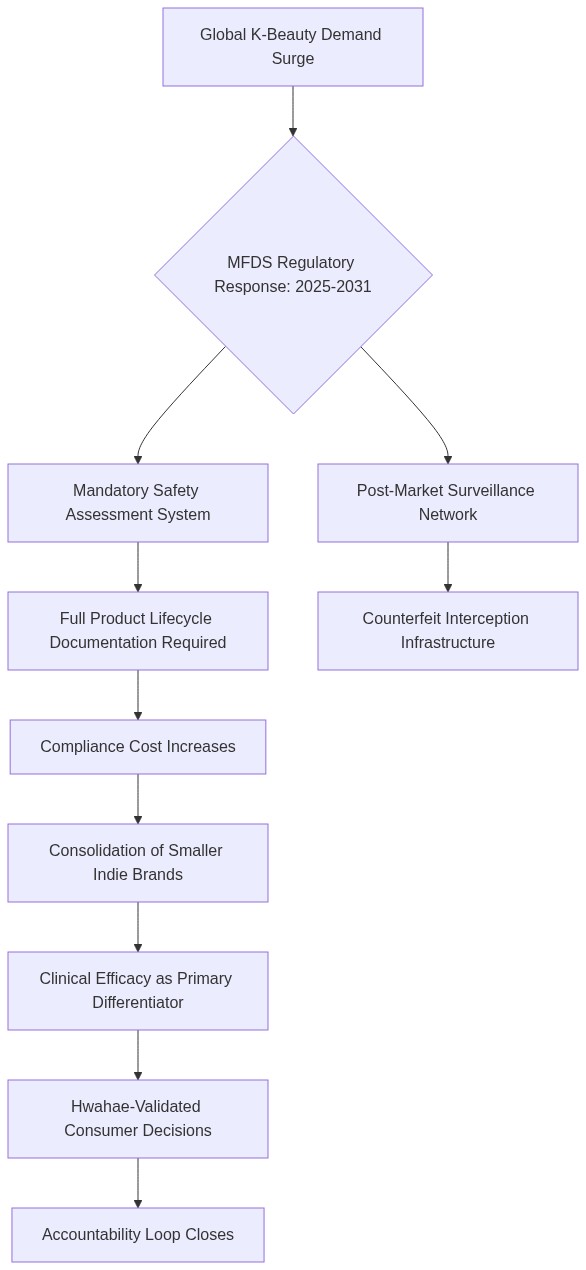
The key shift is in the concept of the "Hwajangpum Chaekim Panmaeeopja" — the Cosmetics Responsible Seller — a legal designation that transforms the brand's role from passive distributor to active safety guarantor with full product lifecycle accountability. By 2031, every entity in this category must maintain comprehensive safety reports meeting EU-equivalent standards. Registration-only compliance, where a product could reach shelves without rigorous pre-market safety proof, is being dismantled.
What this means in practice: indie brands with thin margins will face consolidation pressure. Brands that have been coasting on marketing narratives rather than clinical substantiation will face either the cost of actual science or the consequence of failing to produce it. The "natural/organic" claims that previously relied on government certification now require manufacturers to substantiate their own standards under ISO 16128.
This is genuinely good news. It comes about fifteen years later than it should have.
The $36.2 billion clinical K-Beauty market projected for 2034 isn't a fantasy number — it reflects the direction the industry is actually heading, toward PDRN, exosomes, peptides, and evidence-backed active formulations that can withstand the scrutiny of the regulatory environment being built around them. The clinical investment is happening because the regulatory pressure is real.
How to Navigate K-Beauty Without Being Naive
Here is what the best-informed Korean consumers already know, applied to a global audience:
✅ What the science actually supports
- Layered hydration with pH-appropriate toners
- Niacinamide for brightening (clinically validated at 4–5%)
- Sunscreen as the non-negotiable foundation of any routine
- PDRN and peptide serums for barrier repair (emerging strong clinical base)
- Centella Asiatica for inflammation and sensitivity
⚠️ What dermatologists in Seoul are actually warning against
- Daily sheet masking (documented barrier disruption from occlusion + surfactant residue)
- "Skin detox" sauna claims (sweat glands don't detoxify; this is marketing, not physiology)
- Layering more than 4–5 active products simultaneously
- Using whitening products without SPF (photosensitivity risk)
- Purchasing K-Beauty from unverified third-party resellers
The actionable steps, in order of impact:
1. Use Hwahae logic, wherever you are. The principles the app applies — check ingredient position in the INCI list, check for known irritants, verify active concentration claims — work on any product from any country. INCI Decoder and CosDNA serve the same function in English.
2. Distinguish between the practice and the product. Many K-Beauty rituals are genuinely effective. Some exist because the industry needs to sell more products, not because your skin needs more steps. Daily exfoliation plus daily sheet masking plus multiple actives is a recipe for compromise, not optimization.
3. On whitening products: read the active, not the marketing. Niacinamide, arbutin, and tranexamic acid in brightening products have legitimate clinical support. Products that don't list a specific brightening active — just "natural extracts" and "brightening complex" — are selling you an aspiration, not a mechanism.
4. Verify purchase channels for high-value products. Olive Young's global platform, brand-direct websites, and Korean retail giants (Coupang's global service, W2Beauty) offer more authentication security than informal resellers, where counterfeit risk concentrates.
5. Reframe the relationship. The best thing K-Beauty ever gave the world wasn't a specific product — it was the cultural insistence that skin deserves daily care and attention. That practice, stripped of the anxiety and the marketing, is genuinely valuable. The glass skin ideal? That's optional. The idea that your skin is worth knowing? Keep that one.
Korea's beauty industry has produced some of the most sophisticated skincare science on earth. It has also produced a beauty anxiety ecosystem, a skin-whitening industry with colonial roots it is still reckoning with, and a regulatory environment that was, until recently, more permissive than the innovation it housed required. All of those things are simultaneously true.
The most honest form of respect for something you love is seeing it whole — the brilliant and the broken, the innovation and the cost, the product in your hand and the system that built it.
The brands reformulating away from "whitening" toward transparent brightening actives, the indie labs publishing their own safety data, the consumers using Hwahae to hold the industry accountable — these are signs that Korea's beauty culture is capable of the same honest reckoning it's asking its products to undergo. That process is slow, and it's real, and it's worth watching.
⚠️ Disclaimer: This article is for educational and informational purposes only. The safety data referenced (mercury concentrations, colorant absorption rates) reflects ranges found across diverse product testing and should not be interpreted as representative of any specific brand or product. If you experience any adverse reaction to a cosmetic product, discontinue use immediately and consult a board-certified dermatologist. Individuals with sensitive skin, compromised skin barrier, or existing dermatological conditions should consult a licensed skincare professional before introducing new actives. For concerns about cosmetic product safety or contamination, contact your regional health authority or the MFDS consumer reporting portal. Purchasing decisions should always prioritize verified retail channels.
✓ Researched and compiled using verified data as of the publication date.
 Operated by: Quiet Korea | Contact: rsl.2001.1975@gmail.com
Comments
Post a Comment