[Real Value Report] 14 Kbeauty Dark Side
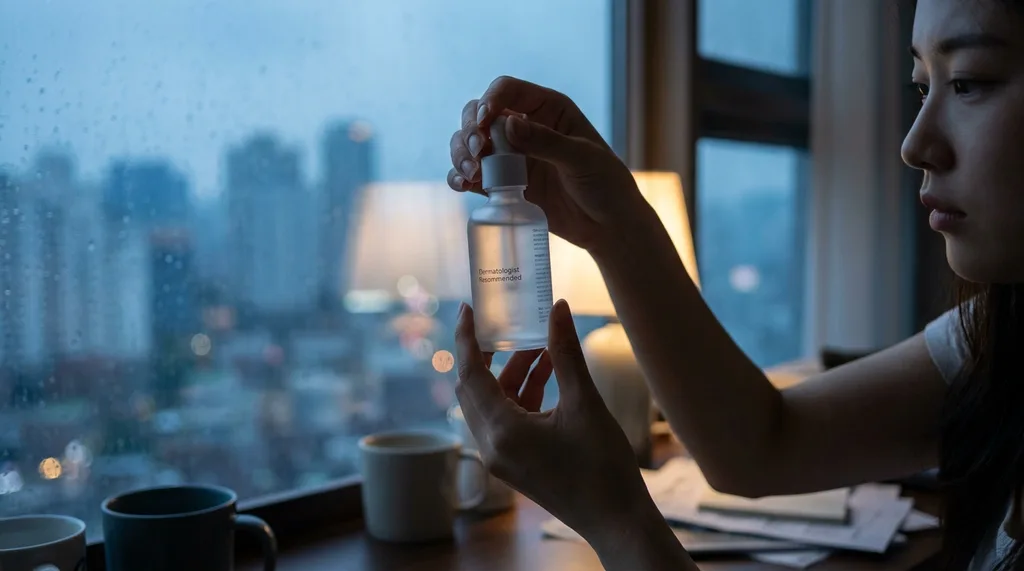
There is a phrase printed on the box of almost every serious K-Beauty product you have ever purchased. It appears in clean sans-serif, sometimes in both English and Korean, always positioned near the ingredient panel where it radiates quiet authority. Three words, or some version of them: Dermatologist Recommended.
You have seen it. You have probably trusted it. And you have almost certainly misunderstood what it means — because in the Korean regulatory context, it does not mean what those words mean anywhere else on earth.
That is where this conversation starts. Not at cancellation. Not at cynicism. But at the gap between what K-Beauty's marketing language promises and what the science — and the culture underneath the science — actually delivers. If you love K-Beauty enough to want the complete picture, what follows is yours.
The Label That Was Never What It Claimed to Be
Walk into a Korean pharmacy — not an Olive Young, the kind with the buzzing fluorescent lights and the pharmacist behind a chest-high counter surrounded by prescription boxes — and pull a "derma" product off the shelf. Turn it over. The label will reference compliance with Korean Ministry of Food and Drug Safety standards, often abbreviated as MFDS. That compliance is real. What it means is more complicated.
Korea's MFDS classifies certain cosmetics as "functional cosmetics" — a legal category that includes products making specific claims around brightening, anti-wrinkle, and UV protection. For a product to carry those claims legally, it must adhere to what the industry calls 고시 (Goshi) — the official government notification that defines which ingredients are permitted, and at what concentrations. Niacinamide for brightening. Adenosine for anti-aging. The list is specific, the rules are real, and the safety screening is more rigorous than many Western equivalents.
But here is what "dermatologist recommended" does not mean: it does not mean a panel of clinicians reviewed your specific product. It does not mean clinical trials were conducted on the finished formula. It means the product's ingredient choices fall within an administratively approved category. The "derma" in "derma brand" is often a marketing identity, not a medical credential.
[K-Beauty 101] 고시 (Goshi) — The official MFDS notification listing approved cosmetic ingredients and their permitted concentrations. In K-Beauty, regulatory Goshi compliance is the legal foundation brands build marketing claims on — a legitimate safety framework, but not a clinical endorsement of any specific product's efficacy.
This distinction is not a technicality. It is the structural crack in the foundation of how global consumers understand and trust Korean beauty products. When the gap is this wide between the implied meaning and the legal reality, the consequences run downstream in ways that are worth examining closely.
The K-Beauty market is on track to nearly double from roughly $16 billion today to over $34 billion by 2034, growing at close to 9% annually. That is an industry expanding faster than almost any consumer category on earth. And expansion at that scale requires marketing language that sustains consumer trust across markets that have no direct experience with Korean regulatory frameworks. "Dermatologist recommended" travels well. "Goshi-compliant functional cosmetic" does not.
When the Safety App Becomes the Danger
🎵 K-Mono Lofi — Seoul Study Beats
Read deeper with Seoul lo-fi in the background — curated by K-Mono Lofi
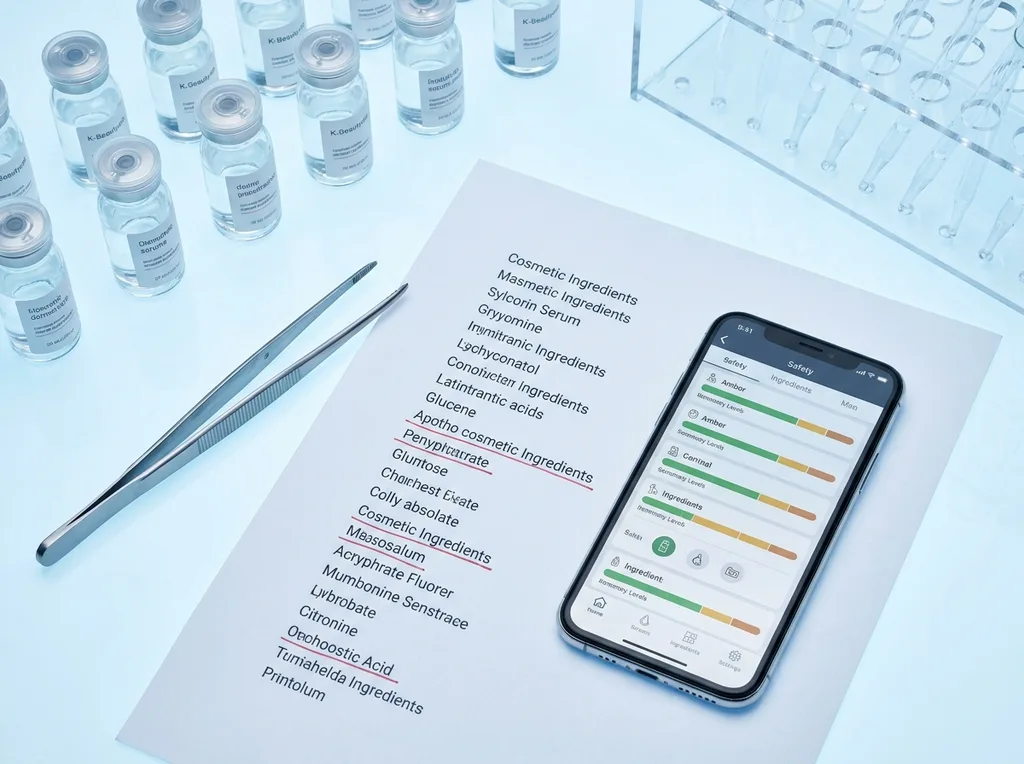
Korea produced something extraordinary in response to a legitimate consumer problem: an app called 화해 (Hwahae) — a platform that lets users search any cosmetic product and see its full ingredient list ranked by safety scores. The concept was democratizing. Suddenly, someone without a chemistry degree could open their phone in an Olive Young aisle and understand what was actually in the bottle. This felt like power.
And in some ways, it was. Hwahae forced formulators to clean up their ingredient decks. It created accountability. It gave Korean consumers a shared language for talking about what they were putting on their skin.
But a tool is only as good as its methodology. And here is where the ingredient-literacy movement — one of K-Beauty's proudest exports — produces a paradox nobody talks about.
The safety scoring systems used by platforms like Hwahae, and their Western cousin the EWG Skin Deep database, operate on what scientists call a hazard-based framework rather than a risk-based one. The difference is enormous. Hazard asks: can this substance cause harm under any conditions? Risk asks: at the concentration present in this formula, for this use pattern, for this population, will it cause harm?
Retinol — one of the most clinically validated anti-aging ingredients in the history of cosmetic dermatology, with decades of double-blind trial data — scores as a "high hazard" ingredient on EWG. Not because it is dangerous at cosmetic concentrations. Because it can cause transient irritation, and because high doses carry theoretical risks that have nothing to do with the 0.025% concentration in your night cream. The algorithm cannot distinguish between a dose that heals and a dose that harms. It sees the ingredient. It flags it.
The result is a generation of highly educated K-Beauty consumers who have rejected proven, well-studied actives based on algorithmic scores, and who have pivoted to products marketed as "clean," "fragrance-free," or "natural" — many of which contain naturally occurring allergens like Limonene or Linalool that don't generate the same consumer alarm. The ingredient app gave them literacy without fluency. The industry, watching this closely, has responded by emphasizing the aesthetic of safety rather than the substance of it.
[K-Beauty 101] 내돈내산 (Naedonnaesan) — "Purchased with my own money." In the Korean influencer economy, this phrase is the gold standard of authenticity — a signal that a review is not sponsored. Its cultural salience tells you something about how saturated the space has become with paid content, and how hungry Korean consumers are for unmediated truth.
Dermatologists in Seoul are quietly frustrated by this. The clinical consensus is increasingly that binary "good vs. bad" ingredient scoring has pushed patients away from evidence-based treatments and toward formulas optimized to look clean on an app — not to produce clinical outcomes. That tension between algorithm-driven consumer behavior and professional dermatological judgment is one of K-Beauty's most underreported fault lines.
Here is where the article's price-performance reality becomes visual. Because not all of K-Beauty's "dark side" lives in the same quadrant:
The dark zone — high marketing intensity, low clinical evidence — is where the most profitable products in global K-Beauty live. And the pathway there is paved with regulatory language that sounds authoritative but means something narrower than advertised.
The Pressure System Behind the Bottles
This is the part that most K-Beauty platforms skip, or handle with a careful one-liner before moving on to product recommendations. It is the part that actually matters most.
Korea's beauty industry did not emerge in a vacuum. It grew inside a specific social architecture — one where appearance has quantifiable career consequences, where cosmetic surgery is a graduation gift in some families, and where the ideal of pale, smooth, undifferentiated skin carries layers of historical meaning that the word "brightening" does not begin to address.
[K-Beauty 101] 외모 차별 (Oemmo chabyeol) — Appearance discrimination. In Korea, submitting a resume photo is standard practice. Appearance is openly discussed in hiring contexts in ways legally prohibited across most of the Western world. The K-Beauty industry both responds to this structural pressure and profits from it — which makes the relationship between the two impossible to disentangle.
Korean resumes historically include photographs. The concept of 외모 차별 is documented widely in Korean academic literature and labor reporting — it describes the measurable career disadvantage that attaches to not meeting certain aesthetic standards. This is not informal. It is structural. And a $16 billion beauty industry operating inside that structure is not simply offering products. It is offering relief from a pressure that it did not create but that it absolutely sustains.
The 화이트닝 (hwaiteuning) industry sits at the center of this discomfort. Skin-brightening products are one of K-Beauty's most lucrative export categories — and they carry a history that the marketing language has worked hard to smooth over. Pre-colonial Korean aesthetics associated pale skin with aristocratic leisure (the logic: those who worked outdoors tanned; those who did not were wealthy). Japanese colonial occupation in the early twentieth century amplified these preferences in specific, documented ways. The contemporary K-Beauty whitening category is the product of both, filtered through a commercial apparatus that now sells this history globally as aspiration.
Younger Korean women are aware of this. Domestic feminist discourse around 화이트닝 has grown considerably — there is a reason the industry is slowly rebranding the category from "whitening" to "brightening," a linguistic shift that acknowledges the criticism without actually resolving it. The products remain. The pressure remains. The name changes.
Then there is 성형 (seonghyeong) — plastic surgery culture. Korea has one of the highest rates of cosmetic surgery per capita anywhere on earth, concentrated particularly in the Gangnam district of Seoul where entire city blocks are dedicated to aesthetic clinics. This is a medical industry achievement: Korean surgeons are genuinely among the most technically skilled in the world, and patients travel internationally for that skill. Foreign patients contributed over $2 billion to South Korea's medical and cosmetic tourism industry in 2023 alone.
But the same surgical ecosystem that attracts global medical tourists also operates inside a domestic market where double-eyelid surgery is discussed at high school graduations, where rhinoplasty is an employment strategy, and where the line between personal choice and structural coercion is genuinely difficult to draw. The conversation inside Korea about this is real, ongoing, and more nuanced than any outside narrative gives it credit for. It is not that Koreans are unaware of the pressure. It is that the pressure is load-bearing in ways that make resistance personally costly.
The ingredient-app paradox, mapped out for the obsessively curious →
What This Actually Changes For You
The point of 팩폭 — brutal truth-telling — is not destruction. It is orientation. Knowing the uncomfortable interior of an industry you love is what transforms you from a consumer into an informed one. So here is what the science and the cultural context actually give you as actionable tools.
On "dermatologist recommended" labels: Read them as you would read a certification of manufacturing compliance — meaningful in the sense that a product has cleared a regulatory baseline, not meaningful in the sense that a physician reviewed your formula and vouched for your skin type. For genuine clinical guidance on actives, the interaction you want is with an actual Korean board-certified dermatologist (피부과 전문의), particularly for anything involving retinoids, chemical exfoliants, or PDRN. The label is a starting point, not an answer.
On ingredient apps: Use them for what they are genuinely good at — identifying known allergens you have personally reacted to, checking for irritants relevant to compromised barrier skin, and understanding ingredient positioning (an active listed in the last third of an INCI list is almost certainly at concentrations too low to do much). Do not use them as binary safety oracles. The difference between hazard and risk is the difference between a knife and a kitchen knife — one is a category, one is a context.
On whitening products: The ingredient science in many K-Beauty brightening formulas is real. Niacinamide at 4-5% has robust clinical evidence for reducing melanin transfer to keratinocytes. Tranexamic acid has emerged as a genuinely well-studied option. Alpha-arbutin works through documented mechanisms. These are not myths. But understanding what you are buying — a product whose market existence is entangled with colonial beauty history and structural appearance discrimination — is part of being an informed adult who makes conscious choices rather than unconscious ones. You can use a product and still think critically about the culture it emerged from.
On the surgery culture: If you are considering a procedure in Korea, the caliber of surgical skill at reputable Gangnam clinics is legitimately world-class. The $2 billion in medical tourism spending reflects real outcomes for real patients. What it does not guarantee is immunity from the same marketing pressure dynamics. "Consultations" at many clinics are structured to identify additional procedures, not to advise restraint. Getting a second opinion from a physician who has no financial stake in the procedure is not paranoia — it is basic healthcare consumer literacy.
The K-Beauty market table below frames where these tensions live in terms of what the industry calls value versus what clinical science actually validates:
| Category | Marketing Claim | Clinical Reality | Informed Consumer Move |
|---|---|---|---|
| "Dermatologist Recommended" | Medical endorsement | Goshi regulatory compliance | Ask: endorsed by whom, for what trial? |
| App "Safe" Score | Scientific safety rating | Hazard list, not risk analysis | Check ingredient position + concentration |
| Whitening / Brightening | Universal brightening | Proven actives with colonial context | Choose ingredients, not the marketing story |
| "Natural" / "Clean" | Zero irritant risk | May contain natural allergens | Patch test regardless of label |
| Cosmetic Surgery Tourism | Affordable, world-class | Often both — with upsell pressure | Second opinion from non-operating physician |
The K-Beauty industry didn't invent Korea's beauty anxiety. But it became extraordinarily fluent in profiting from it. The formulation science is often genuinely excellent. The regulatory framework, while imperfect, is more rigorous than many assume. The cultural pressure underneath all of it is real, documented, and worth sitting with. Knowing this doesn't mean you stop loving the products — or Korea. It means you stop buying the stories uncritically. And that is the most respectful thing a genuine fan of any culture can do.
Medical & Financial Disclaimer:
⚠️ Disclaimer: This article is for educational purposes only and does not constitute medical advice. If you are considering prescription-strength actives (retinoids, hydroquinone, chemical peels), consult a board-certified dermatologist (피부과 전문의) before use — particularly if you have a history of contact dermatitis, rosacea, or compromised skin barrier. Patch-test all new products on the inner forearm for 48 hours before full application. If you are considering cosmetic procedures in Korea or elsewhere, seek consultation from at least two qualified, board-certified specialists who have no financial stake in performing the procedure. No product mentioned in this article constitutes a personal endorsement.
✓ Researched and compiled using verified data as of the publication date.
 Operated by: Quiet Korea | Contact: rsl.2001.1975@gmail.com
Comments
Post a Comment