📋 Table of Contents
The $8 Serum That Embarrassed the $80 One
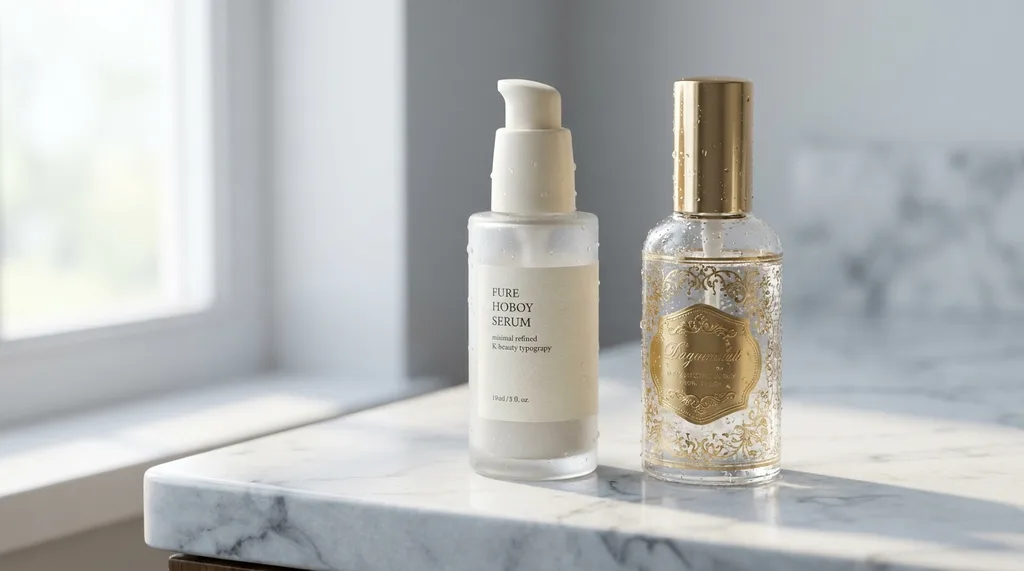
Here's something the K-Beauty industry doesn't advertise: the people who know Korean skincare best — the formulation chemists, the dermatologists running patch tests in basement clinics, the obsessive app-users who can recite an ingredient list faster than their own phone number — have been quietly moving away from the luxury tier. Not because they're broke. Because they learned to read the label.
That shift is worth understanding before you spend another dollar on a beautifully packaged bottle that may be selling you a feeling more than a result.
🎵 K-Mono Lofi — Seoul Study Beats
Read deeper with Seoul lo-fi in the background — curated by K-Mono Lofi
The Price Tag Has Never Been Doing What You Think
The global K-Beauty market sits somewhere between $11.1 billion and $17.22 billion today, projected to more than double by 2035. Those are the headlines brands love to quote. What they don't quote is the structural story underneath: the fastest-growing segment isn't premium. It's "masstige" — a portmanteau of mass and prestige that describes products engineered to deliver clinical-grade ingredients at accessible price points. Over the last five years, the mass segment has grown five percentage points in market share. The masstige segment has grown four more on top of that. Luxury K-Beauty hasn't disappeared, but it has stopped leading.
Why? Because the ingredient that plumps your skin barrier doesn't know what you paid for it.
Take Niacinamide — Vitamin B3, the workhorse of modern K-Beauty formulations. Clinical research shows that a 5% concentration acts as an effective plasticizer for the stratum corneum: it makes the outer skin layer more flexible, more resilient, and dramatically better at retaining moisture. Five percent is five percent whether it's suspended in a $9 toner or a $90 one. The molecule doesn't read the packaging. Korean dermatologists have made this point for years, and Korean consumers have finally started listening.
The same logic applies to Centella Asiatica — CICA, as Olive Young regulars know it. Extracted from a wetland herb with a history in traditional medicine, CICA-derived compounds have shown measurable reductions in wrinkle depth in 12-week clinical trials: between 11.1% and 13.3%, depending on concentration and delivery system. The research increasingly focuses on delivery innovation — nanoemulsions, extracellular vesicles — and those technologies are reaching affordable formulations faster than most consumers realize. The gap between what a $12 CICA cream and a $120 one actually delivers to your dermis is narrower than the price gap implies.
This isn't an argument that luxury K-Beauty is a scam. It's a more precise observation: the premium you're paying is often for texture, fragrance, packaging, and brand positioning — not for meaningfully superior concentrations of the active ingredients that actually change your skin.
When the People Who Make the Products Stop Buying Them
[K-Beauty 101] Ko-deok (코덕) — The self-appointed quality gatekeepers of Korean beauty. These are the consumers who memorize ingredient lists, buy new launches before the marketing campaigns land, and share detailed breakdowns on community platforms. Their collective verdict makes or breaks a product in Korea — and lately, their verdict has been anti-luxury.
According to recent market analysis, brand loyalty metrics in the Korean beauty sector have dropped by roughly 20% in just two years. That figure is striking precisely because it comes from a market where brand heritage was once a premium signal. Korean consumers aren't less interested in skincare — they're more interested in what's inside it. And for that, they've built their own infrastructure.
Platforms like Hwahae (the Korean ingredient-analysis and review app with millions of active users) have functionally democratized the formulation audit. On Hwahae, a consumer can input a product, see every ingredient ranked by safety profile, compare it to a competitor, and read thousands of unsponsored reviews from people who bought the product with their own money. The platform's most trusted badge isn't a celebrity endorsement. It's the 공병템 (gong-byeong-tem) designation — meaning "empty bottle items," products that have been used completely to the last drop, which signals genuine satisfaction that no free sample can fake.
When this kind of verification is available at your fingertips, brand prestige loses its grip. A heritage luxury label can't survive a side-by-side ingredient comparison if the $14 alternative contains a higher niacinamide concentration, a gentler preservative system, and 4.7 stars from verified purchasers. The market has made that comparison effortless. And the results are showing up in what Korean consumers actually buy.
The mermaid below maps exactly how this shift happened — not as a trend, but as a structural cause-and-effect:

This is why the current retail environment at Olive Young — Korea's dominant beauty chain and a reliable proxy for what actual Korean consumers buy — skews heavily toward bundle-based value: 1+1 promotional sets, multi-functional formulations, trouble-specific serums at accessible prices. The "10-step routine" image that went viral globally is, within Korea itself, being quietly replaced by something more surgical.
[K-Beauty 101] Sub-un-ji (수부지) — Skin that is simultaneously oily on the surface and dehydrated beneath. Understanding this specific condition — rather than just defaulting to "oily" or "dry" — is emblematic of the Korean diagnostic approach. Consumers who identify their Sub-un-ji status buy a targeted hydrating serum and a lightweight non-comedogenic moisturizer. They don't buy a 7-product luxury line.
The real K-Beauty philosophy was never "layer everything expensive." It was always: identify the specific problem, select the precise ingredient, apply it in the right order at the right concentration. That philosophy is now finding its fullest expression in the affordable tier, where ingredient-forward brands compete on science because they can't compete on prestige.
What the Luxury Tier Actually Gets You — And What It Doesn't
This is where honest analysis requires nuance, because the affordable-is-always-better argument has its own blind spots.
✅ Where Affordable Wins
High active concentrations at accessible price points. Transparent ingredient ordering on labels. Rapid iteration based on community feedback via platforms like Hwahae. Bundle-format value that stretches routines further. Dermatologist-tested formulations now reaching the mass segment.
⚠️ Where Luxury Earns Its Premium
Advanced delivery systems (liposomal encapsulation, nanoemulsions) that genuinely improve bioavailability. Fragrance-free, irritant-controlled formulations where quality control matters. Proprietary fermentation processes that produce meaningfully transformed actives. Texture engineering for sensitive or rosacea-prone skin that cheap emulsifiers can't replicate.
Delivery technology is the honest case for paying more. Korean Red Ginseng (KRG), for example, has been a luxury-tier staple for decades — but its efficacy was always constrained by poor dermal penetration of its large-molecule actives. The genuinely innovative work happening in the luxury space involves nanoemulsion carriers and fermentation-derived bioavailability that do change what the ingredient can accomplish. If a brand can prove that technology with data — not just proprietary-sounding marketing language — then the premium is defensible.
But "fermented" has become nearly as abused a buzzword in K-Beauty as "natural." The fermentation that produces meaningfully bioavailable actives is a controlled, validated process. The fermentation that gets mentioned in a product name to imply heritage and sophistication is often a different thing entirely. The 코덕 community knows this distinction. Too many international consumers don't, and that gap is exactly where luxury markup lives.
Fragrance is the other legitimate frontier. Cheaper formulations frequently rely on synthetic fragrance blends and less refined preservative systems to hit price targets. For the approximately 30-40% of people with reactive or sensitized skin, that's not a minor detail — it's a rash, a purge cycle, or a compromised skin barrier. In this context, paying more for a fragrance-free, minimal-ingredient formulation from a brand with rigorous irritancy testing is not vanity. It's legitimate risk management.
The darker edge of this conversation: the "솔직 후기" (sol-jeok hu-gi) culture — Korea's tradition of unsponsored, brutally honest user reviews — reveals that even well-regarded affordable products cause problems for specific skin types. Over-care (오버케어, or over-care, as Korean dermatologists call it) is considered one of the most common ways K-Beauty routines go wrong. Stacking three high-concentration actives from affordable brands that each individually test safe can, in combination, strip the skin barrier faster than any single luxury product would. The freedom to buy more cheaply can become the freedom to damage more cheaply, too.
The ingredient stacking risk that affordable routines carry — for the genuinely curious →
Korean dermatologists flag a consistent pattern in their clinics: patients who have built aggressive affordable routines combining AHAs, BHAs, high-concentration Niacinamide, retinol, and Vitamin C simultaneously. Each product may be individually dermatologist-tested and clinically validated. Together, they can create pH conflicts, over-exfoliation, and a compromised barrier that presents as "purging" but is actually structural skin damage. The fact that something is affordable makes it psychologically easier to layer — which makes over-care more common in budget routines, not less. The answer isn't to spend more. It's to use less, more deliberately.
The Diagnostic Question That Cuts Through Everything
The most useful thing K-Beauty ever exported wasn't a product. It was a question. Before reaching for anything — affordable or luxury — Korean skincare culture asks: what does this skin specifically need right now?
That question is the inheritance of a medical tradition rooted in centuries of observational medicine. It's why Korean consumers are obsessively skin-type literate, why the Sub-un-ji distinction exists as a named category, why Hwahae was built before it seemed necessary. The industry monetizes your confusion. The philosophy profits from your clarity.
Research into the K-Beauty market shows that roughly 70% of purchases now happen online, and roughly 60% of purchase decisions are influenced by social media — which means the majority of global K-Beauty consumption is driven by algorithmic content, not diagnostic self-knowledge. That gap between Korean insider practice and global consumer behavior is exactly where money leaks out of wallets and into packaging.
The brands that built the luxury tier understood this before the affordable tier did. They marketed aspiration: you're not just buying a cream, you're buying the idea of glass skin, effortless luminosity, the woman who has figured it all out. That's genuinely powerful marketing. And it still works on the 60% of consumers making social-media-informed decisions.
But among those who've gone further — who've read the clinical data, who've used Hwahae, who've spent time in the ingredient-literacy communities that Korean ko-deok built — the aspiration has been replaced with something more satisfying: competence.
A K-Beauty routine built on knowing exactly why each product is there — what ingredient it delivers, at what concentration, to solve which specific problem — performs better than either a luxury stack bought on brand trust or a budget stack bought on viral momentum. Not always. But consistently.
The bottle never contained the secret. The philosophy did.
⚠️ Disclaimer: This article is for informational and educational purposes only and does not constitute medical or dermatological advice. Skincare ingredients affect individuals differently based on skin type, health conditions, and existing sensitivities. Before introducing new active ingredients — particularly at higher concentrations (Niacinamide above 5%, retinol, AHAs, BHAs) — conduct a patch test on a small skin area and consult a board-certified dermatologist, especially if you have rosacea, eczema, sensitized skin, or are pregnant. Clinical data cited reflects general ingredient research and should not be interpreted as a guarantee of results from any specific product.
✓ Researched and compiled using verified data as of the publication date.
 Operated by: Quiet Korea | Contact: rsl.2001.1975@gmail.com
Comments
Post a Comment