The Island That Built K-Beauty's Scientific Foundation
Walk through any duty-free shop in Incheon International Airport and pay attention to what Korean women are actually buying for themselves — not as gifts, not as safe souvenirs, but as personal replenishments before they land. A disproportionate number of those bottles will say one word somewhere on the label. Not Seoul. Not Korea. Jeju.
Locals understand this instinctively, and tourists often misread it entirely. To a global buyer, "Jeju" means clean, volcanic, pristine — a pastoral romance packaged in a pump dispenser. To a Korean consumer who grew up watching their grandmother press camellia oil into her palms on a November morning, it means something more specific: a geology and a cultivation tradition that simply does not exist anywhere else on the peninsula. That distinction — between a location as branding and a location as genuine source material — is the gap this article exists to close.
Every brand that has ever put a volcanic island on its label wants you to picture the same thing: morning mist over basalt fields, water filtered through ancient lava rock, a camellia grove where the air smells like winter flowers. What those brands almost never show you is what happens to those ingredients after harvest. That's where the actual story lives. And that story is considerably more sophisticated — and considerably more honest about its own limits — than anything you'll read on a product page.
The Ecosystem Nobody Has Fully Counted
Here is a fact that should stop you mid-scroll: no official statistic exists for the total number of cosmetic brands based on Jeju Island. Not because the industry is small or unorganized. Because the question itself doesn't have clean edges.
Jeju's beauty economy exists in layers that resist simple taxonomy. At the outermost layer, you have the major global K-beauty brands — Innisfree being the most recognizable — that built their entire identity around Jeju sourcing while operating as subsidiaries of mainland conglomerates. At the next layer sit mid-sized regional manufacturers, many of them operating out of Jeju Technopark, who supply ingredients and finished formulas to brands that never mention Jeju in their marketing. Then there are the micro-producers: the camellia oil cooperatives, the green tea farms with processing facilities, the haenyeo (the island's female divers) who harvest marine ingredients under traditional licensing arrangements. And finally, the smallest layer — the local apothecary-style operations selling directly to the tourist retail market, producing in quantities that would barely fill a Seoul convenience store.
Where does a "Jeju brand" end and a "Seoul brand that sources from Jeju" begin? The boundary is deliberately porous, and exploiting that porosity is a legitimate business strategy for brands on both sides of it.
What the data does tell us is that the economic stakes are real. The Korean beauty market sits at roughly USD 17.5 billion, with the domestic specialist K-beauty sector growing at an 8.48% compound annual rate through 2032. Korean cosmetics exports hit USD 2.3 billion in Q1 2025 alone — a 21.7% year-on-year increase. Jeju's travel retail market is expanding at over 11% annually, driven partly by a 114.7% surge in medical tourism. An island with roughly 700,000 permanent residents is hosting a beauty economy that punches several weight classes above its demographic.
The reason isn't mystique. It's geology.
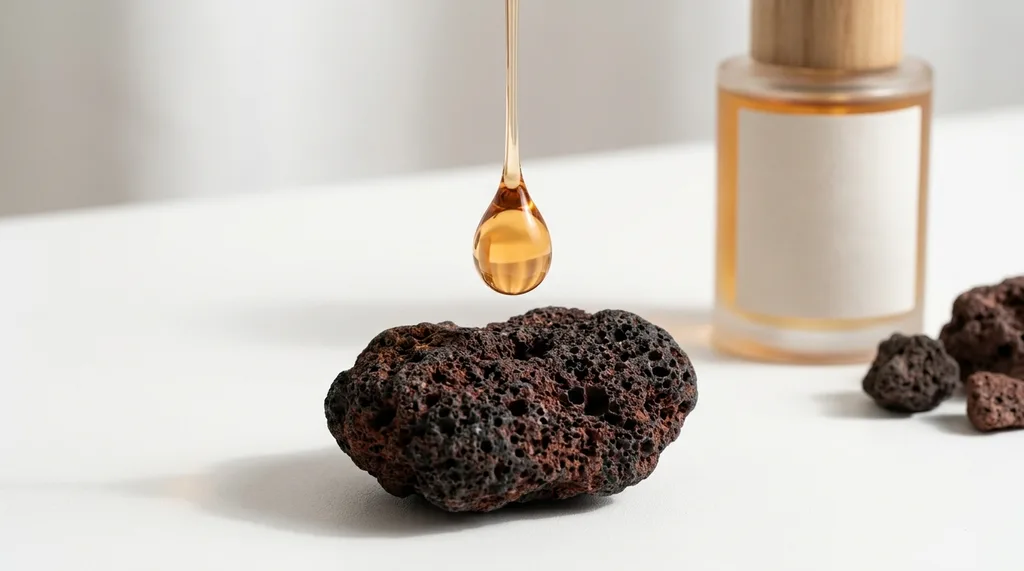
[K-Beauty 101] Jeju Hwasansongi (Jeju Volcanic Scoria) — The porous, iron-rich volcanic byproduct that forms when magma solidifies rapidly with trapped gases. Its pore-rich microstructure gives it exceptional oil-absorption capacity, and its mineral composition — shaped by Jeju's specific basalt geology — differs measurably from volcanic materials found elsewhere. This is the ingredient that turned a geological accident into a sebum-control category.
Jeju sits on one of Korea's most geologically distinctive zones. The volcanic soil produces botanicals with compound profiles that differ measurably from the same species grown on the mainland — different mineral uptake, different UV stress responses, different concentrations of the bioactives that K-beauty's formulators actually want. This is not marketing language laundered through science. The claim is testable, and the measurements hold.
The volcanic scoria — the porous reddish rock that covers much of the island's surface — has a documented sebum reduction rate of approximately 30% in blackhead-focused studies, driven by its physical absorption capacity and its specific mineral interaction with sebaceous secretions. The green tea cultivated in Jeju's high-altitude fields produces concentrations of EGCG (epigallocatechin gallate, the primary catechin responsible for green tea's antioxidant and anti-inflammatory activity) that suppress UV-induced oxidative stress markers by 68 to 90%. Those are not small numbers. For context, they represent a performance threshold that most synthetic antioxidants still struggle to match at equivalent concentrations.
The geological case for Jeju is real. What happens to that geology after harvest is where the picture gets more complicated.
After the Camellia Grove: The Science Behind the Story
The pastoral imagery that Jeju brands cultivate so carefully is not dishonest. The camellia groves exist. The volcanic fields are real. The haenyeo still dive. But the distance between a bioactive compound surviving in a plant and that same compound surviving in a finished formula, at a concentration that actually crosses the skin barrier, is one of the most underreported gaps in cosmetic consumer education.
This is where Jeju's second revolution happened — largely invisible to the consumer, entirely invisible to most of the content written about K-beauty.
The manufacturers operating out of Jeju Technopark and the R&D facilities serving the island's ingredient supply chain have made a decisive shift toward extraction and formulation technologies that belong more to pharmaceutical manufacturing than to traditional botanical skincare. Two methods dominate.
The first is ultrasonic extraction, which uses high-frequency sound waves to rupture plant cell walls at room temperature, releasing bioactives that would degrade under conventional heat-based processing. Heat is the enemy of the compounds that make Jeju's green tea and camellia worth formulating with in the first place — and ultrasonic methods preserve them in a way that traditional solvent extraction simply cannot.
The second is subcritical extraction.
[K-Beauty 101] A-im-gye-chu-chul (Subcritical Extraction) — A high-pressure, high-temperature process using water as the solvent instead of petroleum-derived chemicals. At subcritical conditions, water behaves differently from boiling or room-temperature water — it becomes a highly efficient non-toxic solvent that extracts potent compounds from plant material with minimal degradation and no synthetic residue. The sustainability credential is real; so is the yield.
This matters because camellia oil — the ingredient most closely associated with Jeju's skincare heritage — contains oleic acid, squalene, and polyphenol profiles that behave beautifully in subcritical conditions and degrade badly under others. The brands that have invested in subcritical extraction infrastructure are, in measurable terms, delivering a different product than brands using cheaper processing methods, even when they're drawing from the same Jeju fields.
But extraction is only half the problem. Extracted and preserved does not mean delivered. A bioactive that can't cross the stratum corneum — the outermost layer of skin, which evolved specifically to keep things out — is skincare theater. It sits on the surface, makes the skin feel nice for an hour, and leaves no lasting impact.
This is why Jeju's most scientifically serious manufacturers have moved to liposomal delivery systems: nanometer-sized vesicles built from phospholipid bilayers that structurally mimic the cell membranes they're designed to penetrate. Creating stable, nanoscale liposomes requires high-pressure homogenization at around 800 bars — equipment that looks like it belongs in a pharmaceutical pilot plant, not a beauty lab. The investment is substantial. The result is an ingredient that can actually reach the epidermis at a concentration where it performs.
The honest corollary: most products carrying Jeju ingredients have not made this investment. They contain the ingredient. They do not contain it at a deliverable concentration, in a stable form, at a dose that crosses the threshold between topical presence and actual cellular effect. A brand can be completely truthful — "contains Jeju volcanic minerals," "formulated with Jeju green tea" — and still be selling you the geography rather than the chemistry.
Reading a Jeju Label Like Someone Who Actually Lives There
The local consumer relationship with Jeju-origin products is more sophisticated than the global one, and understanding why changes how you shop.
Korean consumers have access to platforms like Hwahae — an ingredient transparency and review app that functions something like a combination of EWG's Skin Deep database and Reddit's skincare community, crossed with actual purchase data. When a new Jeju-origin product launches, Hwahae's user base dissects the INCI list publicly within days. Ingredient position, concentration estimates, cross-referencing with previous products from the same manufacturer — all of it becomes part of the purchasing conversation in a way that's mostly invisible to the global buyer relying on English-language reviews.
The "Only Hwahae" promotional strategy that some brands deploy — bundling core moisturizers with trial-sized toners and sheet masks specifically to drive Hwahae engagement and review velocity — is a response to exactly this culture of informed scrutiny. The transparency platform created a more demanding consumer, and the brands that thrived adapted to serve that consumer rather than avoid them.
What does that look like in practice? A few principles that translate directly to your shopping behavior, regardless of where you're buying:
| Signal | What It Means |
|---|---|
| Extraction method specified (ultrasonic, subcritical) | Brand understands bioactive preservation — worth investigating further |
| "Jeju-sourced" with no further context | Location branding; evaluate the INCI list independently |
| Active ingredient in top 5 of INCI list | Concentration likely efficacy-relevant |
| Active ingredient after "fragrance" or "water" near end | Trace presence; cosmetic claim, not therapeutic dose |
| Clinical study cited for the formulation | Highest confidence signal; check if study is on the ingredient or the product |
The sebum-reduction data from volcanic scoria studies is real — approximately 30% reduction in blackhead-related sebum metrics. The EGCG antioxidant data from Jeju green tea is real — 68 to 90% suppression of UV-induced oxidative stress markers. Neither number means anything in a formula that contains those ingredients at concentrations too low to reach those thresholds.
There is one further complication worth naming honestly: Jeju's tourism and medical wellness economy creates a retail environment optimized for high-margin, high-volume sales to visitors who are unlikely to return the product. The duty-free channel, the airport boutiques, the hotel skin bars — these are not necessarily where Jeju's best formulations live. They are where Jeju's best marketing lives. The most interesting Jeju-origin products are often in formats that never see tourist-facing retail at all: the ingredient supply agreements with Seoul-based dermatology clinic brands, the OEM manufacturing relationships with European cosmeceutical companies who need subcritical-extracted camellia oil and don't advertise the source.
The island feeds the industry quietly. The industry credits it selectively. Knowing this doesn't make Jeju-origin skincare less worth buying — it makes it more worth buying correctly.
The ingredient science that explains why camellia oil from Jeju performs differently than other oleic-acid oils →
What the Island Actually Exports
The K-beauty world has spent years telling a story about Jeju that is technically accurate and structurally incomplete. Yes, the volcanic minerals are real. Yes, the green tea is potent. Yes, the camellia groves produce oil with a composition that is genuinely worth formulating with. All of that is true.
What the story leaves out is that Jeju's most important contribution to modern K-beauty is not any single ingredient. It is the proof that the most rigorous extraction science, the most demanding formulation standards, and the most sophisticated delivery technology can be built around hyperlocal, geologically specific botanical sources — and that the result outperforms the generic international supply chain.
The brands that understand this are using Jeju as a technology platform. They're investing in subcritical extraction lines, in liposomal homogenization infrastructure, in ingredient provenance documentation that would satisfy a pharmaceutical auditor. They are a minority of the brands that put Jeju's name on a bottle.
The brands that don't understand this are selling you a landscape. A beautiful one. But a landscape nonetheless.
Jeju's greatest export isn't an ingredient. It's a proof of concept: that the most sophisticated technology in modern skincare can emerge from the most specific place on earth — but only if someone asks what actually happened between the volcanic field and the bottle. Ask that question every time. The brands worth buying will have an answer.
⚠️ Disclaimer: The ingredient efficacy data referenced in this article (volcanic scoria sebum reduction, EGCG UV-stress inhibition) derives from in-vitro and ingredient-level studies and does not guarantee equivalent results from finished cosmetic products at retail. Individual skin responses to topical ingredients vary significantly based on skin type, barrier function, concurrent product use, and environmental factors. If you have active acne, rosacea, seborrheic dermatitis, or compromised skin barrier, consult a board-certified dermatologist before introducing new active ingredients — including naturally derived ones. "Natural" and "gentle" are not synonyms. Jeju-origin ingredients, including volcanic minerals and botanical extracts, can cause contact sensitization in susceptible individuals; patch-test any new formula on the inner arm for 48 hours before full facial application.
✓ Researched and compiled using verified data as of the publication date.
 Operated by: Quiet Korea | Contact: rsl.2001.1975@gmail.com
Comments
Post a Comment