The Korean Anti-Aging Supplement Guide Nobody Wrote for You
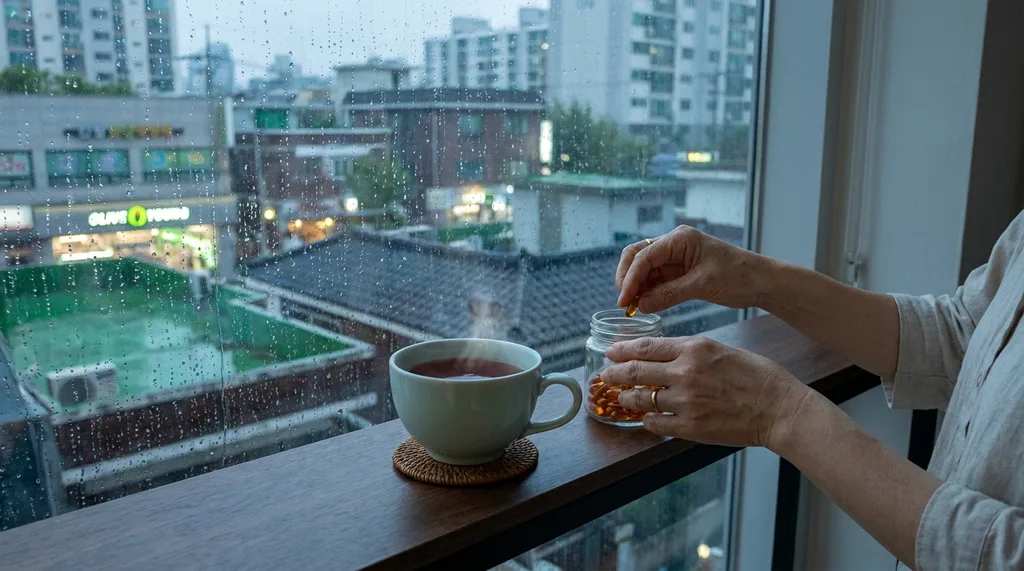
Korean beauty media has a word for the moment you catch your reflection in your phone camera on the brightest setting — 현타 (hyeonta). It means the jarring instant when reality breaks through your mental image of yourself. No flattering filter. No golden hour. Just your face as it actually is, at 45 or 52, in a fluorescent-lit bathroom, and the realization that whatever you've been doing needs to change.
- What Korean Dermatologists Actually Prescribe (And Why It Surprises Everyone)
- Inside-Out: The Supplement Stack Korean Dermatologists Actually Recommend
- The Clinical Evidence, Stripped of Marketing
- Building Your Stack: The Korean Protocol
- Dosage Safety: Where the Evidence Lives
- Where to Find These (Global Access)
- Explore Korean Anti-Aging Supplements
- The Honest Risks (The Part That Doesn't Make It Into Most Guides)
If you've spent any time searching for K-Beauty guidance at this stage of life, you already know the problem: every article assumes you're 26. The models are 22. The routines promise to maintain skin that never had anything to maintain. The supplements are marketed with before-and-after photos of people who didn't need them.
This article is not that.
Here's the counterintuitive truth that Korean dermatologists know and the K-Beauty marketing machine will never tell you: women over 40 are being prescribed fewer steps, not more. The elaborate multi-step ritual that made K-Beauty famous is, for mature skin, actively counterproductive. And the real anti-aging work — the part that explains why Korean women in their 50s often look fundamentally different from their Western counterparts — isn't happening in a serum at all. It's happening at the breakfast table.
The question isn't whether it's too late to start. It's where you enter the system. This is the map.
What Korean Dermatologists Actually Prescribe (And Why It Surprises Everyone)
Walk into a dermatology clinic in Gangnam and tell the doctor you've come about aging skin. The prescription that follows will not be the one you expect.
The Korean skincare regulatory framework is unlike anything in the West. The Ministry of Food and Drug Safety — the MFDS — maintains a legal classification called 기능성화장품 (Gijeungseong Hwajangpum, Functional Cosmetic). This isn't a marketing badge. It's a legal status that requires rigorous clinical proof before a brand can make any claim about wrinkle improvement or pigmentation. In practice, this means that a product legally permitted to say "reduces wrinkles" in Korea has actually been tested in controlled trials and has the data to prove it. Most of the global beauty market operates with no such requirement.
The benchmark active that has repeatedly earned this designation is Adenosine — not a trending ingredient, not a peptide of the month, but a molecule that binds to A2A receptors on dermal fibroblasts and stimulates collagen synthesis. Clinical studies supporting the MFDS standard show measurable wrinkle improvement at concentrations between 0.04% and 0.1% with daily application over 3 to 8 weeks. This is not a guess. It is documented, auditable, government-verified data.
But here's what that same dermatologist will tell you before writing a single product name: if your skin barrier is compromised, nothing else matters.
[K-Beauty 101] 스킵케어 (seukip-ke-eo) — Skip-Care. Not a marketing trend but a clinically motivated simplification of routine for mature skin. As estrogen levels decline, the skin barrier's ability to regenerate its natural ceramide-fatty acid-cholesterol matrix weakens. Complex multi-step routines stress a barrier that is already under structural pressure. Korean dermatologists increasingly prescribe a three-step maximum for women over 45: a ceramide-rich cleanser, a functional active, and an occlusive moisturizer. The goal is barrier repair first, everything else second.
This is the thing the 10-step content machine cannot say: for your demographic, more steps are often the problem. The sophisticated Korean consumer on platforms like Hwahae has already figured this out. The global K-Beauty media hasn't caught up.
And yet — the barrier work, the topical actives, the clinical prescriptions — they address the surface. What Korean medicine has known for centuries, and what modern dermatology is now confirming, is that the skin you see is built from the inside. Which is where the real conversation starts.
🎵 K-Mono Lofi — Seoul Study Beats
Read deeper with Seoul lo-fi in the background — curated by K-Mono Lofi
Inside-Out: The Supplement Stack Korean Dermatologists Actually Recommend
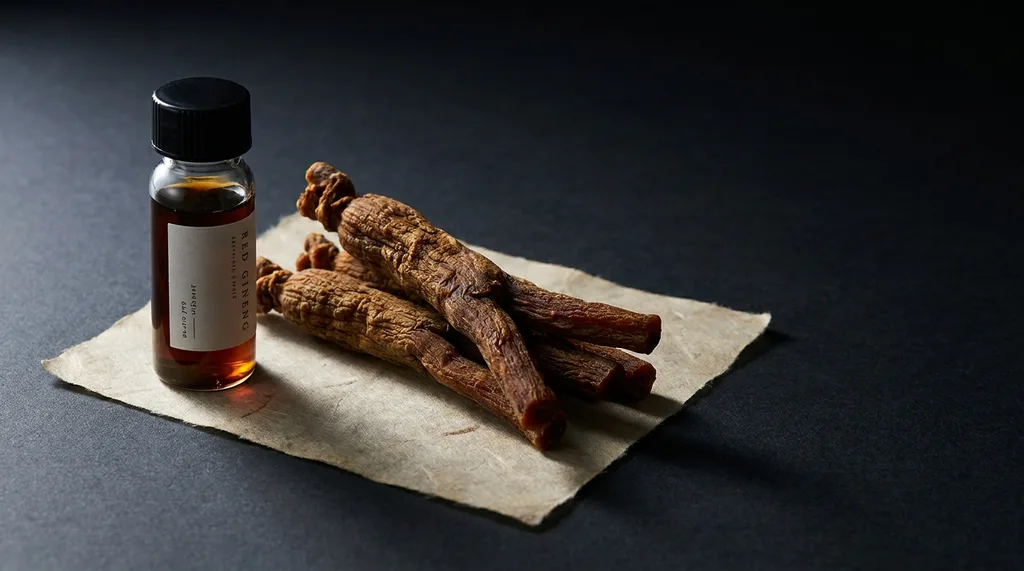
[K-Beauty 101] 한방 안티에이징 (hanbang anti-aging) — Traditional Korean medicine applied to aging skin. Not folk remedy dressed in modern packaging: the hanbang tradition has 2,000 years of recorded clinical observation behind it, and modern Korean cosmetic science has spent decades validating its core ingredients with controlled trials. The result is a category where grandmother's wisdom and published research point at the same shelves.
The ingredient at the center of that tradition is 홍삼 (hongsam, red ginseng). Not fresh ginseng — red ginseng, which undergoes a specific steaming and drying process that transforms its ginsenoside profile. The heat processing increases bioavailability of compounds that, in human clinical trials, have demonstrated antioxidant activity, anti-inflammatory modulation, and measurable contribution to collagen framework support. Korean grandmothers have been taking this daily for generations. Korean cosmetic scientists have now spent years running the trials. The two data sets are converging.
But red ginseng is one instrument in an orchestra that Korean dermatologists are now composing with real precision. The full inside-out protocol for women over 40 typically centers on four categories:
Marine Collagen Peptides. The Korean clinic standard is hydrolyzed peptides — fragments small enough to reach the bloodstream from the gut. The evidence base for marine collagen peptides specifically shows increased dermal density and measurable improvement in 탄력 (tallyeok, skin elasticity) — the quality Korean women in their 40s cite as their primary concern. Not line reduction. Elasticity. The treatment target is different from the Western approach, which explains why the results look different.
Ceramide Ingestibles. The same lipid molecules that form the skin barrier's "mortar" can be supplemented orally. Plant-derived ceramides (most commonly from wheat or rice) have been studied for their ability to support barrier function from the inside, with trials showing improvements in hydration and a reduction in the sok-geon-jo (속건조) phenomenon — that deep inner dryness that no surface moisturizer fully resolves in mature skin.
Vitamin C. Foundational, not glamorous. Collagen synthesis requires Vitamin C at every step of the hydroxylation process. Without adequate circulating Vitamin C, the body cannot build the collagen that peptide supplementation is stimulating. Korean dermatologists often pair these two for exactly this reason.
Red Ginseng Extract. The hanbang entry point, and increasingly the one with the most clinical backing for systemic anti-inflammatory support — which matters for aging skin because chronic low-level inflammation is one of the primary drivers of accelerated structural breakdown.
The Clinical Evidence, Stripped of Marketing
This is where most supplement guides stop being useful, because most supplement guides are not willing to say what doesn't work.
So here is the table as honestly as it can be built from the available clinical data:
| Supplement | Clinical Evidence Level | Effective Daily Dose | Time to Visible Effect | Notes |
|---|---|---|---|---|
| Marine Collagen Peptides | Strong — multiple RCTs | 2.5–5g | 8–12 weeks | Hydrolyzed form required for absorption |
| Red Ginseng Extract | Moderate-strong | 1–3g | 8–16 weeks | Ginsenoside standardization matters |
| Plant Ceramides | Moderate | 30–130mg | 6–8 weeks | Wheat-derived most studied |
| Vitamin C | Strong (foundational) | 250–1,000mg | 4–8 weeks | Ascorbic acid or buffered form |
| Collagen + Vit C Combined | Strong synergy | Per individual doses | 8–12 weeks | The Korean clinical pairing |
The Korean anti-aging focus on 탄력 (tallyeok) deserves more attention than it typically receives in Western coverage. When Korean dermatologists talk about what they're treating in women over 40, elasticity restoration comes first — consistently, across clinics, across price points. Western anti-aging has been dominated by the line-reduction narrative: if you can smooth the lines, you've won. The Korean assessment is that lines are a symptom, not the disease. The disease is structural collapse — lost collagen density, diminished elastin network, compromised dermis. Treat the structure, and the surface follows. Treat the surface only, and you've applied paint over a crumbling wall.
The supplements above are not the paint. They are, if the clinical evidence holds and if you use them at the right doses for long enough, the structural work.
Building Your Stack: The Korean Protocol
The Korean approach to supplement timing is more deliberate than most Western practices. Here's how the clinical-minded Korean consumer structures the anti-aging stack:
🌅 Morning Protocol
Marine Collagen Peptides (2.5–5g)
With water, 30 min before breakfast. Empty stomach improves peptide absorption.
Vitamin C (500–1,000mg)
With breakfast. Fat-soluble meal improves uptake. Pairs synergistically with collagen.
Plant Ceramides (30–130mg)
With a meal containing fat. Lipid-soluble absorption pathway.
🌙 Evening Protocol
Red Ginseng Extract (1–3g)
With dinner. Korean dermatology standard: evening dosing aligns with the body's nocturnal repair cycle.
Additional Collagen Dose (optional, 2.5g)
For accelerated protocols: split the daily collagen dose between morning and evening. Clinical trials have explored both single and split dosing.
Realistic timelines. This is the information that never appears in supplement marketing. Marine collagen peptides require 8 to 12 weeks of consistent use before most clinical trials show measurable changes in skin density. Red ginseng effects on systemic inflammation and skin quality take 8 to 16 weeks. If you stop after three weeks because you haven't noticed anything, you haven't failed the supplement — you've just interrupted the construction project before the structure was visible.
The Korean clinical approach also treats supplementation as cyclical for some ingredients. Red ginseng, in particular, is commonly taken in 3-month-on, 1-month-off cycles in Korean practice — a protocol borrowed from its use in traditional medicine that some integrative dermatologists maintain is appropriate for adaptogenic herbs to prevent receptor desensitization.
Dosage Safety: Where the Evidence Lives
The single most important thing to understand before spending money on any of these is the difference between a dose that has been studied and a dose that appears on a product label. These are not always the same number.
The caution zone matters particularly for Vitamin C. At doses above 2g daily, gastrointestinal distress is the most commonly reported side effect — and because high-dose Vitamin C is sometimes marketed as more potent, this is worth flagging explicitly. The clinical sweet spot for skin benefit sits comfortably at 250mg to 1g. More is not better here.
Where to Find These (Global Access)
One practical reality for global readers: the supplements Korean dermatologists recommend are rarely the branded ones you'll see in Olive Young's beauty supplement aisle. The actives that matter — hydrolyzed marine collagen, standardized red ginseng extract, plant-derived ceramides — are available from reputable international sources with consistent potency.
The Honest Risks (The Part That Doesn't Make It Into Most Guides)
Red ginseng is an adaptogen with documented effects on blood pressure and blood sugar regulation. If you are on antihypertensive medications, anticoagulants (including aspirin), or diabetes medications, the interaction risk is real and documented. Do not take red ginseng without discussing it with your physician first.
High-dose Vitamin C supplementation can reduce the efficacy of certain chemotherapy agents — a drug interaction that is not hypothetical. If you are in active cancer treatment, this supplement combination requires medical sign-off, not just a wellness blog.
Marine collagen peptides are sourced from fish. Shellfish allergies do not typically cross-react with fish-derived collagen, but if your allergy history is complex, confirm the source before purchasing.
Plant ceramides derived from wheat are a consideration for those with Celiac disease or non-celiac gluten sensitivity, depending on the extraction and purification process. Check manufacturer documentation on gluten content before use.
And perhaps the most important caveat: supplements address the nutritional substrate for skin health. They do not replace the structural work of topical actives, sun protection, or clinical procedures. The Korean model treats them as infrastructure — the foundation that everything else builds on. Treating them as a standalone fix is the same category error as buying a single serum and expecting it to reverse decades of barrier damage.
The Korean approach to aging is not optimistic in the feel-good marketing sense. It's methodical. It treats the skin as a system that requires simultaneous intervention at multiple levels — regulatory-grade topicals, dietary ingestibles, barrier protection, and when appropriate, clinical procedures. The 40s are not the beginning of the end. They are the point at which the scaffolding either holds or it doesn't. The work you do now determines which.
Restoration requires knowing what was there in the first place — and building it back, deliberately, from the inside out.
Medical & Financial Disclaimer
⚠️ Disclaimer: This article is for informational and educational purposes only and does not constitute medical advice. The supplements and ingredients discussed have varying levels of clinical evidence, as noted in the text. Before beginning any supplement protocol — particularly red ginseng, high-dose Vitamin C, or any combination regimen — consult a qualified healthcare provider, especially if you are pregnant, breastfeeding, managing a chronic condition, or taking prescription medications. Drug interactions with red ginseng (including with anticoagulants, antihypertensives, and diabetes medications) are clinically documented and require professional evaluation. Clinical results vary by individual, formulation quality, and dose consistency. Patch test all new topical products before full application. Prices and product availability are subject to change. The iHerb affiliate code referenced in this article may generate a commission for this publication — product recommendations are based on ingredient evidence, not commercial arrangement.
✓ Researched and compiled using verified data as of the publication date.
 Operated by: Quiet Korea | Contact: rsl.2001.1975@gmail.com
Comments
Post a Comment