17 DIY Traditional Korean Beauty Recipes (And the Molecular Science Behind Every One)

Walk into a jjimjilbang — Korea's communal bathhouse — on a cold Seoul evening and you'll catch it before you see anything: a deep, slightly medicinal, almost ancient smell rising from the steam room. It's mugwort. Bundles of dried ssuk laid over the heat stones, releasing volatile compounds into the air. The women inside aren't thinking about azulene or flavonoids or COX enzyme inhibition. They're just doing what their mothers did. What their grandmothers did. What, if the founding myth of Korea is to be believed, Koreans have been doing since before the nation had a name.
Here is the thing nobody in the YouTube rice-water tutorial space will tell you: the grandmother was right. Not because science eventually got around to validating her. But because she — and her mother, and her grandmother — were running the longest observational skincare trial in human history, passing down only the protocols that actually produced results. Generation by generation, the ineffective recipes were quietly dropped. The ones that survived did so because they worked, visibly, reliably, across different skin types and seasons. What modern cosmetic chemistry added was not proof of efficacy. It added names for what was already happening at the molecular level.
And one more thing — the thing this article will come back to before it ends — that beautiful blue compound in the expensive "azulene calming serum" on your shelf? There's a very good chance it came from chamomile, not mugwort. And the difference matters more than the brands would like you to know.
The Philosophy of the Empirical Grandmothers
Before any recipe, you need the framework that makes sense of all of them. Korean traditional beauty — what the industry is now packaging as hanbang (Hanbang, meaning Korean traditional medicine-applied beauty) — was never mystical. It was observational. Ingredients were chosen because they produced observable outcomes: clearer skin, reduced redness, softened texture, improved luminosity. The mechanism was unknown. The outcome was not.
The distinction matters because it changes how you use these recipes. You're not trying to recreate nostalgia. You're accessing a delivery system — water-soluble fermentates, enzyme-active powders, lipid-compatible plant oils — that was refined across centuries of outcome-based iteration. The molecular science your dermatologist studied in medical school arrived at roughly the same destinations, just with better documentation.
What modern science added: the language of inositol, ferulic acid, saponins, kojic acid, oleic acid, azulene. What it confirmed: almost everything the grandmothers were already doing.
[K-Beauty 101] ssaldteumul (rice water) — The milky water collected from rinsing raw rice before cooking. Contains inositol (a carbohydrate that actively repairs the skin barrier), ferulic acid (a potent antioxidant), and vitamins B and E. For most Korean women, this is not a beauty practice — it's simply what you do with the water before you cook.
The seventeen recipes that follow are grouped not by ingredient but by mechanism — because understanding why something works is what separates a protocol from a ritual.
The Fermentation Protocols: When Time Is the Active Ingredient
The deepest current in Korean beauty isn't a product. It's a process. Fermentation.
1. Basic Rice Water Toner (Ssaldteumul)
Rinse two cups of short-grain rice in filtered water, swirling with your hands for thirty seconds. Collect the milky water — don't discard it. Let it sit at room temperature for 12–24 hours to allow slight fermentation. The pH drops marginally; inositol concentrations increase. Apply to clean skin with a cotton pad or press in with palms.
The science: inositol's primary job in human skin is phospholipid synthesis and cellular signaling. When skin barrier function degrades — from cold, from over-cleansing, from stress — inositol is one of the compounds it depletes first. Topical delivery partially compensates. This isn't folk wisdom. This is biochemistry.
2. Fermented Rice Water (Extended Method)
Same preparation as above, but allow fermentation for 3–5 days at room temperature until a slightly sour, yeasty smell develops. Dilute 1:3 with fresh water before use — the undiluted version at this stage has dropped in pH enough to cause irritation on sensitive skin.
The honest risk here: fermented preparations at home have no preservative system. Bacterial contamination is a real possibility if your equipment isn't clean or if the fermentation goes longer than 5–7 days. If it smells rotten rather than yeasty, discard it. Mold is visible and non-negotiable — toss the entire batch. This is the tradeoff of DIY: proximity to the active, and proximity to the failure mode.
3. Makgeolli Toner
Makgeolli — Korea's unfiltered rice wine — deserves its own paragraph before the recipe, because its chemistry is genuinely remarkable.
[K-Beauty 101] makgeolli (rice wine) — Unfiltered Korean fermented rice wine containing kojic acid (a melanin synthesis inhibitor), alpha-hydroxy acid analogs from the fermentation process, and live probiotics. Korean women were using fermented rice on their skin before the word "probiotic" existed in any language.
Dilute refrigerated makgeolli 1:4 with filtered water. Soak a cotton sheet mask in the mixture for 15 minutes. Leave on face for 10–15 minutes. The kojic acid targets tyrosinase — the enzyme responsible for melanin overproduction — at the same step that modern brightening serums target it. The AHA-like acids gently loosen the bonds between dead skin cells. The fermentation byproducts support the skin microbiome.
The commercial fermented skincare industry is worth watching here: it exists, in large part, because cosmetic chemists looked at what makgeolli does to skin and asked, "can we engineer this at scale?" The answer was yes. But the original remains as effective as the industrial version — for a fraction of the cost, and with live cultures the commercial version typically lacks.
4. Makgeolli + Green Tea Double Ferment
Brew a strong cup of green tea, cool to room temperature, then mix 1 part makgeolli to 2 parts green tea. Use immediately as a toner. The catechins in green tea add antioxidant coverage; the fermentation compounds handle exfoliation and brightening. These mechanisms don't interfere — they stack.
The Powder Rituals: Korea's Pre-Industrial Cleanser
Before foam cleansers existed, before surfactant chemistry was understood, Korean women cleaned their faces with powder. Specifically, mung bean powder. The fact that this predates commercial cosmetics by roughly two thousand years should give pause to anyone who thinks "innovation" in skincare always means "newer."
5. Mung Bean Powder Cleanser (Nokdu)
Finely ground mung bean powder mixed with enough warm water to form a smooth paste. Apply to damp skin, massage gently in circular motions, rinse. Use 2–3 times per week.
The saponins in mung bean are natural surfactants — they do what the sodium lauryl sulfate in your commercial cleanser does, but without the disruption to the lipid barrier. Mung bean also contains vitamin C and proteins that support barrier function. You are cleaning your face and reinforcing its defenses simultaneously. Commercial cleansers largely have to choose one or the other.
[K-Beauty 101] nokdu (mung bean) — Ground mung bean powder, the original Korean exfoliating and clarifying mask ingredient. Contains saponins, vitamins C and B, and barrier-supporting proteins. The pre-industrial K-Beauty formula that the modern "clean beauty" movement is only now rediscovering.
6. Mung Bean + Honey Mask
One tablespoon nokdu powder, one teaspoon raw honey, enough water to form a spreadable paste. Apply to clean skin, leave 10–15 minutes, rinse gently without rubbing. The honey contributes humectant properties (drawing moisture to the surface) and antimicrobial peptides. Together with the saponins, this is a one-step cleanse-exfoliate-treat protocol.
7. Rice Bran Exfoliating Mask
Rice bran — the outer layer of the rice grain, removed during milling — is denser in vitamins E and B than the grain itself, and contains ceramide-precursor lipids. Mix 2 tablespoons rice bran with enough warm water to bind, apply to damp skin, massage gently. The particle size of rice bran makes it a genuinely gentle physical exfoliant — far more forgiving than walnut shells or apricot kernels, which have irregular jagged edges.
8. Rice Bran + Camellia Oil Night Treatment
Combine 2 tablespoons rice bran with 1 teaspoon camellia oil and enough warm water to create a thick paste. Apply as a 15-minute mask before rinsing. The oleic acid in camellia oil (82–88% of its fatty acid profile) mirrors the composition of human sebum almost exactly — meaning the skin recognizes it as structurally compatible and absorbs it without the surface occlusion that coconut oil, for instance, causes in many skin types.
9. Barley Water Brightening Rinse
Simmer two tablespoons of hulled barley in 500ml of water for 30 minutes. Strain, cool, use the liquid as a facial rinse after cleansing. Barley water is rich in beta-glucan — the same polysaccharide that modern "soothing" serums synthesize at cost — and niacinamide precursors. This one is simple, overlooked, and genuinely effective for dull, tired skin.
The Plant Medicine Section: Mugwort and the Blue Compound
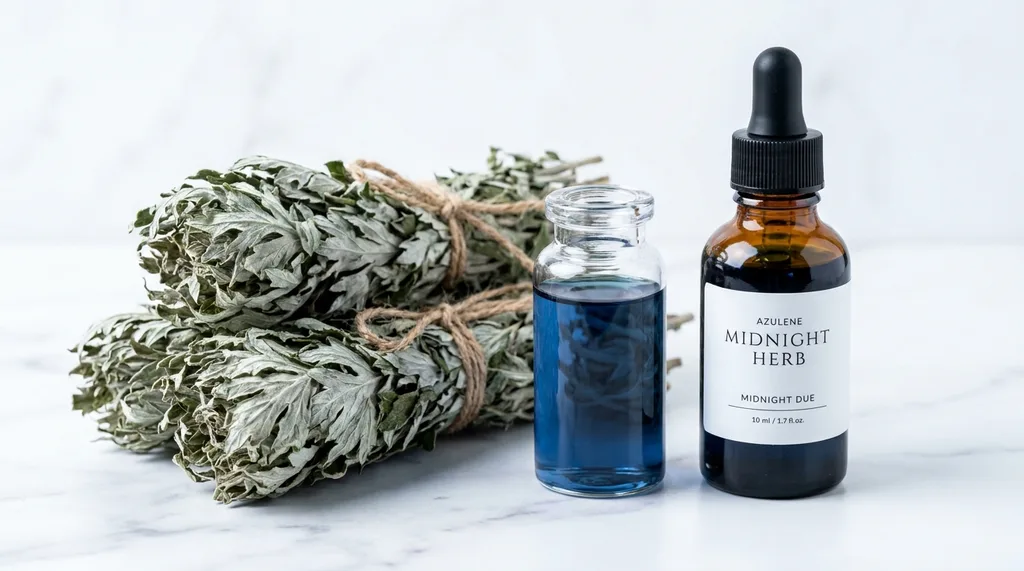
Now we need to talk about the thing that brought us here.
Mugwort — ssuk in Korean, Artemisia princeps in scientific nomenclature — is not just a skincare ingredient. It appears in the Dangun myth, the founding story of Korea: a bear who survived 100 days consuming only garlic and mugwort was transformed into the woman who gave birth to Dangun, the first Korean. This is a plant so embedded in Korean cultural identity that it exists in the nation's creation story. And it turns out, molecular biology thinks fairly highly of it too.
The confusion begins when "mugwort skincare" and "azulene skincare" are used interchangeably — which happens constantly in the K-Beauty content space.
Here is the actual chemistry: azulene is a blue aromatic compound with anti-inflammatory properties. Commercial skincare most commonly uses guaiazulene — a specific sesquiterpene hydrocarbon most efficiently extracted from Matricaria chamomilla, which is chamomile, not mugwort. Guaiazulene works by inhibiting the COX and 5-LOX enzyme pathways — precisely the same pathways that NSAIDs like ibuprofen target systemically. Its high lipophilicity (cLogP 5.74, for those who want the number) means it integrates into cell membranes efficiently and stays there.
Mugwort does contain azulene-adjacent compounds. But it is not primarily an azulene delivery vehicle. It is something more complex and, for many skin concerns, more useful: a multi-compound botanical that simultaneously addresses inflammation, oxidative stress, and barrier integrity through a synergistic complex of sesquiterpenoid lactones, flavonoids, and phenolic acids.
The short version: guaiazulene is a precision drug. Mugwort is an ecosystem intervention. They are not in competition — they target different timescales.
| Property | Guaiazulene (commercial) | Mugwort (Artemisia) |
|---|---|---|
| Primary source | Chamomile (Matricaria chamomilla) | Artemisia princeps |
| Mechanism | COX/5-LOX enzyme inhibition | Multi-compound synergy |
| Best for | Acute redness, immediate soothing | Chronic sensitivity, barrier support |
| Typical concentration | 0.1% – 0.5% in commercial formulas | Highly variable (no standard) |
| Allergy risk | Asteraceae family cross-reactivity | Same family — same risk |
The implication for anyone with ragweed or chamomile allergy: both commercial azulene serums AND mugwort preparations carry cross-reactivity risk. Patch test is not optional.
10. Mugwort Facial Steam (Traditional Ssuk Steam)
Bring 1 liter of water to a boil with 3–4 tablespoons of dried mugwort (available at Korean grocery stores and herbal medicine markets). Reduce to a simmer. Drape a towel over your head, position your face 30–40 cm above the pot, and steam for 5–8 minutes. The heat opens follicular openings; the volatile compounds — azulene precursors, flavonoids, essential oils — deposit on the skin surface.
The jjimjilbang mugwort steam room operates on exactly this principle, scaled up. Women have been doing this in Korea for centuries. The fact that modern extract technology now captures these compounds in serum form doesn't make the steam any less effective — it just makes it less convenient.
11. Mugwort Compress
Steep 2 tablespoons of dried mugwort in 500ml of just-boiled water for 20 minutes. Cool to room temperature, strain into a glass jar. Soak a cotton pad and press gently onto areas of redness or sensitivity. Store remaining liquid in the fridge for up to three days.
The chlorophyll in mugwort has mild skin-clarifying properties; the flavonoid content provides antioxidant coverage. This is a jinjeong (jinjeong — soothing/calming) treatment in the truest sense of the word: it's not just removing irritation, it's restoring baseline.
12. Mugwort + Green Tea Calming Mask
Steep equal parts dried mugwort and green tea leaves in 300ml boiled water. Cool, strain. Use the liquid to hydrate 2 tablespoons of kaolin clay or rice bran powder to form a paste. Apply to clean skin, leave 10–12 minutes, rinse. The EGCG in green tea (epigallocatechin gallate — the primary catechin antioxidant) works at a different pathway than mugwort's anti-inflammatory compounds. Combined, this is a genuinely comprehensive calming and antioxidant mask.
13. Green Tea Ice Cube Facial
Brew very strong green tea (4 teabags to 500ml water), cool completely, freeze in an ice cube tray. Wrap a single cube in a thin cloth, press gently against flushed or irritated skin for 1–2 minutes. The cold constricts dilated capillaries; the catechins absorb transdermally in small amounts. Korean women with rosacea-prone skin have used this for immediate redness reduction before important events. It works within minutes.
The Oil Traditions: Jeju's Answer to Modern Serums
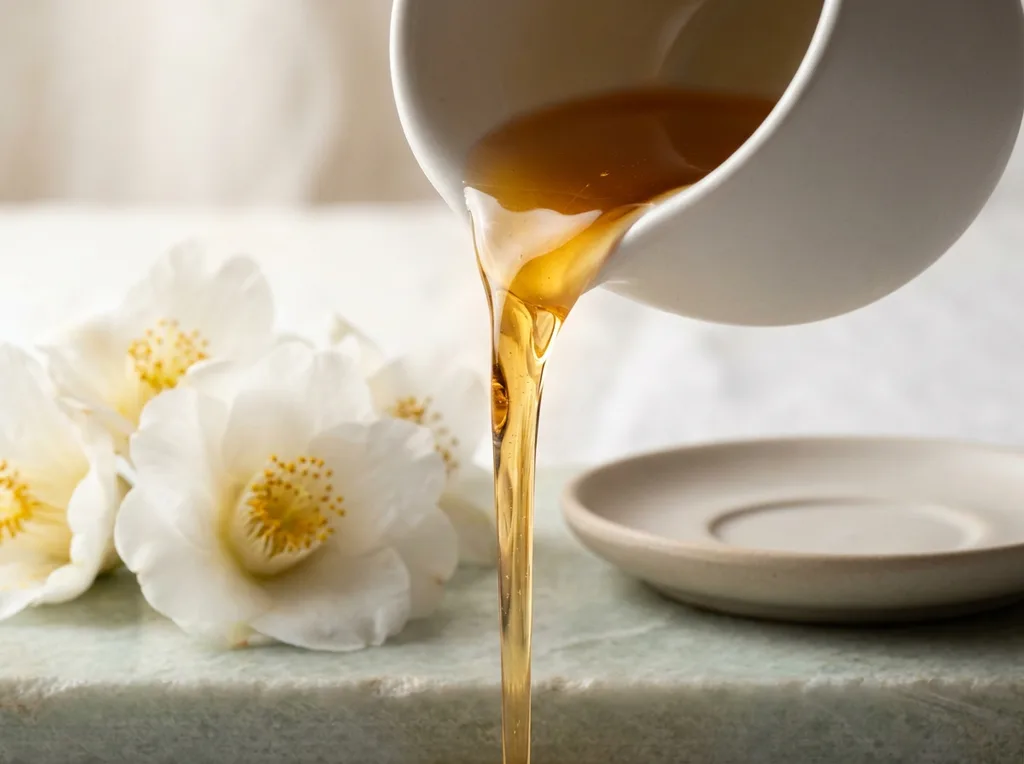
14. Camellia Oil (Dongbaek) Face Treatment
Warm three drops of cold-pressed camellia oil between your palms, press into slightly damp skin after toning. The "slightly damp" detail is not aesthetic — it's functional. Applying oil to damp skin traps water molecules in the lipid layer being formed; applying to dry skin can actually increase transepidermal water loss by creating an occlusive seal over already-dehydrated tissue.
Jeju Island's camellia oil has been exported across East Asia for centuries precisely because of its skin compatibility. The 82–88% oleic acid composition is the highest of any commonly used plant oil — and oleic acid, specifically, is the dominant fatty acid in the sebaceous secretions of human skin. Your skin doesn't have to work to incorporate it.
15. Camellia + Sesame Hair and Scalp Treatment
Mix 2 tablespoons camellia oil with 1 tablespoon cold-pressed sesame oil. Warm gently, apply to dry hair and scalp, wrap in a warm towel for 30–45 minutes, then shampoo out. Sesame oil contains sesamol and sesamolin — lignans with antioxidant activity that protect hair lipids from oxidative degradation. Camellia provides structural conditioning. Together, this is the oil treatment behind generations of Korean women with famously healthy, dense hair.
16. Honey and Rice Bran Brightening Scrub
Equal parts raw honey and rice bran powder, applied to damp skin with gentle circular motions. The honey's hydrogen peroxide precursors (released enzymatically on contact with skin moisture) contribute mild antimicrobial action. The rice bran exfoliates physically and deposits vitamin E. Use once per week — not more. Even gentle physical exfoliation done daily disrupts the stratum corneum faster than it can repair.
17. Sesame + Camellia Night Oil Serum
Five drops camellia oil, two drops sesame oil, one drop of a high-quality vitamin E oil. Mix in your palm, press into clean skin as the final step in your evening routine. This replicates — very closely — the composition of a healthy epidermal lipid layer. For anyone with compromised skin barrier, dry climate damage, or post-active-ingredient sensitivity, this combination is more effective than most commercial "barrier repair" products at a fraction of the cost.
The complete chemistry of why these oil ratios work — for the genuinely curious →
Closing the Loop: What Your Blue Serum Doesn't Tell You
The commercial azulene serum industry is not dishonest, exactly. Guaiazulene is a real compound with real, well-documented anti-inflammatory mechanisms. It works. But it is a single isolated molecule — a sniper shot at one inflammatory pathway. What mugwort does is broader: it recalibrates the skin's inflammatory environment, supports the barrier from multiple angles, and delivers antioxidant coverage through flavonoids that work synergistically with its sesquiterpenoid compounds.
The global mugwort market is currently valued at approximately $1.2 billion and growing at 7.8% annually — not because the industry discovered something new, but because it finally caught up to something old. The "Hanbang 2.0" trend now dominating K-Beauty innovation isn't a marketing angle. It's the cosmetic industry belatedly reading the observational data that Korean grandmothers compiled across centuries.
What you have in these seventeen recipes is not the poor cousin of commercial skincare. In some cases — the fermented rice water with live cultures, the full-spectrum mugwort steam, the biologically compatible camellia oil — you have something the commercial versions are actively trying to replicate.
The grandmother who steamed her face over a pot of mugwort was not being superstitious. She was doing empirical science — with a centuries-long dataset, without the vocabulary.
Start Tonight: Your First Three Steps
The gap between reading about these recipes and using them is the only thing standing between you and results. Here is where to begin, in order of ease and impact:
Step 1 (Tonight): The next time you rinse rice before cooking, collect the milky water in a clean bowl. Let it sit on the counter, covered loosely, for 12 hours. Apply to clean skin with a cotton pad before any other products. This is the most low-barrier entry point into this entire tradition.
Step 2 (This week): Source dried mugwort from a Korean grocery store or herbal market. Do the steam treatment once. Note how your skin feels afterward — particularly if you carry any chronic redness or sensitivity. Give it three weeks of weekly use before drawing conclusions.
Step 3 (When you're ready to go deeper): Pick up cold-pressed camellia oil — look for "camellia japonica" on the label, not camellia sinensis, which is tea seed oil and different in fatty acid profile. Use it on damp skin, three drops, as your last step at night. Track barrier function changes across 30 days.
These three steps alone cover fermented toning, botanical soothing, and lipid barrier restoration. That's the full architecture of traditional Korean skincare — and it costs less than a single bottle of the commercial serum inspired by it.
Medical & Financial Disclaimer: The DIY recipes in this article involve food-grade and plant-based ingredients that may cause allergic reactions in individuals with sensitivities to the Asteraceae plant family (mugwort, chamomile), rice, legumes, or tree nuts (including camellia). Always perform a patch test on the inner forearm or jawline for 24–48 hours before full application. Fermented preparations (rice water, makgeolli) should be prepared in sanitized containers and discarded if any mold growth, off odors, or discoloration occurs. These recipes are not a substitute for professional dermatological care. If you have active inflammatory skin conditions (rosacea, eczema, psoriasis, active acne), consult a board-certified dermatologist before introducing new topical preparations. Product cost estimates and market data cited reflect publicly available figures as of mid-2025 and are subject to change.
✓ Researched and compiled using verified data as of the publication date.
 Operated by: Quiet Korea | Contact: rsl.2001.1975@gmail.com
Comments
Post a Comment