Glass Skin Was Never in the Bottle
Here's what no K-beauty influencer will tell you: some of the founders behind Korea's most celebrated skincare brands are publicly, deliberately dismantling the exact routine that made them famous. Not in private emails. In blog posts. In interviews. And they're doing it with a quiet urgency that suggests the stakes are higher than shelf space.
That tension — between what K-beauty sells and what it actually knows — is the most important story in skincare right now. And to understand it, you need to follow a number.
The $10.2 Billion Secret Nobody Prices In
In 2024, Korean cosmetics exports crossed US$10.2 billion, a 20.6% jump from the year before. The United States now accounts for a 22.2% share of imported cosmetics — making Korea the single largest supplier of foreign beauty products to American consumers, ahead of France, ahead of Japan, ahead of everyone.
That's not a Hallyu wave. That's structural dominance.
But the reason most global commentators give for this — "Koreans figured out hydration," "the 10-step routine went viral," "glass skin is aspirational" — misses the actual engine entirely. Because if you ask Korean dermatologists or the sharp community of consumers Koreans call 코덕 (ko-deok, the obsessive ingredient-trackers who effectively gatekeep what succeeds in the domestic market), the answer is something far less photogenic.
It's a government regulator.
South Korea's Ministry of Food and Drug Safety, known as the Sik-yak-cheo, operates a tiered classification system for what it calls:
[K-Beauty 101] 기능성 화장품 (Gineung-seong Hwajang-pum) — Functional Cosmetics. A specific legal tier of products that claim active physiological effects — brightening, anti-aging, UV protection — beyond basic moisturization. Products in this category must contain MFDS-notified ingredients within legally mandated concentration ranges. Making the claim without the data is a legal violation, not a brand judgment call.
This is why a Korean "brightening" product is not the same object as a Western "brightening" product. In Korea, that word on the label triggers a regulatory requirement. The formula must contain one of nine approved brightening compounds at a verified concentration. The retinol in an anti-aging product must meet 3,333 IU or higher to carry that designation. These aren't suggestions — they're enforced standards.
When Western consumers feel that K-beauty "just works," this is largely what they're feeling: the downstream effect of a system that makes efficacy claims legally binding. Not the snail mucin. Not the 17 layers of essence. The regulatory architecture that forces manufacturers to either formulate properly or stay silent about what their products do.
That's the foundation. And it also explains what happens when you build a marketing industry on top of it — because not every K-beauty claim lives in that protected regulatory space.
🎵 K-Mono Lofi — Seoul Study Beats
Read deeper with Seoul lo-fi in the background — curated by K-Mono Lofi
What the Ko-deok Know Before They Buy Anything
Walk into any Olive Young location in Seoul and you'll observe something that Western beauty retail never quite replicates: customers photographing ingredient lists. Not product shots for Instagram — ingredient lists. They're running them through Hwahae, Korea's dominant cosmetic ingredient database and review platform, cross-checking formula transparency against community-verified results. This behavior has a name. It's called 팩트체크 (fact-check) culture, and it's brutal.
The ko-deok community has essentially built a parallel verification layer on top of the industry's marketing output. They distinguish rigorously between what they call 내돈내산 (nae-don-nae-san) — "my money, my purchase," shorthand for an unsponsored, unbiased review — and anything that arrived in a PR package. Korean beauty forums treat the former as primary evidence and the latter as marketing material until proven otherwise. The skepticism is institutional, not cynical.
What these communities discovered, and what has slowly filtered into global K-beauty discourse, is the concept of:
[K-Beauty 101] 꿀조합 (Kkul-johap) — Honey combination. The pairing of specific products or ingredients that produce results dramatically superior to either used alone. The "honey" implies a kind of discovered sweetness — an insider synergy that wasn't advertised, just tested. Examples circulating in current Korean skincare communities include pairing absorption-focused treatments with PDRN (purified DNA-repair compounds) for recovery, or layering barrier ceramides under niacinamide to prevent the flushing response some users experience.
This is the philosophy that actually drives sophisticated Korean skincare. Not ten steps. Not a fixed routine that applies to every face. A data-driven approach where you identify your skin's specific problem, find the clinically active ingredients that address it, and then find the pairing that makes those ingredients work better together.
It's the opposite of what K-beauty marketing typically sells — which is more products, more steps, more layers. The ko-deok approach says: fewer, smarter, verified.
Here's where the system the MFDS built becomes even more valuable: when you're ingredient-led, the certification matters. Seeing a gineung-seong hwajang-pum designation tells the informed consumer that the active compound in this bottle is actually present at a therapeutically relevant concentration — not just listed 23rd on the ingredient deck after several forms of water and emulsifier.
The flow from regulatory standard to consumer trust to this kind of community intelligence is not accidental. It's the compounding effect of a system that was designed to reward transparency:

Now here's the uncomfortable part. Because that $10.2 billion flows from global consumers who largely don't know any of this. They know glass skin. They know the 10-step routine. They know the TikToks. And therein lies the most expensive myth in beauty.
The Glass Skin You're Actually Chasing
The 10-step Korean skincare routine is, at this point, a piece of cultural mythology so thoroughly accepted that pointing out its artificiality feels almost rude. But the evidence is clear, and the people best positioned to know are saying it plainly.
Korean dermatologists have begun to push back against the layering-everything model with increasing directness. The concern isn't that the products don't work — it's that when you stack multiple actives, multiple acids, multiple exfoliants, and multiple vitamin C serums into a single routine without understanding their interactions, you don't get better skin. You get a compromised skin barrier. The Korean skincare community has its own term for this failure mode: 오버케어 (over-care), and it's responsible for a pattern of "skincare-induced sensitivity" that Korean cosmetic dermatology sees regularly.
The "glass skin" aesthetic deserves the same scrutiny. What's sold as a Korean beauty baseline is, in reality, a digitally curated ideal. Research into the actual practices of South Korean consumers reveals that the luminous, pore-free complexion in beauty campaigns is substantially the product of studio lighting, editing, and in many cases, professional clinic treatments that exist far outside the scope of any at-home routine. The average person photographed in a Gangnam dermatology waiting room is not achieving that skin from a 10-step drugstore routine. They're often using prescription-strength actives, IPL, and treatments involving biological compounds that have no consumer equivalent.
The marketing gap — between what the campaign promises and what the product can deliver — is exactly where Western consumers have been most consistently misled. And it's not always bad faith. Part of it is structural: the MFDS-regulated functional cosmetics are genuinely efficacious in their specific, narrow claims. Brightening. Anti-aging. UV protection. But glass skin, as a totality? That's not a regulatory category. That's a vibe. And vibes don't have concentration thresholds.
🔬 The Regulatory Reality
Brightening claim → requires one of 9 MFDS-notified compounds at verified concentration
Anti-aging claim → requires retinol at 3,333 IU minimum or equivalent approved active
10-step routine → not a regulatory category; a marketing construct
Glass skin → not a regulatory category; a digitally-assisted aesthetic ideal
📣 The Marketing Myth
"Brightening" → often applied to any formula with vitamin C, regardless of concentration
"Anti-aging" → used for products containing peptides at sub-clinical quantities
10-step routine → sold as the Korean standard, widely adopted outside Korea
Glass skin → marketed as achievable with specific product lines
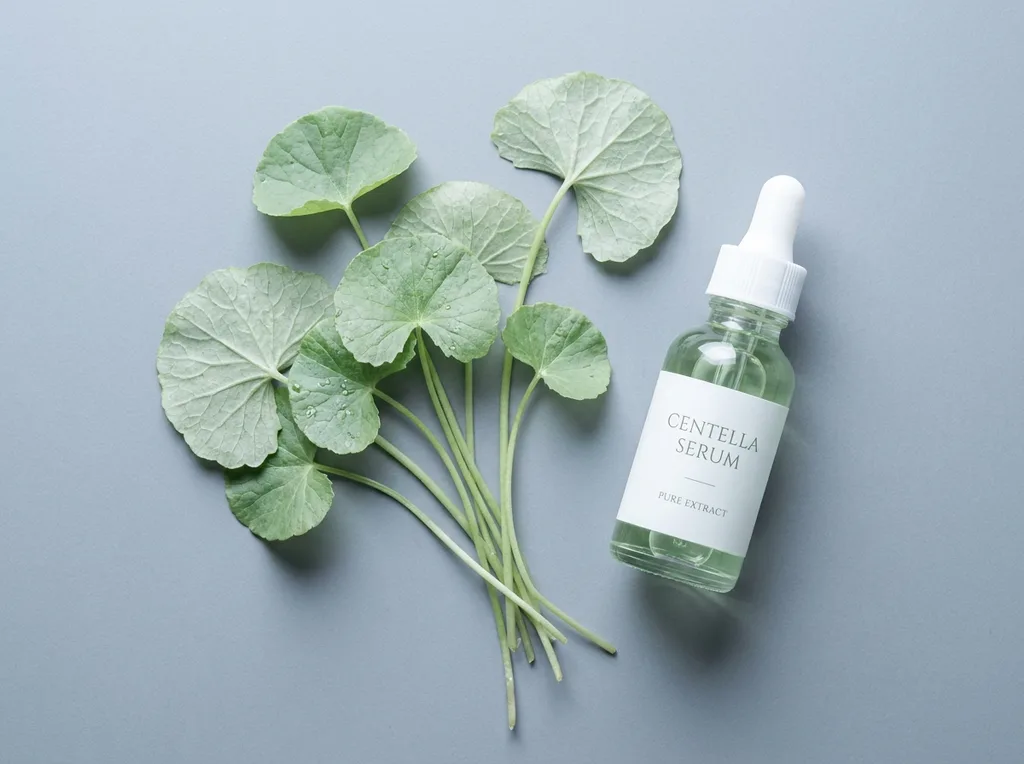
There's also the matter of "natural ingredients." K-beauty marketing has leaned heavily into the idea that Korean botanical extracts carry some inherent superiority — that the hanbang (traditional Korean herbal medicine) lineage makes a formula more trustworthy. Some botanicals are genuinely backed by evidence: Centella Asiatica (known in Korea as 병풀, byeongpul) has solid clinical data supporting its role in barrier repair and wound healing. But outside of Centella, the evidence for many "traditional" botanical claims ranges from preliminary to nonexistent. "Natural" is not a synonym for "effective," and in the MFDS system, a natural ingredient that hasn't been notified with concentration standards carries no functional cosmetics certification. The marketing cloud around hanbang ingredients often trades on cultural prestige more than clinical evidence.
This isn't a reason to abandon K-beauty. It's a reason to read the label the way the ko-deok do — looking for the MFDS certification, checking the ingredient position in the formula, and asking whether the active is present at a concentration that can actually do something.
The Routine That Actually Earns Its Real Estate on Your Shelf
What the most sophisticated Korean consumers have quietly arrived at — and what some of the industry's own founders are now saying out loud — is a philosophy closer to deliberate minimalism than maximalist layering. Double cleanse, yes: Korean dermatologists confirm that oil-based cleansers are the only reliable way to dissolve long-wear sunscreen residue that water-based surfactants simply cannot reach. This step has genuine clinical rationale. But from there, the question shifts from "what do I add?" to "what has the evidence, and what does my specific skin actually need?"
The Kkul-johap model asks you to think in terms of outcomes, not routines. You identify a target — barrier repair, hyperpigmentation, fine lines, acne — you find the MFDS-validated active that addresses it, and you find the combination partner that enhances delivery without causing competition or irritation. That might be three products. It might be five. It is almost certainly not ten.
The Hwahae platform, which functions as Korea's most rigorous community-based cosmetic database, exists precisely because consumers demanded a place where product claims could be weighed against actual user data rather than brand communication. Review culture in Korea draws a hard line between 내돈내산 reviews and sponsored content — the former carrying genuine credibility, the latter treated as a marketing artifact. In an environment where this distinction matters, brands are forced to produce products that survive real-world testing, not just photogenic claims.
That accountability loop — regulatory standard, community verification, honest review culture — is K-beauty's actual competitive advantage. Not the sheet masks. Not the fermented essences. Not the glass-skin aspirational campaign. The system that makes lying about your formula a legal and reputational hazard.
The American market's 22.2% share — that US$1.91 billion in exports to the U.S. in 2024 alone — suggests that global consumers are sensing something real, even if the marketing layer has obscured what it is. They're feeling the regulatory floor beneath the hype. They're benefiting from formulas that had to meet actual standards before they were allowed to make claims. They're using products that Korean consumers tested, argued about, and verified through platforms built around skepticism rather than enthusiasm.
The best-performing K-beauty products aren't magic. They're well-regulated, community-tested, and honestly formulated. That's rarer than it sounds — and far more valuable than ten steps of anything.
⚠️ Disclaimer: This article is for educational and informational purposes only and does not constitute medical or dermatological advice. Skincare ingredients affect individuals differently depending on skin type, existing conditions, and concurrent product use. If you experience irritation, barrier disruption, or unusual skin sensitivity, discontinue use and consult a board-certified dermatologist. Claims about MFDS (Ministry of Food and Drug Safety) regulatory standards reflect the Korean domestic regulatory framework and may not apply to products sold in other markets. Always patch-test new products before full application.
✓ Researched and compiled using verified data as of the publication date.
 Operated by: Quiet Korea | Contact: rsl.2001.1975@gmail.com
Comments
Post a Comment