[Real Value Report] Korean Anti-Aging: What the $120 Cream Doesn't Tell You
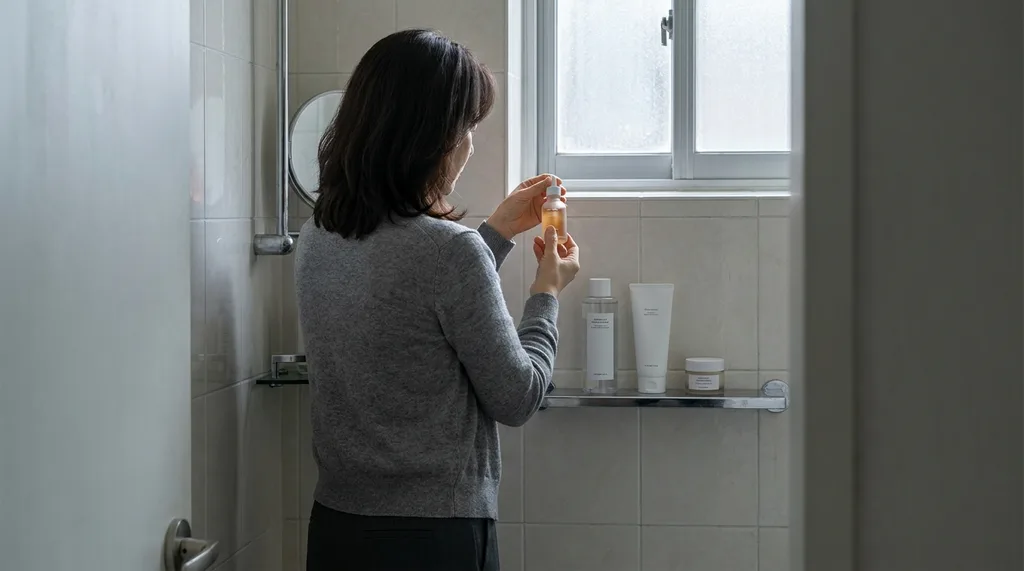
There's a stamp on the back of certain Korean skincare bottles — four characters on a small rectangular label, usually in a pale peach or light blue — that the average Western shopper scrolls right past. Korean women in their 40s who know what they're doing stop at it every single time.
- The Legal Moat Nobody Told You About
- The Ingredient Autopsy: Where the Money Actually Goes
- The Retinal Question: Why Your Retinol Might Be Working Harder Than It Needs To
- What Skip-Care Actually Means for Mature Skin
- The Price Reality: What You're Actually Paying For
- The Synergy Map: How to Actually Build a Mature Skin Routine
- The Verdict: Your Situation, Your Decision
- Explore Korean Anti-Aging Actives
That stamp is the difference between a product that is legally required to prove it reduces wrinkles, and one that is merely allowed to imply it might.
Before we get into the ingredient science and the price autopsy, you need one piece of context that changes everything: if you're over 40 and feeling invisible in K-Beauty media, the gap isn't about finding the right product. It's about operating inside a completely different regulatory system — one that the marketing department never explains. The full philosophical framework behind Korean anti-aging is laid out here: The Infrastructure Question: What Korean Anti-Aging Actually Means. What we're doing in this report is something more specific. We're taking a $120 Western prestige anti-aging serum and a Korean functional cosmetic at $18, and we're cutting them open on the table.
The gap is almost never what you think.
The Legal Moat Nobody Told You About
Korean dermatologists have a phrase for the look on a patient's face when she sees her skin in clinic lighting for the first time in years. 현타 (hyeonta) — a sudden, jarring reality check. That moment lands hard. And what follows it, for millions of Korean women, is not a trip to the department store luxury counter. It's a very specific piece of knowledge about what products are actually regulated to do something about it.
[K-Beauty 101] 기능성화장품 (Gijeungseong Hwajangpum) — Functional Cosmetic. A formal legal classification under South Korea's Ministry of Food and Drug Safety (MFDS) for products with clinically proven efficacy in specific categories — wrinkle improvement, whitening, and UV protection. This is not a marketing badge. Brands applying for this status submit clinical trial data and undergo regulatory review. Without it, a product cannot legally claim to improve wrinkles. With it, the claim is backed by the state.
This is not how the FDA works. It is not how the EU Cosmetics Regulation works. In most Western markets, "anti-aging" is a marketing category, not a legal one. You can print it on anything. The Korean MFDS system created a hard wall: brands either prove it or they cannot say it.
What this means practically: a $18 Korean serum bearing the 기능성화장품 certification has cleared a clinical evidence bar that a $120 Western prestige product may never have been required to clear at all. Not because Western brands are incompetent — some are extraordinary. But because they were never legally compelled to prove it.
That is the gap the marketing copy will never tell you about.
🎵 K-Mono Lofi — Seoul Study Beats
Read deeper with Seoul lo-fi in the background — curated by K-Mono Lofi
The active ingredients most commonly approved under this system include adenosine (for wrinkle improvement) and niacinamide (for brightening/tone). These aren't exotic or proprietary. They're well-studied, affordable actives with documented clinical profiles. The question is never "does the ingredient work" — the science on adenosine and retinoids is solid. The question is: is it present in enough concentration, in a formulation stable enough, to actually do anything?
That's where the autopsy begins.
The Ingredient Autopsy: Where the Money Actually Goes
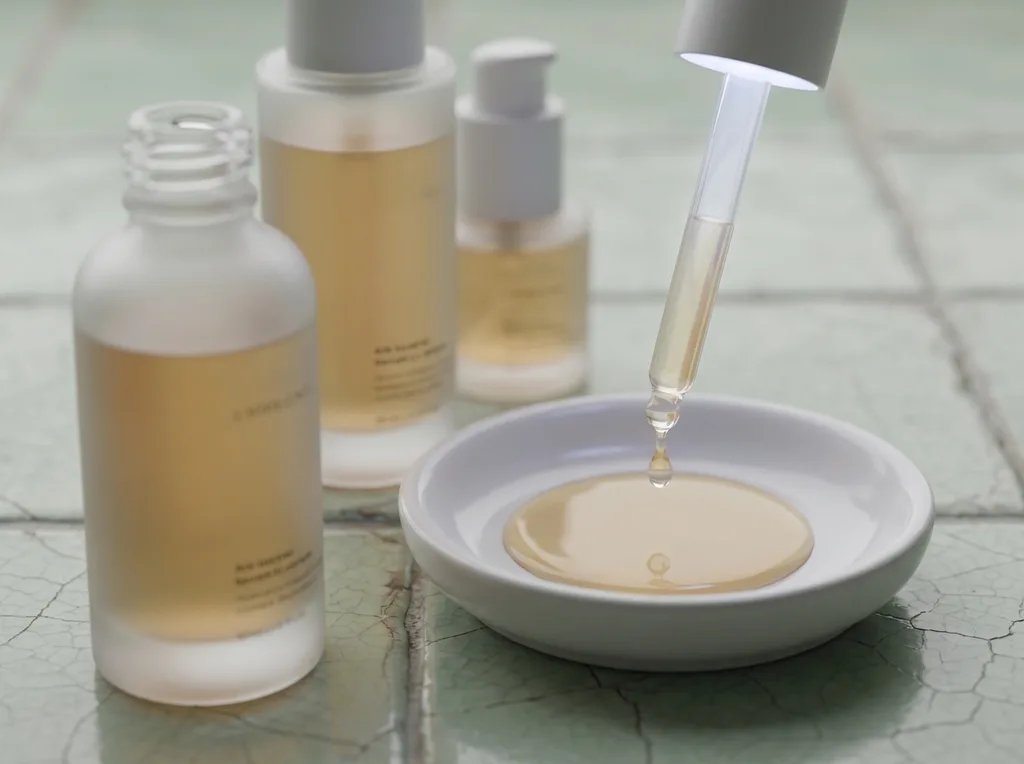
Let's work with a real-world scenario. A typical Western prestige anti-aging serum — the kind sold at Sephora or Nordstrom for $90–$130 — versus a Korean Functional Cosmetic anti-aging serum available at Olive Young or iHerb for $15–$22. Both claim to improve the appearance of fine lines and firmness. Both have sleek packaging and compelling copy.
Here's what the ingredient list reveals when you read it the way a Korean 코덕 (ko-deok, ingredient-obsessed beauty nerd) does.
The Western Prestige Profile
Typical opening: water, glycerin, cyclopentasiloxane (a silicone carrier), dimethicone, various emollients, then — often around positions 12–18 on the list — the hero ingredient appears. Retinol at 0.1–0.3%, perhaps. Or peptides. What appears around it in positions 1–10 is largely a delivery and texture system: elegant packaging for the face, designed to feel luxurious. That texture system is expensive to formulate. It is not doing the anti-aging work.
Importantly, many Western prestige serums are not required to be, and are not, 기능성화장품 equivalents. They can claim "reduces the appearance of fine lines" because regulators read "appearance of" as a cosmetic rather than a functional claim. The ingredient doing the actual work may be present, but at what concentration? In what stability environment?
The Korean Functional Cosmetic Profile
A Korean serum that has cleared MFDS wrinkle-improvement review typically leads with adenosine at a position that suggests meaningful concentration (above 0.04%, which clinical evidence indicates is the threshold for measurable fibroblast activation and collagen stimulation). The formula is built around delivering that active. The texture system is simpler — often lighter, more watery, less silicone-heavy — because the formulation goal is penetration, not sensory luxury.
The ingredient list tells you immediately where the brand's priorities are. Prestige Western formulas spend budget on the first 10 ingredients building an experience. Korean functional formulas spend budget on getting the active to work.
| Comparison Factor | Western Prestige ($90–$130) | Korean Functional Cosmetic ($15–$22) |
|---|---|---|
| Regulatory status | Cosmetic claim (no efficacy proof required) | MFDS Functional Cosmetic (clinically proven) |
| Hero ingredient position | Typically 12th–20th (trace-level risk) | Typically 3rd–8th (functional concentration) |
| Formulation priority | Sensory experience + brand texture | Penetration + active delivery |
| Stability technology | Variable; often standard preservation | Liposome encapsulation, airless packaging common |
| Primary efficacy target | Line reduction (surface) | 탄력 (elasticity) + collagen infrastructure |
| Marketing spend in price | High (~65–75% of retail) | Moderate (~30–40% of retail) |
[K-Beauty 101] 탄력 (tallyeok) — Skin elasticity. The single most cited concern among Korean women in their 40s and 50s, and the primary target of Korean anti-aging clinical formulation. This is not the same as "reducing fine lines" — it is a structural goal, addressing the dermal matrix itself. The difference in target explains why Korean anti-aging results look structurally different from Western ones: they were aiming at a different thing from the beginning.
The Retinal Question: Why Your Retinol Might Be Working Harder Than It Needs To
The most quietly consequential fact in Korean anti-aging ingredient science right now: retinal (retinaldehyde) converts to retinoic acid in skin with approximately 11 times the efficiency of retinol. One metabolic step instead of two. This is not a marginal improvement — it's a fundamentally more direct path to the same receptor.
Korean formulators have moved toward retinal faster and more aggressively than Western brands, largely because the demand for visible results without irritation comes from a consumer base that understands ingredient science and will not accept trade-offs. The challenge with retinal has always been stability — it oxidizes rapidly, rendering it inert before it reaches the skin. The solution Korean brands adopted widely: liposome encapsulation and airless pump packaging. The active is sealed in a delivery vehicle until it contacts skin.
What this means for a woman arriving at this category at 45: she doesn't need to start with retinol and "work up." If she can find a stabilized retinal formula — and the Korean market has several in the $20–$35 range — she can start with a more efficient active from the beginning, at the concentrations Korean functional cosmetic standards actually validate.
This is not to say retinol doesn't work. It does. But here is the honest overdose reality:
What Skip-Care Actually Means for Mature Skin
The concept that K-Beauty media packages as a trend is, for women over 40, a clinical reality. 스킵케어 (seukip-ke-eo, Skip-Care) — the deliberate simplification of routine — isn't laziness or minimalism for its own sake. It's a biological response to what happens to the skin barrier as estrogen levels decline.
Estrogen supports ceramide synthesis. Lower estrogen means less natural ceramide production, a thinner skin barrier, and less tolerance for layering multiple actives. The 10-step routine that Korean beauty media still promotes — and that was always somewhat mythologized — is genuinely counterproductive for mature skin. Each additional step is a potential irritant load. Each active ingredient added to a compromised barrier is a variable that can cause sensitization, inflammation, and ultimately worse outcomes than a simpler routine would have delivered.
What Korean dermatologists actually recommend for women in their 40s and 50s: three to five steps, maximum. A barrier-repairing cleanser. A 기능성화장품-certified functional serum with one hero active (adenosine OR retinal, not both simultaneously in early phases). A ceramide-rich moisturizer that addresses 속건조 (sok-geon-jo) — the inner dryness that feels tight beneath a surface that seems fine. And SPF, without exception, every morning without exception.
The elegant result of this constraint: fewer products, lower total spend, and a routine the skin can actually tolerate consistently over months — which is when the results appear.
The Price Reality: What You're Actually Paying For
Let's work through where the money actually goes in a $120 Western prestige anti-aging serum.
Here's what the price breakdown actually looks like for a typical $120 Western prestige anti-aging serum: roughly 65–75% of the retail price is absorbed by brand equity, marketing, retail markup, and the influencer ecosystem that keeps it visible. About 10–12% goes to packaging (and luxury packaging is expensive). The actual active ingredient content — the retinol or peptides that are supposed to do the work — sits somewhere around 8–10% of what you paid.
Now take a Korean functional cosmetic at $20. Marketing and brand costs are lower, roughly 30–35%. But here's what shifts: the stability technology — the liposome encapsulation, the airless pump that prevents oxidation — takes a larger percentage of the production cost. Because that technology is not decorative. It is what keeps the retinal active from degrading before it reaches your skin. Approximately 25–30% of the Korean product's cost is in active ingredient and delivery system combined.
You're not just buying less marketing. You're buying a different priority structure entirely.
The cases where Western prestige is genuinely worth it: when the brand has invested in proprietary encapsulation technology that is clinically validated and not replicable at lower price points, or when the formula complexity (multi-peptide systems, growth factor delivery) genuinely requires expensive manufacturing. Some do. Check for published clinical data, not just clinical-sounding language.
The cases where you're buying a beautiful bottle and a compelling story: almost everything else.
The Synergy Map: How to Actually Build a Mature Skin Routine
The Skip-Care philosophy doesn't mean doing nothing — it means doing the right things in the right order without unnecessary collision.
For mature skin, the actives that matter are: adenosine (collagen stimulation), stabilized retinal or encapsulated retinol (cell turnover), ceramide-cholesterol-fatty acid trios (barrier restoration), and peptides (structural support). The enemies of this system are: over-exfoliation, high-concentration vitamin C at the wrong pH destabilizing your other actives, and the instinct to add more when something isn't working fast enough.
✅ Strong Synergy Pairs
Adenosine + Niacinamide — different mechanisms, no conflict, combined brightening and elasticity support
Retinal (encapsulated) + Ceramide moisturizer — the retinal drives turnover; the ceramide restores the barrier it transiently disrupts
Peptides + Hyaluronic acid — peptides need hydrated skin to work effectively; layering order matters: HA first, peptide serum second
⚠️ Separate or Sequence Carefully
Retinal + Vitamin C — both are unstable actives; using together increases oxidation risk; split AM (Vitamin C) / PM (Retinal)
Retinal + AHA/BHA exfoliants — the combination on compromised mature skin is a barrier-destruction risk; if using both, use on alternate nights only
Multiple 기능성화장품 actives simultaneously — two functional cosmetics with different hero actives can conflict; build one foundation before adding the second
The practical morning routine for mature skin under the Korean functional cosmetic framework: gentle pH-balanced cleanser → functional essence or toner (adenosine-based if using retinal at night) → ceramide-rich moisturizer → SPF 50+ PA++++. Four steps. The MFDS sunscreen standards are among the strictest globally — Korean SPF ratings are not inflated. This matters enormously because UV exposure is responsible for the majority of visible structural aging, and no amount of retinal corrects what daily sun exposure is continuously doing.
The evening routine: same cleanser → encapsulated retinal serum → heavy ceramide moisturizer (lock in the active, rebuild what the retinal is working on). That's it. Three steps. The Korean dermatology community calls this 피부결 (pibu-gyeol) maintenance — tending to the overall quality and grain of skin rather than targeting individual symptoms in isolation.
The Verdict: Your Situation, Your Decision
There is no universal answer here. There is your situation, the evidence, and your budget. Here is what the science actually supports:
If ingredient efficacy is your only criterion: A Korean 기능성화장품-certified serum with adenosine in the top 10 ingredients, paired with a stabilized retinal product in airless packaging, represents the most evidence-backed formulation approach available at any price point. The MFDS certification means the wrinkle-improvement claim cleared regulatory review. That floor doesn't exist in most Western markets.
If budget is limited: Korean functional cosmetics at the $15–$25 range routinely outperform Western prestige products on active ingredient concentration and delivery technology. The formulation priorities are simply different. Spend the savings on sunscreen — consistent SPF use over two years does more structural work than any serum.
If you're drawn to hanbang (traditional Korean herbal medicine) ingredients: Red ginseng, fermented botanical extracts, and Centella Asiatica are increasingly validated by peer-reviewed research, not just tradition. These categories are worth investigating, particularly for the inflammation-reduction properties that accelerate visible aging in mature skin. But apply the same test: is the active extract present at a meaningful concentration, or is it the 24th ingredient, there for the label?
When Western prestige is actually worth the premium: When you can find published, peer-reviewed clinical data attached to a specific formula — not brand-funded studies, not before/after photography, but actual clinical trial data on the patented delivery system. Some brands have this. It genuinely justifies a price gap. Look for it before you pay for it.
The honest summary: a Korean woman in her 40s standing in Olive Young at 11 PM isn't looking at the most expensive product. She's looking at the 기능성화장품 stamp, checking the ingredient position of her hero active, and buying the one that clears both tests. She's been doing this for years. The system works. You now have the same reading tools she does.
Good skin in your 50s isn't a product you buy. It's a decision you make about what you stop buying — and what you understand before you buy anything.
Medical & Financial Disclaimer:
⚠️ Disclaimer: This article is educational and does not constitute medical, dermatological, or financial advice. Skincare ingredients including retinoids (retinol, retinal), adenosine, and exfoliants can cause irritation, sensitization, or adverse reactions, particularly in mature or compromised skin barriers. Always perform a patch test before introducing any new active ingredient. If you are experiencing significant skin changes, hormonal shifts, or have a diagnosed skin condition, consult a board-certified dermatologist before modifying your routine. Ingredient position analysis and concentration estimates are based on general INCI formulation science and industry standards — they are not laboratory-verified for any specific product. Price comparisons reflect general market observations and may vary by region and retailer. This article contains no sponsored content and no brand has compensated the author for any mention.
✓ Researched and compiled using verified data as of the publication date.
 Operated by: Quiet Korea | Contact: rsl.2001.1975@gmail.com
Comments
Post a Comment