The Infrastructure Question: What Korean Anti-Aging Actually Targets (And Why You've Been Chasing the Wrong Thing)
The Infrastructure Question: What Korean Anti-Aging Actually Targets (And Why You've Been Chasing the Wrong Thing)
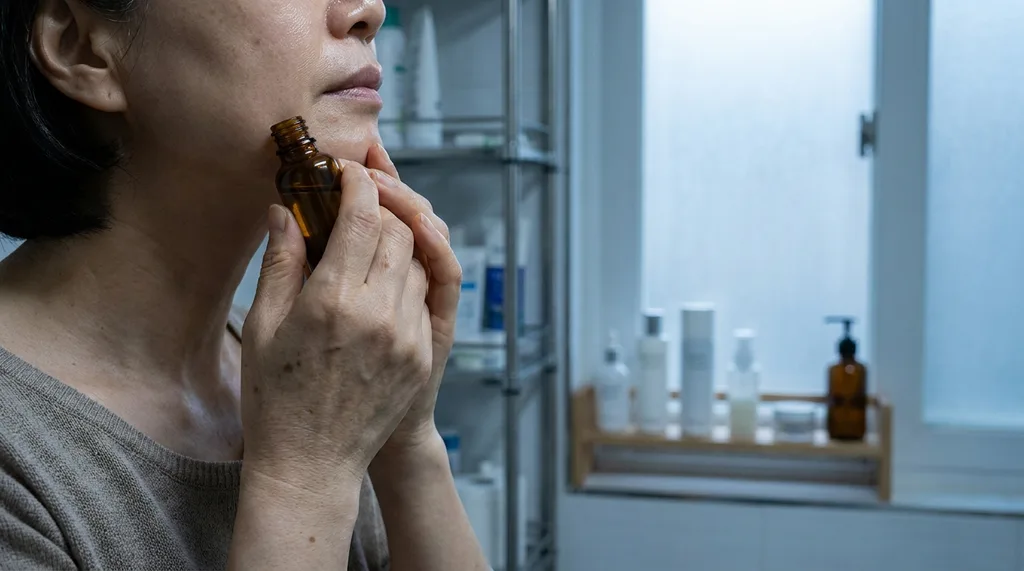
Walk into a dermatology clinic in Gangnam and ask the receptionist what separates a Korean woman's skin at 52 from what she typically sees in Western patients her age. She won't mention a moisturizer. She won't bring up the 10-step routine. She'll say one word — tallyeok — and then she'll ask you something that will stop you cold: "When did you start?"
- The Infrastructure Nobody Told You About
- The Legal Proof That Changes Everything
- The Retinoid Ladder Korean Dermatology Actually Uses
- Why the 10-Step Routine Is Wrong for You Specifically
- Hanbang's Thread From Grandmother to Lab
- How to Actually Enter the System at 45, 50, or 55
- Explore Functional K-Beauty Anti-Aging Products
That question is the entire article. But the answer is more useful than you think.
The assumption baked into almost every piece of K-Beauty content aimed at women over 40 is that the goal is to catch up — to acquire the right products and run the right sequence and gradually close the gap. It's a flattering idea. It's also structurally wrong. The skin you've been admiring on Korean women in their 50s wasn't produced by a great serum in their 50s. It was produced by an entirely different target — one that Korean skincare culture has been working toward since their 20s, and one that Western anti-aging has almost entirely ignored.
Here's what that target is. And here's where you actually enter the system — not at the beginning, but at exactly the right layer for where you are now.
The Infrastructure Nobody Told You About
The foundational misunderstanding goes like this: K-Beauty works because Korean women use more products, more diligently, starting younger. The routine is the secret.
It isn't.
The routine is downstream of a philosophy. And the philosophy operates on a completely different axis than the one Western skincare has built its entire commercial architecture around. Western anti-aging is reactive — it waits for wrinkles to appear and then attempts to treat them. Every retinol launch, every peptide serum, every "anti-wrinkle" moisturizer is designed for a consumer who is already looking at lines in the mirror and trying to reverse course. The market follows the moment of hyeonta — that jarring, stomach-dropping instant when you catch yourself in unforgiving light and realize something has shifted.
Korean anti-aging doesn't wait for that moment. It's building against it for decades before it arrives.
The target is tallyeok — skin elasticity. Not smoothness, not brightness, not even hydration, though those matter too. Elasticity: the structural integrity of the dermis, the bounce-back of well-supported collagen and elastin networks. Korean women in their 40s and 50s cite tallyeok as their primary concern far more consistently than wrinkle depth or fine lines. This isn't semantics. The treatment choices that flow from "I want to maintain elasticity" are radically different from the choices that flow from "I want to smooth this line."
[K-Beauty 101] 탄력 (tallyeok) — Skin elasticity. The structural resilience of the dermis — the skin's ability to return to its original form after compression or movement. In Korean anti-aging philosophy, tallyeok is the primary target; fine lines are a downstream symptom of its loss, not the target itself.
This distinction explains why the results look different. A treatment culture that has been targeting elasticity for 20 years produces different skin than one that has been patching lines for 10. The infrastructure is what you're seeing on those faces.
But there's something more specific driving the Korean system — something that doesn't exist anywhere else in the world. And it changes the calculus for which products actually work.
The Legal Proof That Changes Everything
South Korea's Ministry of Food and Drug Safety — the MFDS — runs a regulatory category with no real equivalent in Western markets. It's called 기능성화장품, or gijeungseong hwajangpum (Functional Cosmetic), and it is a legal designation, not a marketing term.
[K-Beauty 101] 기능성화장품 (gijeungseong hwajangpum) — Functional Cosmetic. A formal legal classification under Korean law for products that have demonstrated clinically proven efficacy in specific areas — most relevantly, wrinkle improvement and skin brightening. To carry this designation, a brand must submit clinical trial data to the MFDS. This is not a self-reported claim. It is a regulatory gate.
This matters more than it sounds. In the U.S. or EU, a brand can claim a product "visibly reduces the appearance of fine lines" with essentially no clinical substantiation. In Korea, to legally say a product improves wrinkles, you need approved actives at proven concentrations with documented evidence. The system forces the industry toward what actually works.
The most prominent example: adenosine. Not a glamorous ingredient. Not a viral trend. But adenosine binds to A2A receptors on dermal fibroblasts to directly stimulate collagen synthesis — a mechanism that is documented, repeatable, and approved by the MFDS for wrinkle-improvement claims. At concentrations between 0.04% and 0.1%, with daily application, clinical studies show measurable wrinkle improvement within 3 to 8 weeks. Walk into any Korean pharmacy and turn over almost any "functional" anti-aging product; adenosine will be on the label.
Then there's the retinoid question — and this is where most Western consumers discover how far behind the conversation they've been.
The Retinoid Ladder Korean Dermatology Actually Uses
Retinol has been the Western anti-aging gold standard for decades. It's everywhere. It's also the least efficient form of vitamin A available for topical use. The reason: retinol requires two metabolic conversion steps inside the skin before it becomes the biologically active form (retinoic acid). Each conversion step costs efficacy. Each step introduces a lag time between application and result. Each step is also where irritation accumulates.
Korean formulation science — and the dermatologists backing it — increasingly favor retinal, also called retinaldehyde. The difference is structural: retinal is one metabolic step closer to the active form. Only one conversion required, not two. This translates to roughly 11 times greater conversion efficiency than retinol at the point of cellular activity.
The irritation profile is also meaningfully lower. Korean brands stabilize retinal through liposome encapsulation — a delivery technology that protects the molecule from oxidation before absorption and releases it at a controlled rate in the skin. This is not a minor technical footnote. For a woman in her 40s or 50s whose skin barrier is already compromised — and almost every woman's barrier is, post-menopause — the difference between a product that destabilizes the barrier further and one that works within it is the difference between results and months of inflamed, sensitized skin.
Which brings up the thing most anti-aging content never says out loud.
Why the 10-Step Routine Is Wrong for You Specifically
The 10-step K-Beauty routine is a marketing artifact, not a clinical protocol. It was built for a specific skin type — oily, young, well-barriered — at a specific time when K-Beauty was trying to introduce the concept of layering to Western audiences. For most women over 40, and especially post-menopause, running 10 active layers over skin whose barrier is already struggling is not a path to better results. It's a path to chronic low-grade inflammation that accelerates the exact aging process you're trying to slow.
As estrogen levels decline, the skin produces less ceramide, less natural moisturizing factor, and has a structurally weaker lipid barrier. The Korean term for what happens next is sok-geon-jo — inner dryness, a tightness that exists deep in the skin layers even when the surface has been slathered with product. This is not a problem of not applying enough; it's a problem of the skin's inability to hold what you're applying. More steps do not solve this. Fewer, targeted ones do.
Western Anti-Aging Model
Primary target: Visible lines and wrinkles
Timing: Reactive — after aging appears
Method: High-concentration actives, aggressive exfoliation
Regulatory claims: Self-reported, minimal substantiation required
Risk for mature skin: Barrier disruption, rebound sensitivity
Korean Anti-Aging Model
Primary target: Elasticity (tallyeok) and structural integrity
Timing: Preventive infrastructure, built from the 20s
Method: Barrier-first, then targeted actives at proven concentrations
Regulatory claims: MFDS-certified functional cosmetics with clinical data
Risk for mature skin: Lower — system is designed around barrier health
This is what seukip-ke-eo (skip-care) actually means in a mature skin context. It's not a lazy shortcut. Korean dermatologists increasingly recommend it as a biological necessity — stripping your routine down to what your compromised barrier can actually process. Three to five steps, deliberately chosen. Cleanser, barrier-rebuilding toner or essence, one clinically active product, SPF. That's often the entire prescription.
The sophistication is not in the number of steps. It's in knowing which three steps to keep.
Hanbang's Thread From Grandmother to Lab

There's a category of Korean anti-aging where the history and the science run so closely together that you can't easily separate them. Hanbang — traditional Korean herbal medicine applied to skincare — is often dismissed by Western consumers as folk remedy aesthetics. Korean cosmetic scientists find this baffling, and with reason.
Red ginseng (hongsam) is the most studied example. The steaming-and-drying process that transforms raw ginseng into red ginseng does something chemically specific: it increases the bioavailability of ginsenosides, the compounds responsible for the antioxidant and collagen-stimulating activity. Clinical trials — not testimonials, trials — have documented meaningful contributions to skin health from red ginseng extract at sufficient concentrations. The ingredient that Korean grandmothers have brewed and applied for centuries is the same ingredient that cosmetic scientists are now formulating into high-concentration serums. The cultural continuity between those two facts is one of the things that makes Korean anti-aging philosophy genuinely distinct — it has 2,000 years of human data behind it that Western cosmetic science is only now beginning to verify formally.
The darker side of hanbang in modern marketing is the dilution problem. "Contains red ginseng" on a label can mean a transformative concentration of ginsenosides or it can mean a drop in a vast base of water and glycerin. The pibu-gyeol (skin texture) improvement associated with quality hanbang formulations depends heavily on this — and it's where the sophisticated Korean consumer (and the data-driven platforms like Hwahae that power them) does the work of reading past the front label to the ingredient list's actual ranking.
🎵 K-Mono Lofi — Seoul Study Beats
Read deeper with Seoul lo-fi in the background — curated by K-Mono Lofi
The consumer base driving Korean anti-aging is perhaps the most ingredient-literate in the world. Hwahae, the dominant Korean beauty review and ingredient analysis platform, has trained a generation of consumers to read INCI lists the way a sommelier reads a wine label. They are not impressed by marketing claims. They are looking at ingredient position, concentration indicators, and the presence or absence of functional-grade actives. This is the consumer that Korean brands increasingly formulate for — which is why the products, when chosen correctly, tend to work.
How to Actually Enter the System at 45, 50, or 55
This is the question that matters, and the honest answer has two parts: what's genuinely recoverable, and what the realistic timeline is.
Skin elasticity loss is real and partly structural — collagen and elastin degradation that has been happening for years is not going to reverse in four weeks of a new routine. Manage that expectation with precision. What is recoverable, and measurably: barrier integrity, cellular turnover, surface texture improvement, and — with consistent use of clinically-proven actives — some degree of collagen stimulation that meaningfully slows further structural loss. This is not a consolation prize. It is a substantial outcome.
The entry sequence for someone starting this system at 45 or later:
Layer 1 — Repair the barrier before you do anything else. Ceramides, cholesterol, and fatty acids in a ratio close to the skin's natural lipid profile. Not a fancy actives-packed product. Something that your barrier can actually receive. Sok-geon-jo — that deep inner dryness — is often the first thing that resolves, within two to three weeks. When it does, the skin becomes more receptive to everything else.
Layer 2 — Choose one proven active and use it correctly. For collagen stimulation: adenosine at a functional concentration (look for it in the first half of the ingredient list). For cellular turnover: retinal, encapsulated, at a low-to-moderate starting concentration. Not both at the same time, not in your first month. One at a time. Let the skin adapt.
Layer 3 — SPF is not optional, it is the entire foundation. The elasticity loss you're working to address is dramatically accelerated by UV damage. Every other step you take is partly undone each morning you walk out without SPF. Korean sunscreen formulations — lightweight, high-PA-rated, actual pleasure to wear — are where the gap between "I apply SPF" and "I apply SPF daily without resentment" closes. Find one you will actually use.
What to honestly not expect: Deep structural bone loss and decades of UV damage are not erased by any topical routine, at any price. The women whose skin you admire have different genetics and different decades. What you can do is change the trajectory — begin building the infrastructure that slows further loss and improves the quality of what you're working with. That is worth everything.
The reason the most sophisticated Korean women in their 50s look the way they do is not that they found a magic product. It's that they spent decades working toward a specific target — tallyeok, structural integrity — with ingredients that had clinical proof behind them, inside a regulatory system designed to force that proof. You didn't have access to that system or that knowledge decades ago. You have it now.
That is not too late. It is exactly when you start.
The women who have been quietly building this infrastructure since their 20s weren't smarter or more disciplined than you. They just happened to grow up in a culture that gave them a different question to ask their skin. Now you have the question. The rest is just ingredients and time.
If you want the insider framework — the specific product categories, the ingredient concentration thresholds, and the honest guide to what a Korean dermatologist would actually recommend versus what the marketing department wants you to buy — that's exactly what the Black Book covers.
Medical & Financial Disclaimer:
⚠️ Disclaimer: The ingredient science and routine recommendations in this article are educational and informational only. They are not a substitute for personalized medical advice. If you are experiencing significant skin changes, are post-menopausal, have a diagnosed skin condition, or are on any hormone therapy or medication, consult a board-certified dermatologist before introducing new active ingredients — particularly retinoids at any concentration. Patch-test all new products before full application, regardless of marketing claims. Results from topical skincare vary significantly based on individual skin biology, consistency of use, and baseline skin health.
✓ Researched and compiled using verified data as of the publication date.
 Operated by: Quiet Korea | Contact: rsl.2001.1975@gmail.com
Comments
Post a Comment