Glass Skin Masterclass
Somewhere in Seoul, a woman in her mid-forties is running her fingers over her face with the quiet confidence of someone who knows exactly what's there. Her skin holds light like the inside of a seashell — not shiny, not greasy, just luminous in a way that makes you look twice. She owns maybe five products. She bought most of them years ago.
- The Two Glows, and Why Only One of Them Is Real
- Why Your Skin Barrier Is the Product You're Actually Missing
- The Glass Skin Morning Ritual: Building From the Inside Out
- The Night Protocol: Where Sok-gwang Is Actually Made
- The Beautiful Things That Are Quietly Destroying Your Barrier
- The Routine That Connects to the Reader Who Wants to Go Deeper
- 💊 Find This on iHerb (Use Code QAK3042 for a discount!)
Twenty minutes away, a beauty enthusiast with a shelf of forty carefully curated K-beauty products is fighting dehydration lines by noon.
Nobody in sponsored content will explain why that gap exists. But everything in this article is about exactly that.
The answer isn't in any bottle. It's in the difference between two Korean words that most global beauty content treats as synonyms — and they are not even close to the same thing.
[K-Beauty 101] Mul-gwang (물광) — Water Glow. The intensely dewy, mirror-like finish that makes skin look as if it just stepped out of a mist. It is a visual surface state — product-dependent and, critically, transient.
[K-Beauty 101] Sok-gwang (속광) — Inner Glow. The lit-from-beneath radiance that Korean skin veterans describe as the skin's own light source. It is not a finish. It is a physiological state — the external evidence of a structurally sound skin barrier functioning exactly as it should.
Here is the distinction that changes everything: mul-gwang is what your products do to your skin. Sok-gwang is what your skin does when your products finally stop getting in the way.
Chasing mul-gwang is easy. Serum flood your face, layer humectants on damp skin, mist every twenty minutes. You will look luminous in certain lighting by 10 AM. By 2 PM, your skin has pulled that surface moisture back into the environment and left you with nothing, because the barrier that was supposed to hold all that hydration in place was never repaired — it was just temporarily plastered over.
That is the trap. And most glass skin content is selling you deeper into it.
The Two Glows, and Why Only One of Them Is Real
💧 Mul-gwang — Water Glow
Source: Surface humectants, occlusives, product layering
Durability: Hours. Evaporates with the product film
Trigger: Hyaluronic acid, glycerin, skin flooding technique
Risk: Can create dependency; barrier still dry beneath
The tell: Tight or dull skin once the product wears off
✨ Sok-gwang — Inner Glow
Source: Barrier integrity, stratum corneum hydration
Durability: Persistent. Present at 6 AM with no product on
Trigger: Ceramides, consistent gentle routine, time
Risk: Cannot be rushed; impatience destroys it
The tell: Skin looks good before you've touched it
The Korean concept of sok-geonjo (inner-skin dryness) is the key to understanding why so many Western glass skin routines fail. Sok-geonjo describes the condition where the skin's surface reads as normal or even oily — but the deeper layers are desperately parched, because transepidermal water loss (TEWL) is pulling moisture out faster than any humectant can replace it. The stratum corneum — that outermost brick-and-mortar layer of corneocytes and intercellular lipids — has been stripped, disrupted, or simply never given the conditions to function properly.
When TEWL is high, you are essentially trying to fill a cracked bathtub with a garden hose. More product does not solve a structural leak. It just delays the inevitable dullness.
Mul-gwang says: pour more water in. Sok-gwang says: fix the crack first.
🎵 K-Mono Lofi — Seoul Study Beats
Read deeper with Seoul lo-fi in the background — curated by K-Mono Lofi
Why Your Skin Barrier Is the Product You're Actually Missing
The skin barrier is not a metaphor. It is a specific, measurable structure — the stratum corneum's ratio of ceramides, fatty acids, and cholesterol that determines how well your skin seals moisture in and keeps environmental aggressors out. When this ratio is healthy, light refracts evenly off the skin's surface. That even refraction is what your eye reads as the glass skin aesthetic. It is physics, not cosmetics.
When the barrier is compromised, the surface becomes uneven at a microscopic level. Moisture pockets next to dry patches. Inflamed areas next to calm ones. Light scatters instead of reflecting, and the result is what tired skin actually looks like: flat, uneven, faintly gray.
Here is where the Mermaid diagram earns its place — because the causal chain from barrier health to glass skin is not a straight line, it is a fork:
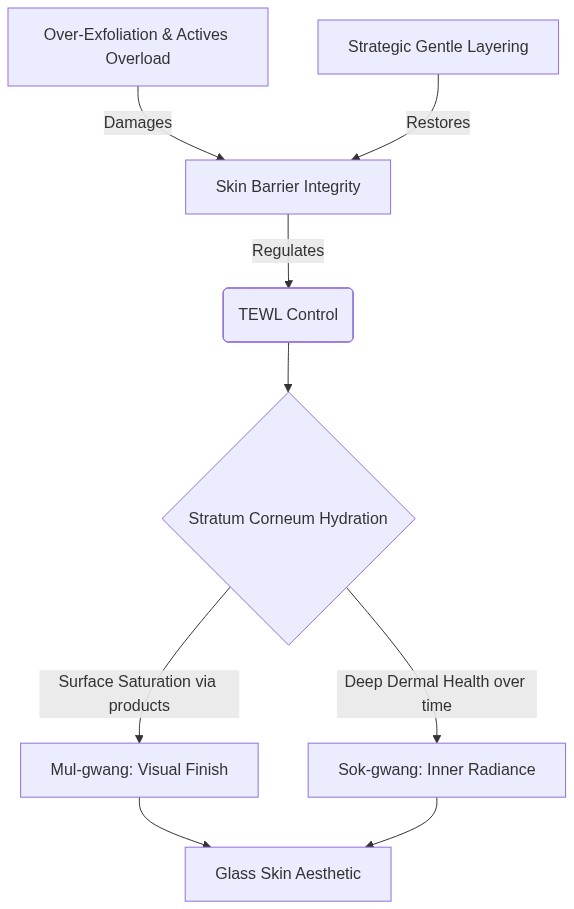
Both paths lead to glass skin — but one path lasts until lunch. The other lasts for years.
The global glass skin market is on track to reach USD 42 billion by 2035, growing at 10.5% annually. That is an enormous amount of product being sold to people who mostly have barrier-disrupted skin and are being handed more products instead of the foundational knowledge that would actually change their skin. The industry has a financial interest in the cracked bathtub. You do not.
The Glass Skin Morning Ritual: Building From the Inside Out
The AM routine has one job: protect what last night built. Every step is defensive, not transformative. Transformation happens at night. Morning is armor.
Step 1 — The Gentle Rinse (Purpose: preserve overnight barrier work)
Unless your skin runs extremely oily, morning means rinse — not cleanse. Lukewarm water, thirty seconds, fingertips only. The skin has spent eight hours in repair mode, rebuilding lipid layers, synthesizing new corneocytes. A cleanser at 7 AM strips those freshly laid lipids before they've had a chance to integrate. Koreans have understood this for decades. Most Western routines still double-cleanse at dawn and wonder why they're perpetually dehydrated.
If you have oily skin that genuinely needs morning cleansing, use a pH-balanced (yak-san-seong, roughly 5.5 pH), non-foaming cleanser. Thirty seconds. Pat dry with a soft cloth — never rub.
Step 2 — Dak-to: The Wiping Toner Pass (Purpose: sweep debris, prime surface)
The Korean technique called dak-to — wiping toner — is your first real active step. Saturate a cotton pad completely until it is translucent with toner. A pad that is barely damp creates friction; friction creates inflammation; inflammation destroys barriers. Sweep along skin texture — not against it, not in circles. Neck upward, cheekbones outward. One pass per zone. This is not exfoliation. It is preparation.
Wait forty-five seconds. Do not skip this. The brief air exposure allows the previous layer to begin setting.
Step 3 — Chap-to: The Patting Toner Pass (Purpose: flood the freshly cleared surface)
Now switch technique entirely. Pour a generous amount of hydrating essence-toner directly into cupped palms. Warm it between both hands for ten seconds — you are using your body temperature to lower the product's viscosity, which improves absorption. Press both palms against your face simultaneously and hold for five seconds. Do not rub, do not pat rapidly. Hold and release, hold and release, working outward from the center. Repeat this three to five times with the same application. This is a compressed version of the 7-skin method (Chil-skin-beop) — and research suggests that layering watery toners this way can improve surface hydration by 30–40% compared to a single application.
Step 4 — Barrier Serum (Purpose: deliver ceramides and niacinamide while the barrier is receptive)
With skin still slightly tacky from the patting toner, apply a serum focused on barrier repair. The molecules you want here are ceramides (they physically replenish the lipid matrix), niacinamide (which increases ceramide synthesis and reduces TEWL), and panthenol (a skin-identical humectant that holds water without creating dependency). Apply three drops to fingertips, press onto forehead, cheeks, and chin simultaneously, then smooth outward. No downward dragging. Always upward and outward.
Wait sixty seconds before the next step. Set a timer if you need to.
Step 5 — Moisturizer (Purpose: seal everything in)
A lightweight gel-cream for oily or combination types; a richer emulsion for dry. Apply the same pressing technique — palms together, body heat, press and release. The moisturizer's job is occlusive: create a breathable film over everything you just layered so it cannot evaporate while you commute or sit under office air conditioning.
Step 6 — SPF (Purpose: protect the barrier from its single greatest daily attacker)
UV radiation degrades ceramides. It directly attacks the lipid matrix that creates mul-gwang and sok-gwang both. SPF is not optional in a glass skin routine. It is the routine. Apply generously — two finger-lengths for face and neck — and do not tap it in with your palms. Smooth outward, let it settle naturally. The barrier you spent the previous fifteen minutes building will thank you by 4 PM.
The Night Protocol: Where Sok-gwang Is Actually Made
If the AM routine is armor, the PM routine is reconstruction. Skin cell turnover peaks between 11 PM and 4 AM. Everything you apply before sleep is delivering into a biological environment optimized to receive it.
Step 1 — Oil Cleanse (Purpose: dissolve sunscreen, sebum, and particulate pollution)
This is i-jung se-an — the double cleanse — and it begins with an oil cleanser applied to completely dry skin. No water first. The oil-dissolves-oil principle only works when the cleansing oil can bind directly to the lipid-based debris on your face. Massage for sixty seconds in circular motions, then emulsify with a small amount of water until the oil turns milky, and rinse.
Step 2 — pH-Balanced Second Cleanse (Purpose: remove water-based impurities without stripping)
Immediately follow with a gentle, yak-san-seong (mildly acidic) foam or gel cleanser. Lather between palms, apply for thirty seconds, rinse with cool-to-lukewarm water. Your skin should feel comfortable and slightly soft — not squeaky. Squeaky is the sound of barrier destruction. If your skin squeaks, your cleanser is too alkaline.
Step 3 — Treatment Toner or Gentle Exfoliant (Purpose: refine texture, maximize absorption — maximum twice weekly)
Two nights a week — not more — you can use a low-acid toning exfoliant (PHA or low-concentration lactic acid works well for barrier-sensitive types; BHA for congestion-prone). Apply to a dampened cotton pad, sweep the face once, and move immediately to the next step. On all other nights, this step is a second pass of hydrating toner using the chap-to technique described above.
Step 4 — Ampoule or Essence (Purpose: concentrated actives delivered into maximally receptive skin)
This is the highest-value moment in your entire routine. Cleansed, gently prepared skin in its nighttime repair state is as receptive as it ever gets. Warm the ampoule between palms, press into skin using both hands simultaneously. Hold for five seconds. The target zone for absorption is the outer layers of the epidermis — you are not forcing product into the dermis, you are creating optimal surface conditions for osmotic absorption.
Step 5 — Targeted Serum (Purpose: address specific concerns — alternate nights for actives)
Retinol, peptides, and barrier-repair concentrates all belong here. Critical rule: do not use high-concentration retinol and AHA on the same night. Do not use vitamin C and benzoyl peroxide in the same layer. These are not myths — they are chemical inactivation. Vitamin C's ascorbic acid requires an acidic pH environment to remain stable; alkaline actives and pro-oxidants degrade it before it can function. If you use multiple actives, alternate them across different nights. Your skin does not need everything every day. It needs consistency more than it needs intensity.
Step 6 — Night Cream or Sleeping Mask (Purpose: occlusive seal for overnight repair)
Apply a richer emollient — one containing squalane, shea, or ceramide complex — in the same pressing motion. On nights when your barrier needs extra support, a sleeping mask over the top provides genuine occlusion, trapping everything beneath and preventing overnight TEWL while you sleep. Press it on. Do not rub.
The Beautiful Things That Are Quietly Destroying Your Barrier

Here is the part nobody writing sponsored content will say clearly: some of the most popular glass skin products and techniques are actively incompatible with achieving sok-gwang.
Daily physical exfoliation — clarisonic-style brushes, gritty scrubs, overused konjac sponges — creates micro-tears in the stratum corneum. The skin responds with low-grade inflammation, which disrupts the lipid matrix, which elevates TEWL, which creates sok-geonjo. The cycle feeds itself, and the solution is sold to you as the cause of the problem.
High-frequency sheet masking — the 1-il 1-pack (one sheet mask per day) approach adored by certain K-pop training narratives — sounds ideal for hydration but can actually macerate the skin barrier if the mask ingredients are not calibrated for your skin type. High-nutrition masks used daily on oily or combination skin can congest pores and disrupt the very barrier they claim to restore. Two to three times a week, lightweight formulations, is the clinically sensible benchmark.
The 7-skin method (Chil-skin-beop) isn't universal. This is worth stating directly. Layering watery toner seven times works beautifully for dry and dehydrated skin types, showing meaningful hydration improvement. But if your skin runs oily or you have active congestion, seven layers of humectant-rich toner can overload the follicular environment and create the breakouts you're trying to eliminate. Know your skin's actual type — not the type you wish you had.
Copper peptides and vitamin C in sequence — one of the more seductive ingredient combinations floating around K-beauty circles — is genuinely contested. Theoretical chemistry suggests they can interact in ways that degrade both actives. The scientific community has not reached full consensus on this, so it would be dishonest to declare it a forbidden combination. What can be said with confidence: allow significant wait times between any high-performance actives, or use them on alternate evenings. Do not gamble your barrier on the assumption that stacking actives faster produces faster results.
The pattern here is consistent: the people chasing glass skin hardest are often the ones most aggressively working against it. The K-beauty philosophy that actually produces sok-gwang is not maximalism. It is a specific kind of informed restraint — what is increasingly called skincare diet (or skinimalism) in Seoul, where skin that shows signs of fatigue is deliberately rested on a two-step protocol of toner and moisturizer until its self-repair function comes back online.
The Routine That Connects to the Reader Who Wants to Go Deeper
Glass skin as the world currently understands it — the products, the layering sequences, the dewy finish photographs — is the last 20% of the story. The first 80% is this: a fundamentally different relationship with your skin's integrity, one that prioritizes what the skin needs to function over what a routine needs to look impressive on a shelf.
The Korean teenagers who begin learning this at fifteen are not starting with serums. They are starting with the understanding that the skin is not a canvas to improve — it is a barrier to protect. Everything else, every luxurious ampoule and every beautifully packaged sleeping mask, is in service of that barrier. Not a replacement for it.
That is what sok-gwang is. It is not a glow you create. It is a glow you uncover — when you've finally stopped doing the things that were covering it.
The woman with five products and luminous skin in her forties wasn't born with it. She arrived there by subtraction.
The people who most want everything below already understand why the barrier is the real glass skin method. What they're looking for is the deeper community, the ingredients list analysis, the sourcing intel that doesn't exist in sponsored content.
Glass skin was never a finish. It was always a report card — your barrier's own assessment of how well you've been listening.
Medical & Financial Disclaimer:
⚠️ Disclaimer: This article is intended for educational purposes and does not constitute medical or dermatological advice. Individual skin types, barrier conditions, and ingredient sensitivities vary significantly. Before introducing new actives — particularly retinoids, chemical exfoliants, or high-concentration treatments — perform a patch test on a small skin area for 24–48 hours. If you experience persistent redness, stinging, barrier disruption, or reactive skin conditions, consult a licensed dermatologist before continuing or modifying your routine. The market growth figures cited are sourced from publicly available industry research reports and are provided for context, not as investment guidance.
✓ Researched and compiled using verified data as of the publication date.
 Operated by: Quiet Korea | Contact: rsl.2001.1975@gmail.com
Comments
Post a Comment