The Uncomfortable Truths Inside K-Beauty's Best Products (2025)
Walk into an Olive Young at 11 PM on a Tuesday and you'll see something that tourists never quite clock: the women standing in the skincare aisle aren't reading the front of the bottles. They're flipping them over, scanning barcodes, and comparing ingredient lists on their phones with the focused intensity of someone reviewing a contract before signing. The app they're using is Hwahae — Korea's homegrown ingredient analysis platform — and what they're looking for says everything about where K-Beauty actually is right now.
- The $11.4 Billion Industry Built on a Registration Form
- What Happens When the Ingredient Scanners Start Looking
- The Pressure System Behind the Beautiful Products
- The Regulatory Reckoning — And What You Can Do With This, Right Now
- Steps You Can Take Before Your Next Purchase
- Explore Vetted K-Beauty Skincare Ingredients
They're looking for what isn't on the label.
Korea's cosmetics industry hit $11.4 billion in exports in 2025. That number is real, and genuinely astonishing. What gets discussed far less is this: for most of the era that built that number, the products behind it were governed by a regulatory system that didn't require a single mandatory safety assessment report. Registration? Yes. Proof that the thing inside the bottle was rigorously safe for daily human use over months and years? That was largely the brand's own problem to solve — or not solve.
The reckoning is coming. But it hasn't arrived yet.
The $11.4 Billion Industry Built on a Registration Form
Korea's Ministry of Food and Drug Safety (MFDS) has launched what insiders call the most significant restructuring of cosmetic regulation in the country's history. By 2031, every brand designated as a 화장품 책임판매업자 (Hwajangpum Chaekim Panmaeeopja) — the "Cosmetics Responsible Seller," a legal category that finally attaches genuine liability to product safety — will be required to maintain comprehensive safety assessment reports for every product they sell.
Read that again. By 2031.
That means the 10-step routines, the glass-skin serums, the overnight masks that launched a thousand skincare tutorials — most of them were formulated, registered, and shipped globally under a system that the Korean government itself is now overhauling for being insufficient. This isn't a conspiracy. It's a regulatory maturation story, the kind every major industry goes through. But the global K-Beauty narrative has almost never mentioned it, because the gap between "Korea is incredibly advanced in skincare science" and "Korea only recently started requiring mandatory safety assessments" is uncomfortable to hold simultaneously.
Both things are true.
The August 2025 abolition of Korea's government-led "Natural/Organic" certification system makes this even more pointed. Brands that previously carried government-backed natural certification now operate under self-regulatory standards based on ISO 16128. The burden of proof has shifted entirely to the manufacturer. Which means a product labeled "natural" today is backed by the brand's own assessment of what "natural" means — not an independent government body.
The China pivot tells a parallel story. US exports hit $2.2 billion, up 15% year-on-year. But China — historically K-Beauty's largest single market — dropped to $2.0 billion, an 18.7% decline. Some of that is geopolitical. Some is Chinese consumers switching to domestic brands. But a portion is direct consumer skepticism: Chinese beauty forums spent years documenting quality inconsistencies in export-grade K-Beauty versus domestic-market versions. The lesson travels.
🎵 K-Mono Lofi — Seoul Study Beats
Read deeper with Seoul lo-fi in the background — curated by K-Mono Lofi
What Happens When the Ingredient Scanners Start Looking
Here is the number that stops conversations: mercury concentrations in Korean face creams have been detected at levels ranging from not-detected all the way up to 67,000 mg/kg.
For reference, the EU maximum permitted concentration of mercury in cosmetics is 1 mg/kg. The US FDA threshold for prohibited levels is 1 ppm (roughly equivalent). The high end of what's been found in the tested range isn't a rounding error. It's four orders of magnitude above what Western regulators consider acceptable.
This isn't a universal indictment of Korean face creams — the range spans from clean products to extreme outliers, and the data reflects a heterogeneous raw material supply chain, not a deliberate industry practice. But it illustrates precisely why the regulatory overhaul was necessary, and why the "clinical K-Beauty" label deserves interrogation rather than automatic deference.
The synthetic colorant picture adds another layer. Amaranth (R2) — a dye found in various Korean cosmetics — absorbs through the skin at a rate of 3.4% when formulated in a lotion, and 0% when formulated in a cream. These aren't identical products. The carrier matters as much as the ingredient, and ingredient-by-ingredient analysis without understanding formulation context produces false confidence in either direction.
The Hwahae generation of consumers intuitively gets this, which is why the platform has become less of an app and more of a cultural institution. But even Hwahae has limits: it analyzes ingredients as listed, not the concentration, purity, or sourcing of those ingredients. Knowing that niacinamide is in the formula tells you nothing about whether the raw material came from a quality-audited supplier or a bottom-tier commodity source.
The preservative problem that nobody talks about at the counter →
And then there's the sheet mask mythology. Dermatologists in Seoul have become increasingly vocal about this: daily sheet masking — one of K-Beauty's most exported rituals — can actively compromise the skin barrier in sensitive individuals. The occlusion effect traps beneficial ingredients, yes. It also traps irritants and disrupts the skin's natural acid mantle with prolonged contact. The "more is more" logic that drives mask culture is the same logic that's sent a significant number of Korean skincare enthusiasts to dermatology clinics with barrier dysfunction — a condition sometimes called 민감성 피부 (minkamsseong pibu), sensitive skin, though its root cause is often iatrogenic: caused by the very skincare meant to heal it.
The Pressure System Behind the Beautiful Products
[K-Beauty 101] 외모 차별 (Oemmo chabyeol) — Appearance discrimination. The documented practice of preferential treatment based on physical appearance in hiring, promotion, and social contexts. In Korea, resume photographs are standard and appearance is legally permissible grounds for assessment in employment contexts.
Understanding 외모 차별 transforms the entire K-Beauty narrative. What the global audience experiences as aspiration — the glass skin, the seamless foundation coverage, the V-line jaw — is, for many Korean women and men, not a lifestyle choice but a structural response to a documented pressure system. The beauty industry doesn't exist despite this pressure. It profits from it at every layer.
This is the thing that no sponsored K-Beauty content will tell you: the market for these products is partly fueled by anxiety that the industry itself has a vested interest in maintaining.
[K-Beauty 101] 화이트닝 (Hwaiteuning) — Skin whitening. As a product category, it predates modern K-Beauty by decades, with roots in both pre-colonial Korean aristocratic aesthetics (pale skin as a marker of class) and Japanese colonial-era beauty standards. Korean feminists and younger consumer generations are actively challenging it; the industry has begun rebranding "whitening" as "brightening" — a linguistic shift that resolves nothing structurally.
The Hallyu (Hallyu — the Korean Wave) halo effect makes this harder to see clearly. When BTS wears a brand or a K-drama actress's skin goes viral, the product and the cultural moment become indistinguishable. What's being sold is often less a formulation than a proximity to an aspirational identity. Which is fine — every beauty culture does this. The K-Beauty version simply operates within a social context where the aspiration itself is entangled with genuine psychological pressure that researchers have documented in Korean populations: elevated rates of beauty-related anxiety, cosmetic surgery considerations beginning in the teenage years, and an openly lookist hiring culture that turns "taking care of your appearance" from personal choice into economic necessity.
Korea has one of the highest rates of cosmetic surgery per capita in the world. The clinics producing genuinely impressive medical results — the same ones that have attracted medical tourists spending over $2 billion annually — operate within a system where the pressure to use them is, for many Koreans, not really optional. The skill of the surgeons is real. The freedom of the patients is more complicated.
None of this means K-Beauty is irredeemable. It means the full picture requires holding two things at once: a skincare science that is genuinely world-class in formulation innovation, and a social apparatus that sometimes weaponizes that innovation against the people it claims to serve.
The Regulatory Reckoning — And What You Can Do With This, Right Now
The transition is real, and it matters. By 2031, mandatory safety assessments will be required across the board. Post-market surveillance is being strengthened. The "Cosmetics Responsible Seller" framework is moving toward genuine legal accountability. These are structural improvements, not marketing rebrands.
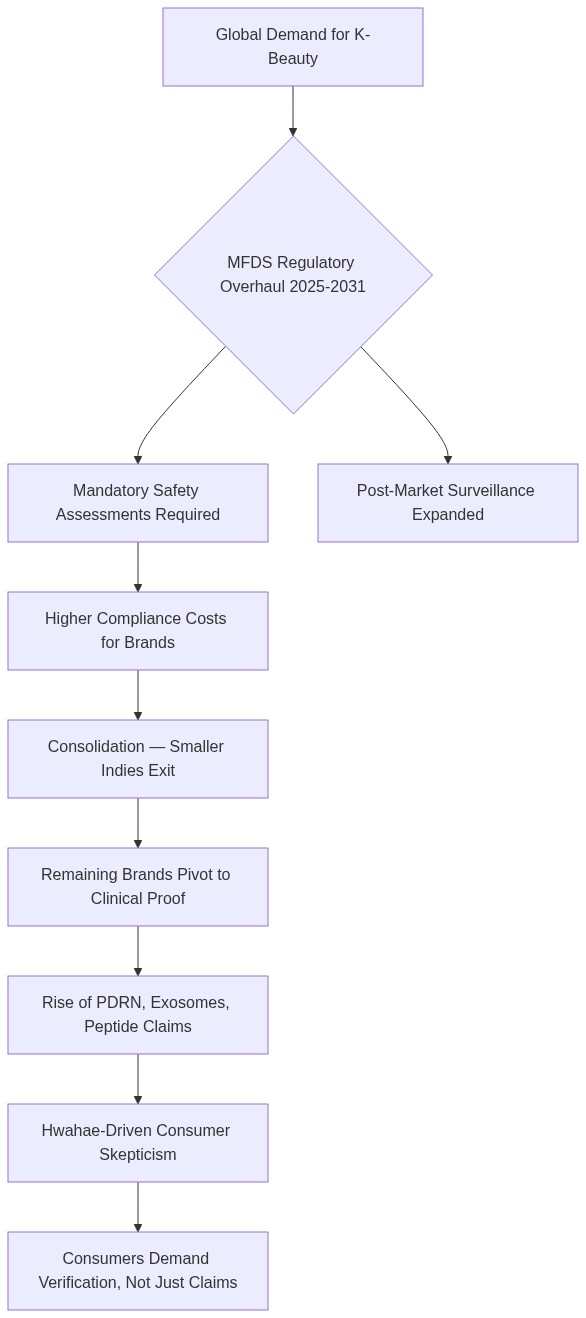
What this map shows isn't pessimistic. It's the shape of an industry growing up. The brands that will matter in 2030 are the ones building clinical dossiers now — investing in stability testing, dermatologist partnerships, and ingredient sourcing documentation. They exist. The work is to find them.
✅ What "Clinical K-Beauty" Actually Means
Peer-reviewed studies on specific concentrations. Third-party dermatologist trials. Ingredient sourcing documentation. Stability testing under varied humidity/temperature. Safety assessment reports prepared under the new MFDS framework. Brands that can produce these on request.
⚠️ What "Clinical K-Beauty" Often Means in Practice
Marketing copy that uses scientific terminology without linked studies. "Dermatologist-tested" with no disclosed methodology. Proprietary blends with no concentration information. Natural/organic claims backed by the brand's own post-August-2025 self-assessment. Efficacy percentages derived from internal consumer panels rather than controlled trials.
Steps You Can Take Before Your Next Purchase
1. Use Hwahae or COSDNA — but know their limits. These platforms tell you what is in a product and flag known sensitizers. They cannot tell you concentration, raw material quality, or supplier origin. Use them as a first filter, not a verdict.
2. Ask where the product is sold officially. The counterfeit market for K-Beauty has matured to the point where holograms and barcodes are being replicated convincingly. If you're buying from an unofficial marketplace, the risk is non-trivial. Cross-reference with brand-authorized retailer lists.
3. Treat "natural/organic" on Korean products with appropriate skepticism. Government-backed certification was abolished in August 2025. What you're reading now is a self-regulatory claim. It may be rigorous or it may be nothing. Ask the brand what standard they're using.
4. Patch-test sheet masks before daily use — and if you're experiencing persistent redness or sensitivity, stop before adding more products. The instinct to add more to fix a broken barrier is almost always wrong.
5. Follow the 2031 transition. Brands that are voluntarily adopting safety assessment documentation before the deadline are telling you something important about their standards. Brands that are not are also telling you something.
6. Hold the complexity. K-Beauty's contribution to global skincare science is genuine. Fermentation technology, layering methodology, ingredient transparency culture — these are real innovations that changed how the world thinks about skin. They coexist with an industry that spent decades under-regulated, operates within a documented pressure apparatus targeting vulnerable populations, and is now rebranding "whitening" without resolving the deeper structural issue. All of this is true. None of it cancels out the rest.
The reader who walks away thinking "K-Beauty is bad" has learned nothing. The reader who walks away thinking "K-Beauty is wonderful and I'll take it all at face value" has learned equally little. The one who holds the contradiction — this is brilliant, and here is exactly where to trust it and exactly where to push back — that's the reader who will spend their money wisely and engage with Korean culture honestly.
Loving something means seeing it clearly. That's not criticism. That's respect.
Medical & Financial Disclaimer:
⚠️ Disclaimer: This article is for educational and informational purposes only and does not constitute medical advice. The presence of mercury or synthetic colorants in cosmetics products varies significantly by brand, batch, and formulation — do not assume any specific product is contaminated or safe based solely on category. If you are experiencing skin sensitivity, barrier disruption, or adverse reactions to cosmetic products, consult a board-certified dermatologist before continuing use or adding new products. If you are considering cosmetic procedures or surgery, seek consultation with a qualified, licensed specialist and verify clinic credentials independently. All regulatory information reflects publicly available data as of 2025; regulations are subject to change and enforcement timelines may shift.
✓ Researched and compiled using verified data as of the publication date.
 Operated by: Quiet Korea | Contact: rsl.2001.1975@gmail.com
Comments
Post a Comment